Gainsight vs Planhat: Main Overview
Let’s begin with an overview of each company:
Gainsight Overview
The majority of Gainsight’s customer base is in the enterprise category, with some mid-market SaaS also in the mix.
- Key advantages: made for advanced customer success tasks and portfolios, deep feature set, advanced AI suite of agents
- Key complaints: Gainsight’s biggest con is how complex it is. Being initially built with native bi-directional Salesforce integrations, it can often get as complex as Salesforce (if not more).
Planhat Overview
At its core, Planhat is a customer success platform for high-touch environments, with a useful CRM bundled in.
- Key advantages: useful platform, great, unified data model and metrics engine, powerful automation engine and success plans
- Key complaints: long implementation timeline and steep learning curve, with increased setup complexity, with Planhat often trying to upsell their own CRM
Custify’s Overview
Custify is an AI-enabled customer success platform made to serve companies of all shapes and sizes, regardless of funding stage or customer engagement model. The biggest advantage of Custify is our strong concierge onboarding and automated AI-backed setup that takes your existing knowledge and sets the platform up for you. Our extensive suite of AI customer success agents is complemented by our advanced health scoring system, powerful automation engine, and fully customizable dashboards.
- Key Advantages: powerful CSP with concierge onboarding, advanced AI agents, complex health scoring, and lifecycle management
- Key Complaints: setup takes longer the more complex your use case, though the new AI-assisted setup and concierge onboarding cut it down significantly
Key Takeaways:
- Gainsight’s solutions run deep but come with a steep learning curve and a setup process that takes real time
- Planhat is a powerful customer success platform that targets enterprise customers and supports advanced data setups.
- Custify’s CSP scales from simple to complex, guided every step of the way by the AI-assisted setup and hands-on, CSM-led onboarding
- Large-scale CS implementations and enterprise complexity are where Gainsight fits best
- Planhat can be slow to implement, depending on account complexities, and they also actively try to push their CRM solution.
- Custify is great for startups, mid-market SaaS, and can serve enterprises with ease.
Comparison Matrix: Gainsight vs Planhat vs Custify



Ingests CRM/support/product via advanced connectors and custom MDA objects
Data-first model with flexible schema to map accounts, subscriptions, events
Event-first accounts/users; custom fields; calculated metrics; lightweight setup
Advanced/customizable health scoring via Scorecards
Dynamic health scoring and customizable metrics
Weighted measures & segment‑level inputs; AI summaries
Journey orchestrator, Cockpit and automated playbooks
Workflows, automation templates, replacement codes
Advanced, event‑based playbooks and flows, AI‑generated playbooks, AI agents
Customer success plans and journey orchestration
Success Plans, customer-facing sharing
Custom and built‑in lifecycles (onboarding, adoption, renewal)
Gainsight Spaces. Shareable Success plans, Gantt charts, timelines
Customer portal pages with clear sections and templates
Branded, shareable, customer portals & dashboards, customizable per client
Fully integrated with Staircase AI, Atlas family of agents, account monitoring, sentiment scoring
Sentiment analytics, integrate custom LLMs
Advanced AI agents able to handle multiple tasks from AI summaries to AI playbooks, AI churn risk, sentiment scoring, platform setup, and more.
Enterprise-grade dashboards, custom report builder, journey/anomaly analytics
Role-based dashboards, metrics engine, time series, funnel analytics
Fully-customizable, shareable dashboards and reports, customer 360 analytics, and full customer experience monitoring
Cockpit (tasks, playbooks), shared success plans, goal-tracking, team views
Real-time collaboration, task/project management inside the platform, shared customer objectives
Task management in your CS dashboards, full collaboration capabilities, and automated task assignment
~8 weeks for full framework, ~4 months to “verified outcomes”
~8 weeks, needing dedicated CS Ops person and engineering support
~1-3 weeks from sign-up to full setup and value addition, with concierge onboarding and AI-assisted setup.
100+ integrations
50-100 integrations (approx)
45+ (+200 in Zapier)
Large enterprise solution
Strong in data model flexibility and metrics engine
Guided, concierge onboarding; fast time‑to‑value
Essentials / Enterprise pricing / quote-based
Quote-based / tiered pricing (platform-focused)
Quote (tiered/account‑based)
Large enterprises and complex orgs seeking deep CS + PX functionality
Teams requiring advanced data modeling and enterprise features
Startup → Mid‑market (scales to enterprise)
Feature Breakdowns: Gainsight vs Planhat vs Custify
1. Which Platform Has the Best Automation: Gainsight, Planhat, or Custify?
Gainsight’s main advantage with automation is its journey orchestrator. Planhat has good automation capabilities and a useful library of automation templates. Custify offers the ability to generate automation flows using natural language prompts and AI, allowing CSMs to build their flows faster and more efficiently.
Gainsight automation features:
Cockpit and playbooks. In Gainsight, CSMs run their day inside the Cockpit, where CTAs surface automatically whenever rules fire. Playbooks can trigger based on risk signals, expansion opportunities, lifecycle milestones, or stated outcomes. In each case, a set of tasks is created and assigned, highlighting next steps for CSMs.
Journey orchestrator. The journey orchestrator involves multi-step, personalized outreach across email and in-app channels, triggered by health score shifts, usage signals, lifecycle stage, or survey answers. Admins can use a drag-and-drop editor and a preview mode to test routing before a program launches. Live automations can then be further customized, such as by changing send times, without you needing to clone or rebuild them.
Planhat automation features:
Customer success automation. Planhat’s automation engine is built to take repetitive work off your CSM workflows, supporting everything from simple triggers to branching logic, wait steps, webhooks, and custom functions. Some steps can call on AI to draft content, like a follow-up email, with a human-in-the-loop approval step built in.
Automation templates. A large library of pre-built, ready-to-use templates means CSMs rarely have to start an automation from a blank canvas.
Replacement codes. Automations can reference account data or outcomes from other automations, adding flexibility. However, the syntax gets overly complex fast.
Custify automation features:
Advanced Automation Engine. In Custify, automations can handle more than just triggers and simple tasks. You can integrate AI agents directly into your flows, use AI signals like sentiment and churn scores, and automate any step of the customer journey based on complex metrics, from note-taking to communication, surveys, customer tasks, and more.
Calculated Metrics. In Custify, CSMs can build advanced calculated metrics that track more advanced metrics. You can use these to monitor account performance in real time and identify patterns regular product signals or metrics would miss.
AI-Generated Playbooks. No more hours spent fiddling with an automation flow to make it work the way you wanted it to. Now you can simply ask for the automation flow you want, and Custify AI builds the playbook instantly. Then all you have to do is fill in the blanks.
2. How Does Health Scoring Work in Gainsight, Planhat, and Custify?
Gainsight features Scorecards, which are basically small dashboards for tracking customer health. However, users complain that they lack the overall flexibility of classic health scores. And while Planhat has the option to monitor customer health, Custify’s health score engine is much more powerful and customizable, with the possibility of using multiple health scores per account, all based on product signals or advanced calculated metrics, with custom weighting and distribution for each score, and custom CSM ratings.
Gainsight health scoring features:
Scorecards are Gainsight’s core health-tracking tool, allowing CSMs to weigh multiple dimensions into one dashboard view, shown as a number, letter grade, or color code. The AI implementation can also suggest measures and weights or spin up new scorecards.
Planhat health scoring features:
Customer Health. Each account gets one overall health score that goes from 0 to 10, custom-built based on whichever metrics your team values most, from product usage to real-time sentiment pulled from emails, chats, and calls.
Advanced Health Factors. Individual health scores can be grouped and averaged across an entire user segment. Each underlying score can carry a distinct weight and complexity within the final number.
Custify health scoring features:
Custify’s customer health feature is slightly more advanced. Let’s break it down:
- Advanced customer health scores. Account-specific, customer-specific, segmented
- Weighted measurements. Each health score in Custify can be weighted so as to perfectly capture customer insights at a glance.
- Signals, or automated health scores. Health scores in Custify rely on a variety of signals from your product, customer communication, or integrated tools.
- Global health score for each account. Each health score can have a greater, normal, lower, or no impact on the overall health of an account. Based on your specific settings, Custify then automatically generates a global health score for each account.
- CSM rating that overrides health scores. Custify also features a custom CSM rating health score which you can edit manually. It also acts as a traditional health score, meaning it can influence the global score and be used in other features such as automation flows.
3. How Do Shareable Customer Portals Work in Gainsight, Planhat, and Custify?
Gainsight offers customer portals called Spaces where CSMs can work together with customers. Both Planhat and Custify offer more advanced, feature-rich, brandable, and shareable customer portals. The biggest difference is that Planhat portals are slightly more difficult to set up than Custify’s.
Gainsight customer portal features:
Spaces. A shared, customer-facing workspace where CSMs and customers can work together on updates, goals, documents, and Success Plans.
Success Plans. Objectives can be presented as a Gantt chart or timeline, either shared on their own or surfaced inside Spaces, and work well as the backbone of a QBR.
Planhat customer portal features:
Customer portal pages and sections. Planhat’s portals feature simple content blocks called Pages, which can hold account-specific documents or dashboards that can then be grouped into Sections.
Portal templates. CSMs can work with templates that auto-apply to new accounts matching specific rules, skipping the from-scratch setup.
Custify customer portal features:
Customer portals. Custify offers complex, customizable customer portals you can share directly with clients. CSMs can configure these white-label spaces to feature client branding, objectives, KPIs, files, current tasks, meetings, and more.
Lifecycle tracking. Custify also lets CSMs track lifecycle progress per account with customers directly in the customer portal.
4. Which Platform Has the Best AI Implementation: Gainsight, Planhat, or Custify?
Gainsight’s AI advantages come mostly from Staircase AI, a customer intelligence AI solution featuring sentiment analysis. Custify AI is a more in-depth, contextual, and complex implementation of AI for customer success. Planhat does feature conversational AI and a writing assistant, allowing you to integrate your own custom LLMs. Custify features an expanding list of AI agents, including SWOT analysis, renewal forecast, churn risk, and expansion opportunity agents, among others. Custify also allows you to integrate your own LLM subscription.
Gainsight AI features:
Gainsight’s AI capabilities are rooted in Staircase AI, a company it acquired and folded into its CSP to enhance its ability to review customer communications, flag at-risk accounts, and score sentiment. Staircase AI also contributes to Atlas, Gainsight’s wider family of AI agents covering adoption, renewals, and more. Atlas also extends into a managed service, where Gainsight’s own team pairs Atlas agents with human oversight to run renewal outreach for long-tail accounts on a customer’s behalf.
Planhat AI features:
Integrate Custom LLMs. Planhat automations can directly query connected LLMs, such as ChatGPT, on top of Planhat’s built-in AI that runs on the Google Gemini Enterprise Agent Platform.
Conversation Sentiment and Category. Every incoming email, chat, and call gets automatically tagged by sentiment and topic. It then feeds directly into health scores, automations, and reporting. Claude and ChatGPT can also connect directly to Planhat.
Writing Assistant and Conversation Summary. Planhat lets CSMs draft notes, pull out action items, translate conversations, and summarize entire threads, all enabled by AI.
Custify AI features:
Custify pairs several AI agents with your CSMs, built to support their work, not replace it.
Advanced AI Summaries. Custify AI can summarize each account dashboard, bringing you a detailed breakdown of the account, together with a churn risk score and a full SWOT analysis.
AI Playbook Generator. When building automations in Custify, you can simply prompt CustifyAI, describe what type of automation you need, and it does the rest. All you have to do is change details to fit your account specifics.
AI Churn Risk and Sentiment Scoring. Every account monitored through Custify gets a churn risk and sentiment score, both monitored through Custify AI. Together, they help CSMs flag friction, suggesting follow-up tasks and enabling automations that prompt CSMs when they need to act.
Conversational AI Assistant. CustifyAI doesn’t just live inside our customer success software, but also in the Slack channel your team already uses. Ask it for MRR, customer data, or account context, and get answers without leaving the conversation.
5. Which Platform Has the Best Implementation and Services: Gainsight, Planhat, or Custify?
Gainsight’s implementation takes anywhere from 8 weeks to 4 months. New users often complain that it feels like a “never-ending project” requiring a dedicated Gainsight implementation manager.
Planhat has been likewise criticized for its heavy lift implementation, requiring a “Salesforce-like effort” to achieve results.
Custify, by contrast, takes between 1 and 3 weeks to complete, and the platform comes with concierge onboarding and guided setup for every new customer.
Gainsight Implementation and Services:
Gainsight typically requires 8 weeks at the minimum for go-live, with roughly 4 months before any outcomes are visible and verifiable. However, real-world timelines often run longer, with reviewers regularly describing a process that drags on indefinitely with a very demanding learning curve and a need for a dedicated, full-time admin.
Planhat Implementation and Services:
Planhat’s implementation bears resemblance to Gainsight in that it’s recommended that you have a dedicated CS Ops person in charge and some engineering support on hand. It also takes roughly 8 weeks for a basic implementation. Users typically complain about the difficult documentation with long, dense articles that complicate even a basic configuration.
Custify Implementation and Services:
AI-assisted. Implementation with Custify is designed to be fast and hassle-free. With the new Foundation feature that enables AI-assisted setup, you simply drop all your customer knowledge into Custify, and the platform sets itself up based on your existing CS processes, account specifics, and internal documents.
Up and running in one week. While it can take longer depending on account specifics, customer base complexities, and engineering tasks, Custify implementation can be completed in as little as one week.
Concierge. From the first call, you get a dedicated concierge (the lead CSM) who not only guides you through the platform and gets you set up for value, but also provides a full engineering checklist your team can start on right away. We then help you set goals, provide guided platform assistance, and onboard your team into Custify.
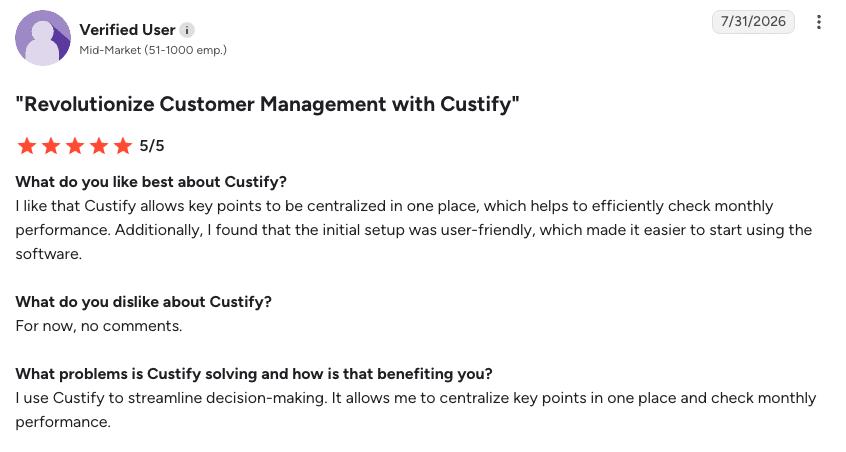
Standout Features: Gainsight vs Planhat vs Custify
1. Gainsight | Best for multi-data-source journey orchestration at enterprise scale
Arguably, what sets Gainsight apart is Staircase AI, the base layer under Atlas, its family of AI agents. It’s able to handle large, multi-source datasets at near data-warehouse depth and surfaces the right next step for each customer. Atlas can also become a managed renewal service run by Gainsight.
2. Planhat | Best for enterprises requiring flexible data modeling
Planhat’s strongest card is the platform’s data model. Seeing as it’s built without a fixed schema, teams are able to shape it around complex, high-end workflows rather than the other way around. This makes it highly adaptable to different organizations with distinct needs.
3. Custify | Best balance of guided onboarding plus flexible automation and portals
Concierge onboarding. Our best advantage is the people that make up our team. We know that. That’s why at Custify we offer concierge onboarding to any new account, manually handled by our CSMs. That means white-glove, guided setup and implementation backed by our team. The AI-backed configuration can help you get the specifics in place quickly. On top of that, our CSMs add deep product knowledge and a desire to understand your goals.
Unbeatable Automation. We like to think of automation as the key differentiator between reactive support and proactive customer success. That’s why we built an industry-leading automation engine that can build playbooks on the fly with the help of AI. You then just step in to tweak the specifics, and you’re off to the races. Every playbook can trigger based on a range of events and customer signals, sending messages, notifying CSMs, creating and updating tasks, or simply triggering separate automations.
Summary: When to Choose Gainsight, Planhat, or Custify
Why large organizations choose Gainsight
Need deep enterprise orchestration and budget is less of a blocker → Gainsight
For the average SaaS company, Gainsight can absolutely feel like more platform than you’d ever need. However, it works well for high-end customers with sprawling books of business and complex engagement models.
Why medium to large, high-touch organizations choose Planhat
Need advanced, enterprise-grade CSP implementation → Planhat
Planhat prices its platform by the number of customer accounts you’re managing, not by seats, so the pricing scales along with your organization. However, the flexible data modeling helps for enterprise use cases, which is why Planhat’s customer base skews toward large organizations with specialized CSM teams.
Why SMBs and enterprises choose Custify
Need guided setup, flexible automation, portals, and fair costs → Custify
Custify can serve small startups, mid-market SaaS, and larger, enterprise-level businesses with large customer bases. The biggest difference comes in how complex implementation and setup can get, but all clients are supported by both our AI-assisted setup through Foundation, as well as our concierge onboarding.
Why choose Custify over Gainsight and Planhat
Get a platform that adapts with you, with fully guided implementation, advanced AI agents, and outcome-focused customer portals.

FAQs about Gainsight, Planhat, and Custify
What customers say about Custify
A better experience for your customers, fewer headaches for your team. You'll be set up in minutes.

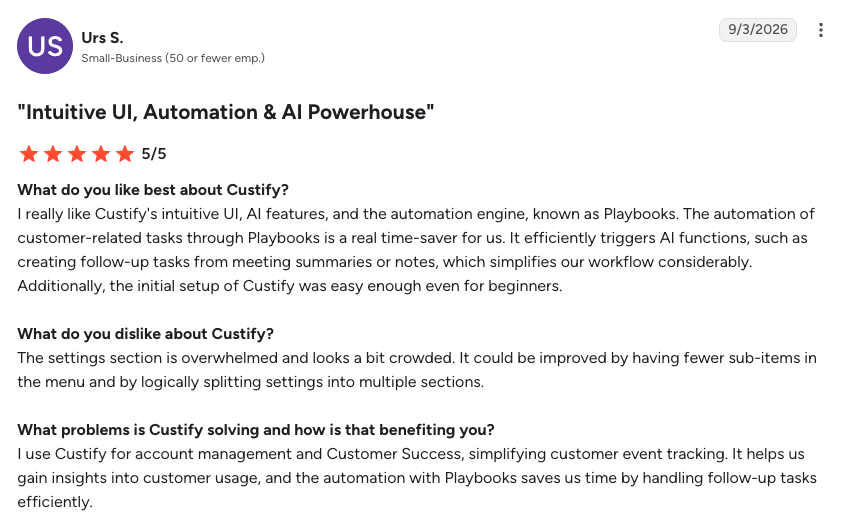
Custify helps us to identify upsell opportunities and churn risks very quickly. We now have better retention and a higher customer lifetime value. If you're looking for a CS tool, this is an easy decision.


Custify helps our success team to strategically manage our customers' life cycle. We can now instantly identify churn risks and use a data driven approach to onboarding, product adoption and health scoring. Custify is a no brainer for subscription businesses.


We saw ourselves reflected in Custify. Two small companies trying to really disrupt an industry and try to do something different. We were just excited to work with a company like that.


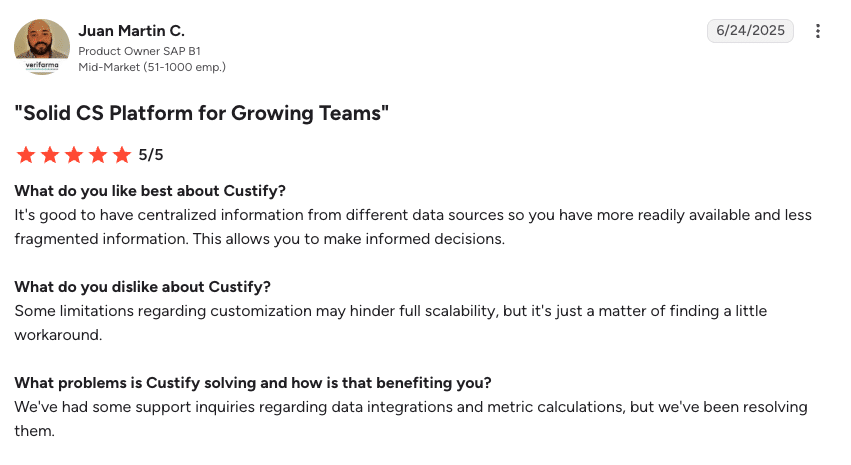
Custify helped us integrate their customer success management solution within weeks. We've gained a 360 degree view of our clients & it has allowed us to improve our customer focus and further refine our CS strategy. Their solution is scalable, easy to deploy and very user friendly.


If you're going to integrate a brand new tool into your day-to-day operations, you want to make sure that the people behind the tool are the ones with whom you see yourself doing business for a number of years. We felt safe investing in Custify because we know that they care about the product and its functionality & performance.


We've watched NRR grow steadily a lot over the past year, as we've doubled down on our customer usage, without increasing headcount. 90% of what we built is either an automated sort of email connection or automated task reminders.


Our SaaS is quite complex and offers multiple integrated solutions. Even in this scenario, Custify has proven to be a great tool. Our CSMs get a holistic 360 view of each customer and their interactions. On top of this, their support exceeded all our expectations.


Since using Custify we could manage more customers per CSM and we could identify customers that needed our attention. It allowed us to be more proactive on a daily basis and automate manual tasks. The process became really streamlined and it helped us become better for our customers.


Custify freed up more time for our team to focus on the parts of the job that they enjoy and remove the manual tasks and the things that they don't particularly like doing quite as much.


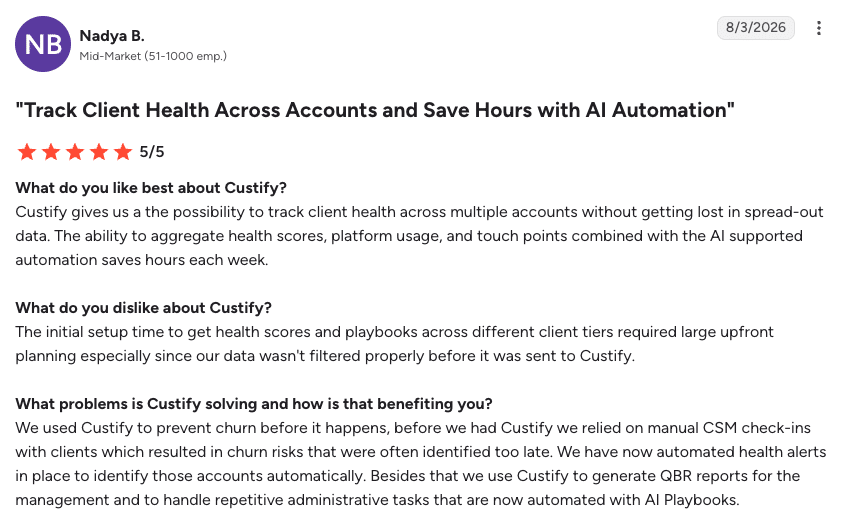
We use Custify to reduce unwanted customer churn. The setup was fast and easy for our tech team. Now our Customer Success Team can't live without Custify anymore.


We feared that the integration would wind up taking a lot of developer time, but we finished in less than half a day thanks to Custify's concierge onboarding.


The most important aspect of working with Custify is that they are very keen to hear and act on customer feedback. Dialogue is key - new product releases often have features that are useful to us. Their CSMs, proactively reach out once feedback that was important for us, has been implemented.


Custify's easy integration and native compatibility with platforms like Intercom and Hubspot streamlined our data centralization. Segmenting customers for targeted automated communications has been a game-changer.


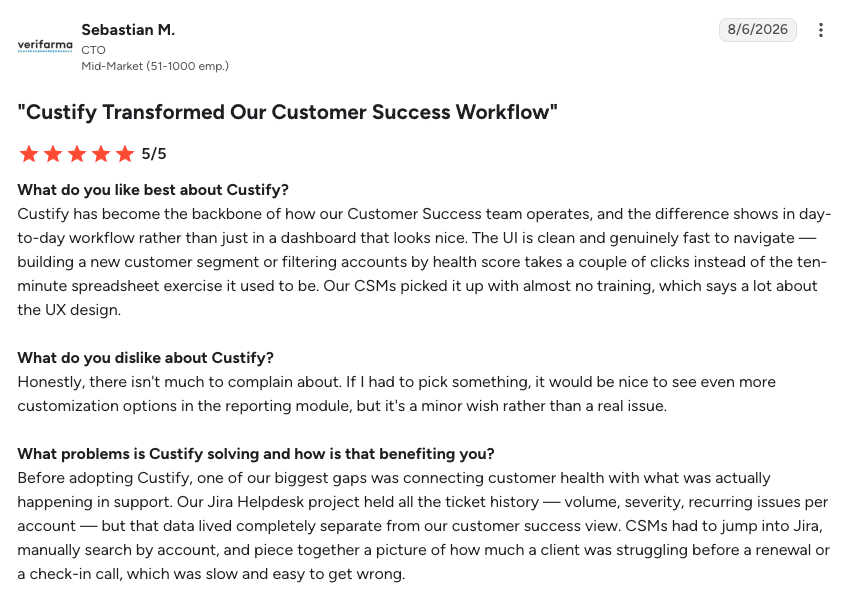
Custify transformed our approach, consolidating information from scattered sheets to one efficient hub with insightful dashboards and dynamic health scores. Thanks to its integration capabilities, our team is now faster, more productive, and closely connected with our clients.

Custify's standout features, the flexible calculated metrics and the visual playbook builder, enable our data-driven company to extract meaningful insights from our customer data. It provides a comprehensive view of our Customer Success impact, from broad overviews to detailed individual customer analyses. With real-time notifications on upsell opportunities and actionable insights for both our Sales and Product teams, Custify is an essential tool for informed decision-making.
read more


Utilizing Custify, we've seen a significant increase in tool adoption, underscoring the value of health scores. The ability to instantly assess a company's performance and track user engagement trends has greatly empowered our customer success team. This has shifted their focus towards enhancing customer experiences, leading to higher engagement and referrals. Essentially, health scores have been pivotal in our strategy to understand and support our customers more effectively.
read more


Since integrating Custify, we've consistently exceeded our core KPIs, improved our retention rate and boosted our upsell revenue by 25 to 35% monthly. Coming into this role after Custify was onboarded, I've seen firsthand how much easier it is to manage these critical metrics. It's a game changer that supports my growth as a customer success manager, allowing me to focus effectively on our clients and drive our company's success forward.
read more


Before Custify, I juggled multiple platforms and tasks, struggling to keep track of everything. Now, everything is centralized, and I can focus on our customers without getting lost in mundane work. We've become more efficient, and our ability to engage and support our customers has greatly improved.


Without Custify, we would be completely blind-sided. It has brought all our customer data into one platform and automated key processes, allowing us to focus on what really matters—driving customer success. Thanks to the real-time alerts and insights, we increased our expansion MRR by 43% and reduced churn significantly. The time savings alone have been invaluable for our lean team.
read more


When we started with Custify, we had been using another platform that was too complex and required a lot of technical effort to maintain. Custify made everything simpler—centralizing our data, improving our NPS by 20%, and automating workflows, which saved us about 15 hours each month. With Custify it's easy to streamline your processes and focus more on customers.
read more


Custify has been a game-changer for us. Before, we were duct-taping solutions together, but now, with real-time insights and a holistic approach to customer data, we've significantly boosted customer satisfaction and made well-informed, data-driven decisions. This shift to proactive management has helped us reduce churn and better support our customers' success.
read more


Custify helped us shift from firefighters to a consultative team, without needing to hire more people.


The creation of our global health score process was definitely a milestone. We see Custify as a partnership rather than something we were sold and had to figure out on our own. That support has been what's made this successful for us.

You might also enjoy:
Best Practices
11 Most Powerful AI Tactics for Customer Retention
With so much AI around us, it can be confusing to separate the good from the bad. Today, … Continued
Roundtable
Expert round-up: How will AI impact the role of CS in the future
Customer success should be the backbone of any company. Why? Because customers are the center of the business … Continued
Best Practices
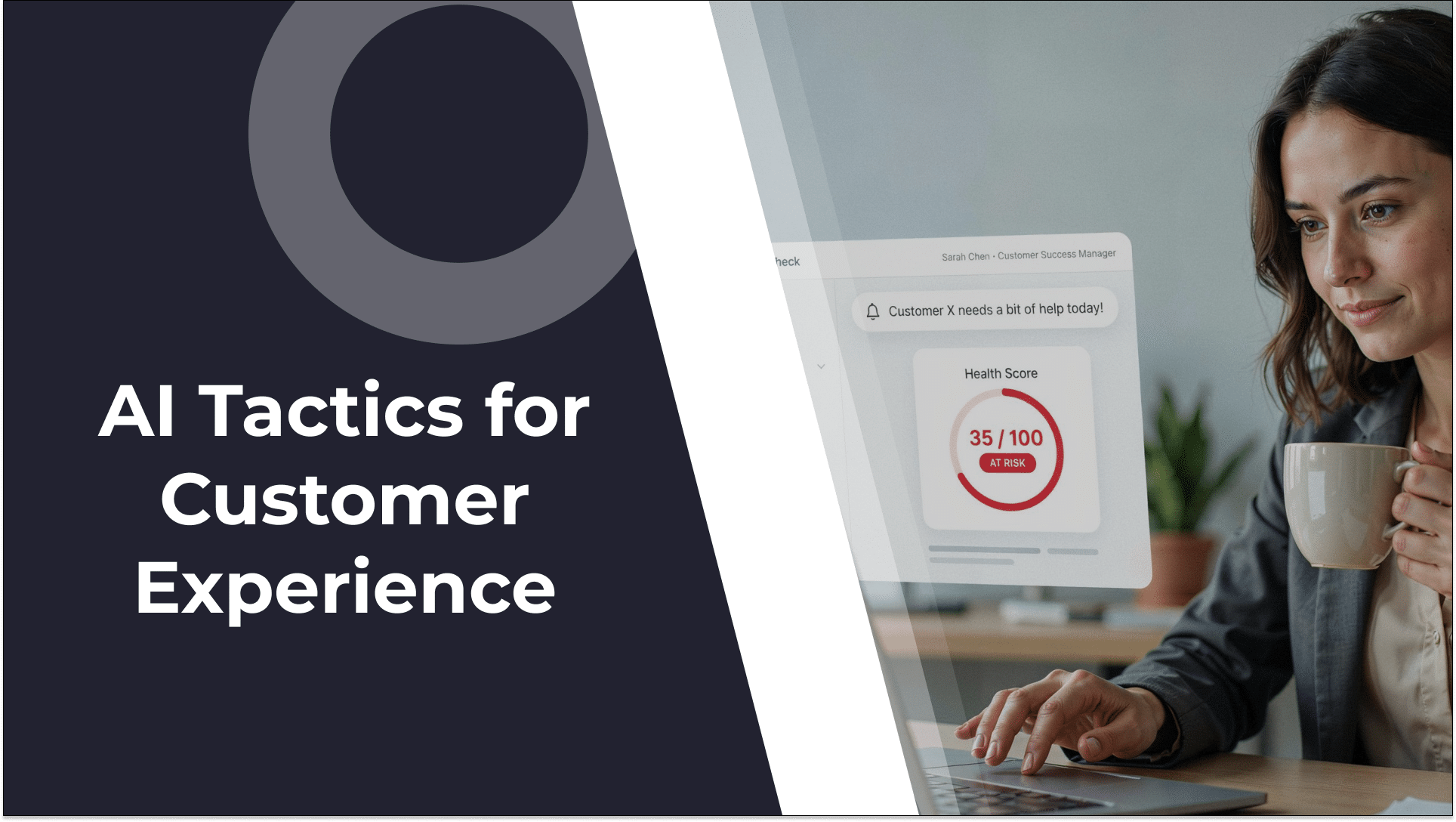
How to Use AI to Improve Customer Experience – 7 Evolving Strategies for AI-First Companies
Learn how SaaS teams can use AI to improve customer experience with sentiment scoring, churn signals, CSM support, automation, and human handoff.