NPS benchmarks vary significantly by business model, survey language, and customer segment, yet most CS teams compare their score to a single global number and stop there. This article breaks down 5 NPS best practices that separate teams who improve retention from those who just report a score. It is based on the analysis of 5.4 million NPS responses across hundreds of SaaS companies.
NPS Benchmarks: Mistakes CS Teams Make When Reading the Score
Over the past 7 years, I’ve worked with a lot of SaaS teams on improving NPS and building feedback programs. Different industries, business models, markets, and products, but often the same mistake: teams treat NPS as a number to report, instead of a signal to act on.
What I’ve also noticed is that the teams that actually improved retention and customer sentiment usually do one thing differently than the “NPS best practice.”: they don’t stop at the score, they connect it to context, ownership, and follow-up.
We’ve analyzed 5.4 million NPS responses across hundreds of SaaS companies for our NPS Benchmarks 2025 report. Some findings surprised us, and others confirmed what CS and CX practitioners have long suspected, but couldn’t prove.
Here are five things to keep in mind when you look at your score, whether you’re trying to improve it, defend it to leadership, or figure out what to do next.
What are NPS benchmarks?
NPS benchmarks help CS teams compare customer sentiment, but they only work when scores are segmented by business model, customer type, lifecycle stage, language, and account context. A single global NPS number can mislead teams because B2B SaaS customers, B2C users, markets, and customer cohorts rate products differently.
For customer success teams, NPS benchmarks become useful only when they connect to customer data. A score should not live alone in a survey tool or a quarterly slide. It should be read next to product usage, onboarding progress, support history, account size, renewal date, health score, and CSM ownership. That context helps teams see whether a low score points to a product gap, weak adoption, poor onboarding, or renewal risk.
1. You’re probably benchmarking against the wrong NPS number
The global median NPS across software companies is 42. But if you compare your results to this number without accounting for your business type, you may get a misleading picture of your performance.
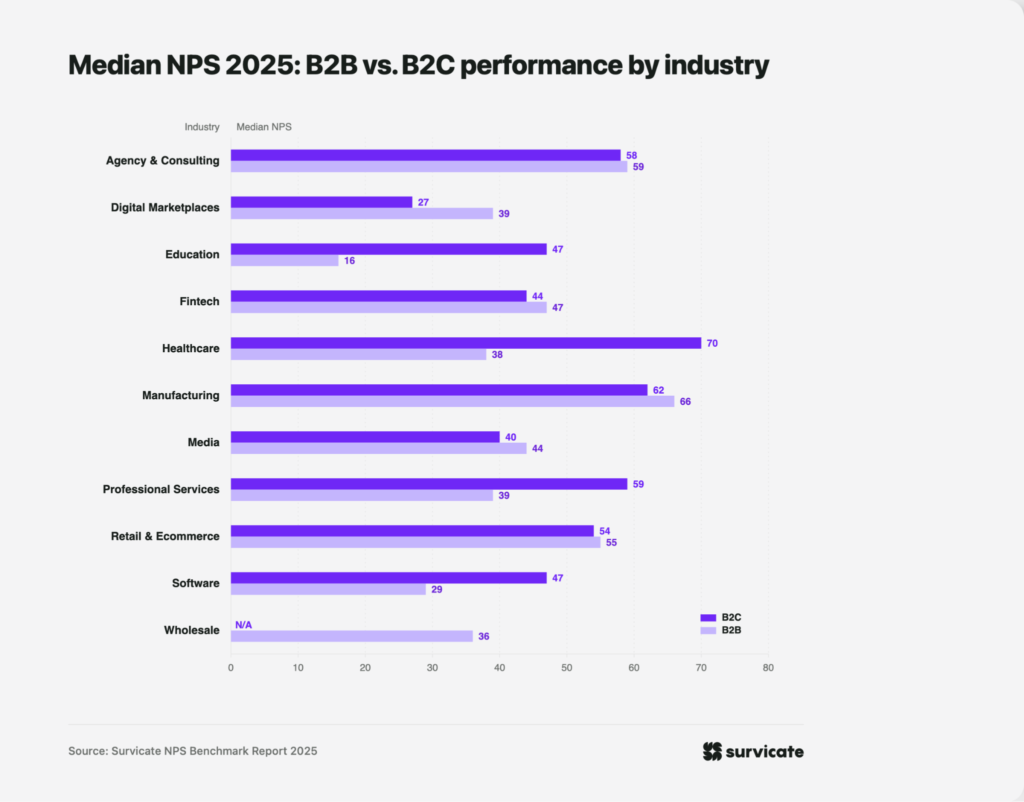
According to our report, B2B software has a median NPS of 29, while B2C software comes in at 47. This 18-point gap does not automatically mean B2C products or services are better. B2B customers weigh more than the product. They factor in onboarding, tech stack fit, multi-stakeholder buy-in, and annual commitments. Consumers usually choose a product for themselves and can easily switch to another tool if they are not satisfied.
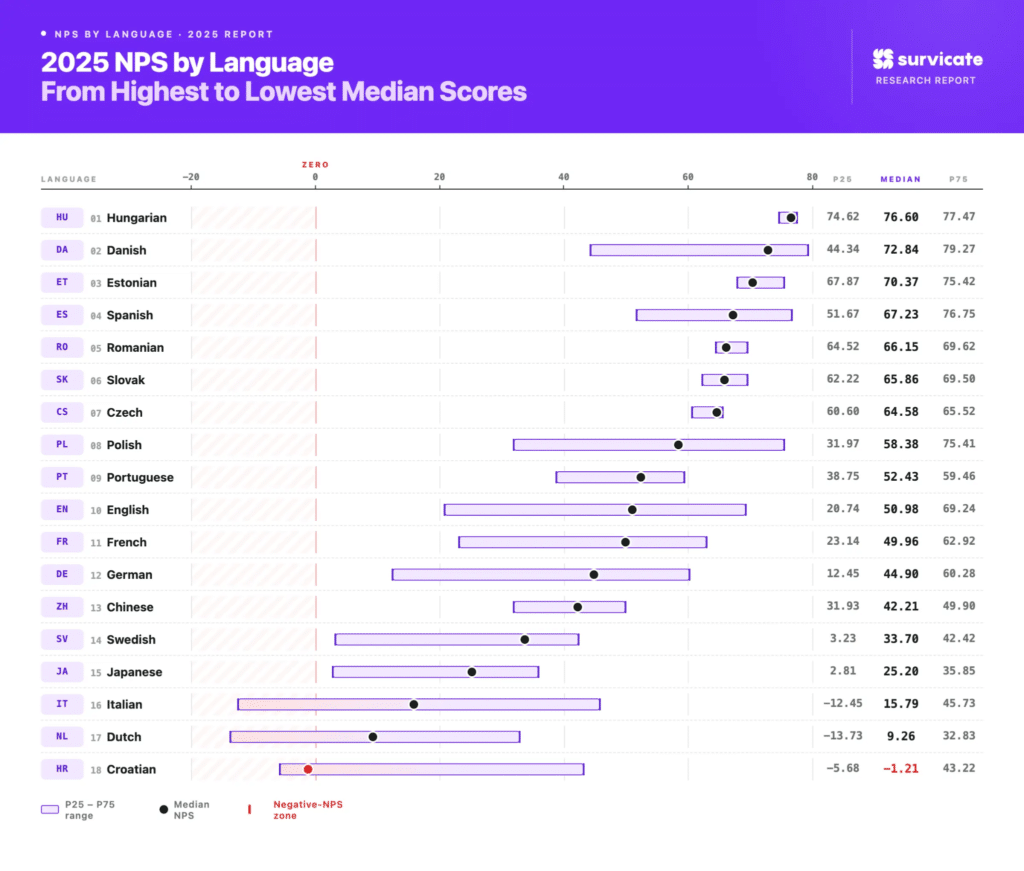
Another thing to keep in mind for global products: the language and cultural aspects of your users can influence your NPS score more than many teams realize. In our 2025 Global NPS by Language report, we analyzed 504 multilingual surveys across 108 companies. We found big differences in the median NPS by survey language. English-language surveys scored 51%, while Portuguese and Spanish-language surveys scored significantly higher. German and Japanese surveys sat significantly lower. Not because the products were worse, but because different cultures use rating scales.
If you’re running a global product and comparing scores across markets without this context, you’re likely drawing the wrong conclusions. A German customer giving you an 8 may be more loyal than an American giving you 9.
2. Passives need more of your attention
One of the more interesting shifts in our new report is that the bottom 10% of companies saw their NPS drop from -0.3 to -4 over the past 12 months. To me, that suggests that customers are becoming less tolerant of mediocre experiences. If just a year ago, customers could have stayed passive, today they are moving into the detractor category.
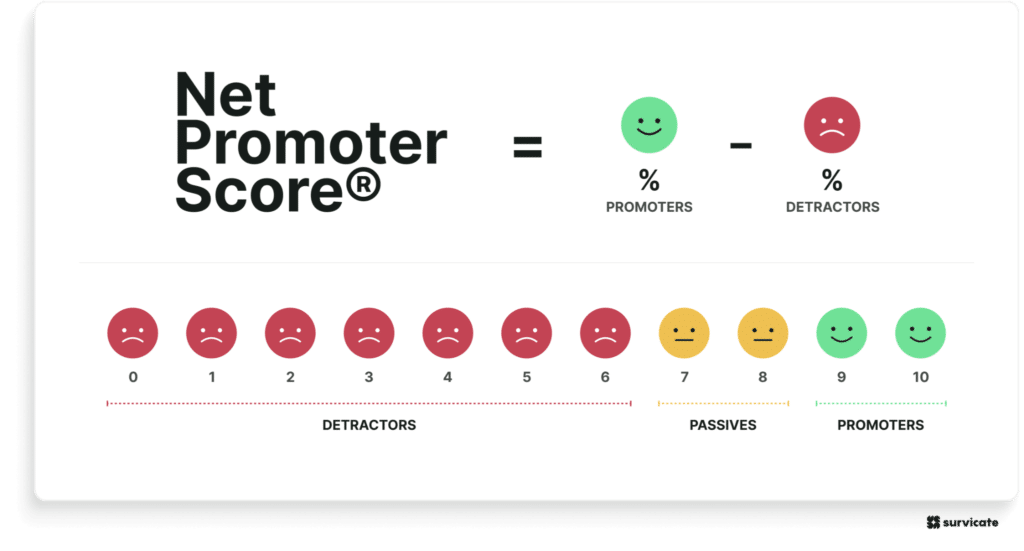
However, in many CS workflows, detractors get urgent attention and promoters get routed into advocacy motions. Passives often sit in the middle with no clear owner. And this is often the segment with the most untapped potential. They are not angry enough to complain, but not happy enough to advocate for you either. That makes them worth watching. Many NPS best practices ignore them, and so quietly drift into churn risk. If you understand what is missing, you have a much better chance of moving them toward loyalty.
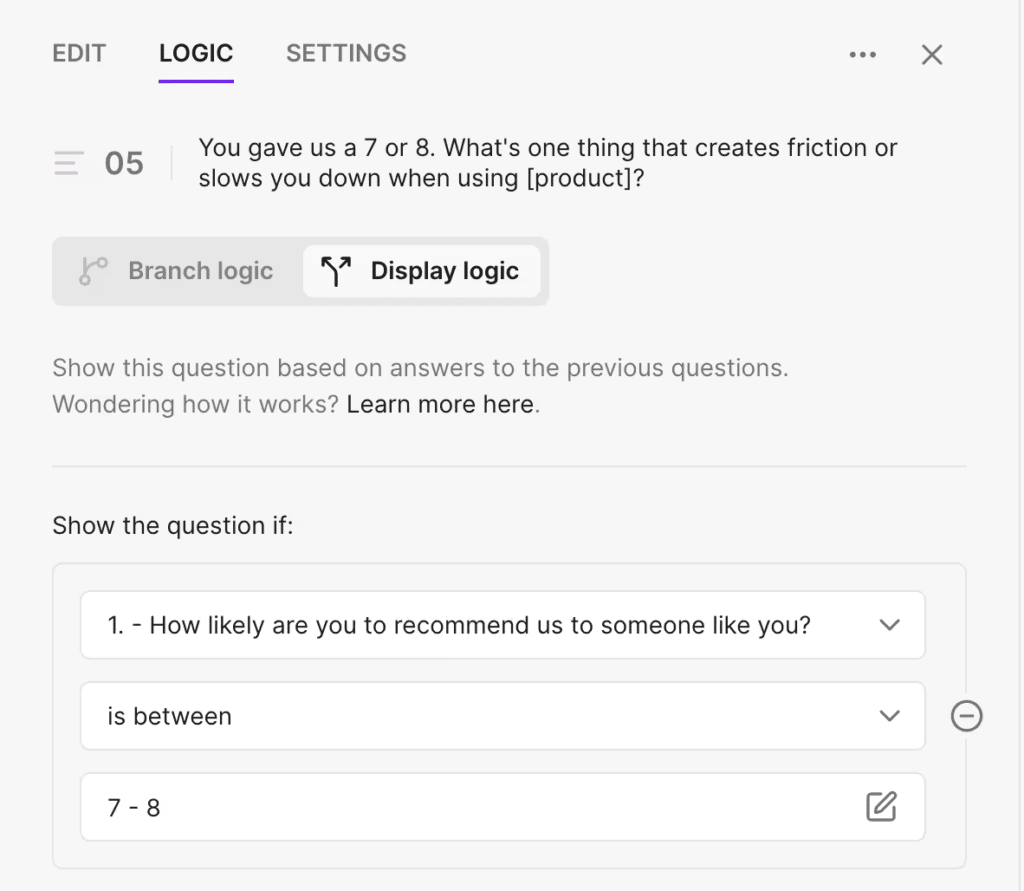
The easiest solution is to create a dedicated workflow for them. Begin with a follow-up question: “What is the one thing that would make you more likely to recommend us?” The responses will give you direct input for your roadmap and perhaps rank the most urgent fixes.
3. A score without context is hard to act on
Two customers, both giving a 7 in your NPS survey, can do it for completely different reasons. One might be a long-term customer who gave a 7 after a rough renewal call but is still expanding to new teams. Another might be a brand-new customer who hasn’t completed the onboarding yet. The scores match, but the risk is completely different.
This is why many teams stop seeing NPS programs as something valuable: they track scores carefully according to NPS best practices, but never segment by lifecycle stage, account size, onboarding status, or recent interactions.
An open-ended follow-up is useful, but it’s not enough on its own. The real context comes from connecting NPS to the rest of your customer data: product usage, lifecycle stage, account size, onboarding progress, renewal timing, support history, and feature adoption.
Once you have that, you can analyze feedback in cohorts instead of reading responses one by one. You can see where low scores are concentrated. Is it new customers who haven’t reached activation? Enterprise accounts waiting on a missing integration? Users who adopted one feature but never found another? Customers approaching renewal after a rough support experience?
4. Don’t rely on one channel to collect NPS
The channel you use to collect NPS has a direct impact on who you hear from. And if you only use one channel, you may be missing a large part of the customer experience.
In-product surveys are powerful because they reach users while they are already inside the product. That context matters. If someone just used a feature, completed a workflow, or hit friction, their feedback is usually more immediate and specific.
But in-product surveys also have a blind spot: they mostly reach people who are active enough to be in your product. If someone is disengaged, stuck before activation, or no longer logging in regularly, you may never hear from them there.
Don’t rely on a single channel for NPS collection. A better approach is to build a sequence. Start with the channel that is most contextual and least disruptive, like an in-product survey. If there is no response, follow up through another channel, such as email. For mobile products, use mobile in-app surveys. For customers managed by CSMs, trigger follow-ups through the account owner when the score requires human attention.
The goal is not to force every customer into the same survey path. The goal is to increase your chances of hearing from the right customer at the right moment.
If your NPS program depends on one channel only, you are not measuring customer sentiment as much as you are measuring the sentiment of the customers who happened to see that one survey.
5. Fast follow-ups matter
Collecting NPS is just the first part, the real challenge is what happens after the response.
In mature CX programs, every NPS response has a clear next step. CS teams don’t just follow up with detractors, they route them into a closed-loop process with defined ownership, response-time expectations, and escalation paths. A low score from a strategic account near renewal should never be treated the same way as a low score from a free user who signed up yesterday.
When a detractor response comes in, the CSM should get an alert with full account context: plan, lifecycle stage, support history, renewal date, and previous feedback. From there, the team decides whether the right next step is a personal follow-up, a support escalation, or a retention playbook.
Custify helps CS teams turn NPS responses into account-level action, not just survey reporting. A detractor score can update customer health, alert the account owner, create a follow-up task, or trigger a retention playbook. A passive score can flag weak adoption before renewal. A promoter score can trigger an advocacy, review, referral, or expansion workflow. The score is only the input. The workflow decides whether the team acts in time.
One of the most common places NPS programs break down is the handoff between collection and action: teams gather the data, maybe read the comments, and then the insight disappears. Closing the loop means the customer knows they were heard, the right team owns the issue, and recurring themes actually surface. That is where automation helps. Not because it replaces the human part of customer experience, but because it makes the process consistent. It can trigger alerts, assign owners, push feedback into the right tools, create follow-up tasks, and help teams act while the context is still fresh.
One of our customers, a Toronto-based real estate platform, Wahi, moved away from manual follow-ups after feedback kept reaching the wrong people too late. After automating survey triggers and follow-ups at key moments, their team saved 10+ hours a week and spent that time solving customer issues instead of chasing feedback internally.
One more thing CX teams should keep in mind
According to Forrester’s 2025 VoC and CX Measurement survey, only 50% of CX teams link their metrics to business outcomes. They didn’t pick the wrong metric. They just never built a system around it.
NPS is only as useful as the system around it. The teams that get value from it benchmark against the right context, analyze their feedback in cohorts, understand the ‘why’ behind scores, and make follow-up part of the operating rhythm. All of this is within reach. The score itself will not improve retention. What you do after the score might.
The question isn’t whether this is possible to achieve. The question is which 50% you will be in next year.