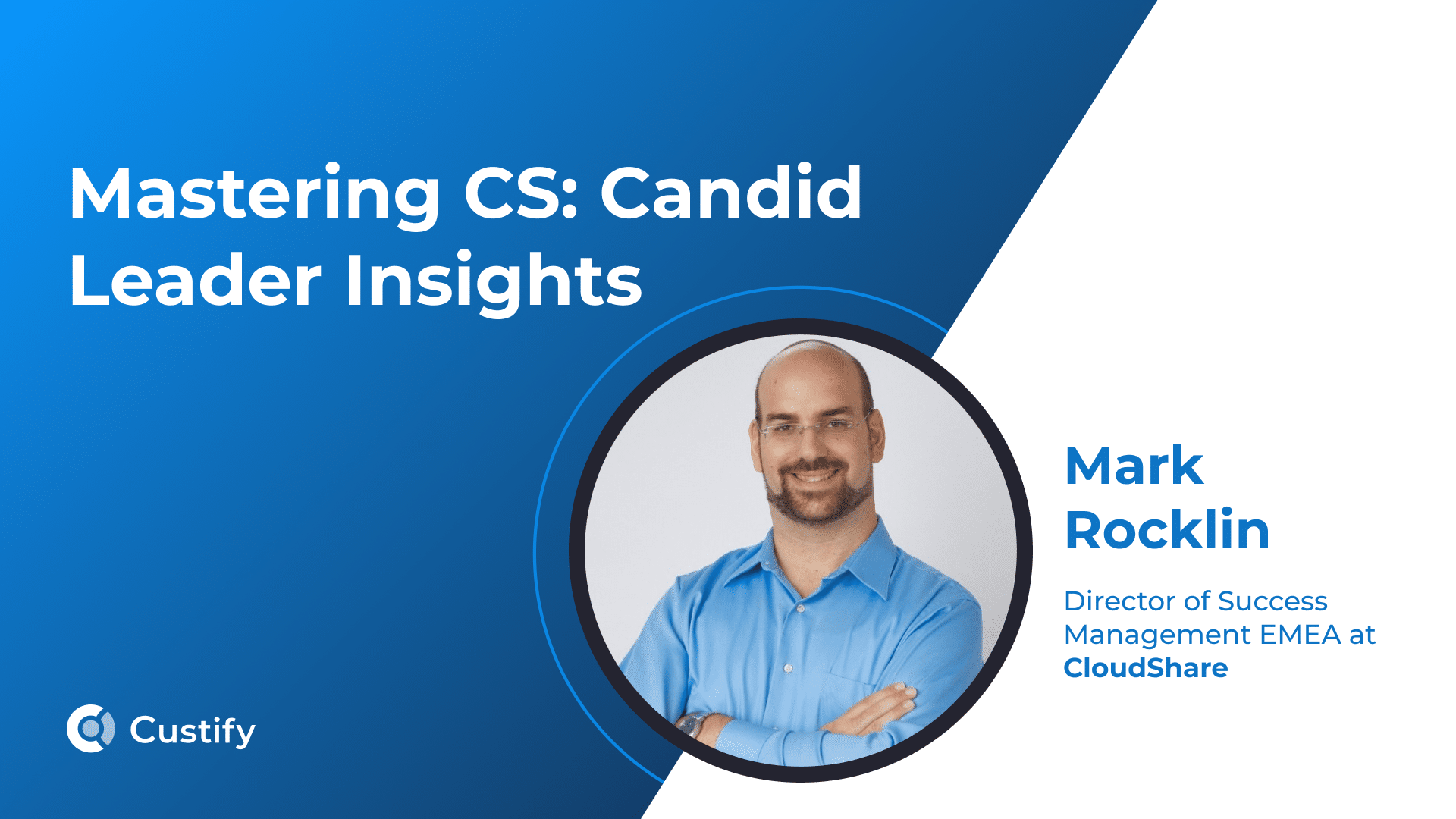
In this episode of Mastering CS: Candid Leader Insights, Irina Cismas talks with Ameer Khan, Head of Customer Success at Mortgage Automator, a software platform for private lenders across North America. Six months into the role, Ameer is leading his team through the acquisition of a second lending platform, ramping up on a new product and preparing to merge two CS teams into one.
He explains how he documents goals for every stakeholder during onboarding, how he segments accounts by time and revenue, and how AI powers handoff snapshots, health scores, and risk signals for low-touch customers. He also shares how to flag churn risk 90 days before renewal, why he forecasts three to four quarters out, how to say no to customers with transparency, and where to start when building internal alignment in a new organization.
What You’ll Learn
- What an acquisition puts on a CS team’s plate and how to ramp up on a new platform
- How to approach merging two CS teams with different day-to-day practices
- What to document during onboarding for champions, sponsors, and day-to-day users
- How to segment accounts into strategic, mid-market, and low-touch based on time and revenue
- How AI supports handoffs, account snapshots, QBR decks, and risk signals
- Why Ameer keeps automated health scores intentionally simple
Key Insights & Takeaways
An acquisition starts with a learning curve. The CS team needs to understand how the new platform delivers value before they can help customers feel comfortable using it.
Consolidate practices before merging teams. Two CS teams often work differently day to day, so align on shared practices first.
Onboarding success depends on documentation. Record why the customer bought, what they want to achieve, and what success looks like for the champion, the sponsor, and the daily user.
Allocate time based on segment. Strategic accounts get more time, but low touch customers aren’t left alone. AI surfaces signals and a pooled team responds.
AI handoffs go beyond summaries. Each handoff from sales to onboarding to CS produces a full account snapshot with personas and success metrics.
Keep health scores simple. Product usage plus active conversations from emails, tickets, and engagements give a clear picture of where a customer stands.
Podcast transcript
Intro
Irina (0:06 – 0:25)
Welcome to Mastering CS Candid Leader Insights, the podcast where we dive into the world of customer success with industry leaders. I’m your host Irina Cismas and today I’m joined by Ameer Khan, Head of Customer Success at Mortgage Automator, a software platform for private lenders. Ameer, I’m really happy to have you here, thanks for joining.
Ameer (0:26 – 0:29)
Happy to be here, excited to be a part of the conversation.
Irina (0:31 – 0:42)
I know that you stepped into the Head of Customer Success seat about six months ago. What does the role look like day-to-day and who are your customers?
Ameer (0:44 – 0:57)
The role looks every day, our focus is primarily on NRR and what I would say our customers is the lending companies across North America, so Canada and then US.
Q4 Priorities After an Acquisition
Irina (0:59 – 1:10)
And right now, we are almost at the end of the year. What’s the thing that you are trying to move the most? What’s the biggest priority for the last quarter of the year?
Ameer (1:12 – 1:43)
So for us right now, Mortgage Automator just went through an acquisition of a platform called Lender in US. So right now, we’re trying to come up with some of the information, collateral and value statements around how Lender and Mortgage Automator are the platforms for the lending industry across North America. And with that, we’re getting the teams enabled, we’re getting our technical teams enabled and working a lot on the product side of things as well.
What an Acquisition Means for the CS Team
Irina (1:45 – 2:00)
I know about, speaking about the acquisition that you just went through, what does this thing put on the CS team’s plate? What’s the impact of the acquisition for the Customer Success team?
Ameer (2:01 – 2:53)
I think the first and foremost would be the learning curve, learning about the new platform, how it behaves and I always relate the learning to how it delivers value. Most of the effort right now, myself and marketing team and sales team, we’re all more focused on getting those value statements together, trying to analyze how this platform can actually help our customers better. And going into the market with more of a modern feel of how lending softwares work, with more of an AI native kind of a tool.
So there’s more of a learning curve for us at this stage. And for this quarter, we’re planning people to be ramped up with this new platform, ramped up with knowledge and then getting our customers to a stage where they feel comfortable using it.
Irina (2:55 – 3:07)
Would you remain with two Customer Success teams, one for Mortgage Automator, one for Lender for the time being? Or you are basically blending in, the two teams will become one?
Ameer (3:09 – 3:50)
So the two teams ideally would become one. Right now, the focus is a lot towards, again, we are customer first organization still, right? Right now, there’s a lot of focus in getting customers to a state where they feel comfortable in using the platform.
What that means is Customer Success teams at Lender and Mortgage Automator obviously behave a bit differently. When I say differently, it is their day-to-day tasks and responsibilities. So we’re trying to create some synergies in between.
We’re trying to consolidate our practices. And based on that, we are planning to merge and consolidate these teams in the next three months.
What Good Onboarding Looks Like
Irina (3:52 – 3:59)
Awesome. I’m curious, what does good onboarding look like at Mortgage Automator? And how do you know when you’ve got there?
Ameer (4:01 – 4:39)
So I would consider ideally onboarding for any software. Transparency is the key. Documenting why the customer bought the platform, what they want to do in the next quarter, in the next year.
And what would success look like for our champion, for our sponsor, and for the day-to-day user, and how we’re solving those issues. So documenting it all together and staying focused on how we’re actually going to get to the end result and the final outcome. I think that’s ideally where onboarding excels.
Segmenting Accounts and Measuring Team Performance
Irina (4:40 – 4:54)
And how do you measure whether the team is performing well? What do you watch week to week? How do you know if you need to scale the team?
How do you know when you need to interfere, guide them, help them?
Ameer (4:56 – 6:05)
So we have a very, I shouldn’t say complex, but we have a very detailed model around the team’s engagement. And when you talk about scaling, it’s part of the team engagement as well. So we have identified accounts in different categories.
And when I say categories, it’s strategic, it’s mid-market, and it’s some of the, I should say, low-touch accounts as well. So we always consider time that the person on our CS team or professional services team is giving to a customer in a specific category. Obviously, with more revenue generation, where there are more needs and ask, there’s more time being allotted to larger customers.
But on the other hand, the low-touch customers are not left alone. There’s more of the AI-generated approach that we’ve seen taking a look at those triggers, signals where interference is required. And then it is a pooled kind of a team where these requests come in.
So it’s always more focused on where we should drive more energies towards and how it impacts our revenue and our customers’ focus.
How the CS Team Leverages AI
Irina (6:07 – 6:22)
Okay. And speaking about the low-touch customers, the ones that will receive an AI-assisted approach, I’m curious about how is your team leveraging the AI?
Ameer (6:23 – 7:45)
Yeah. So the team is leveraging AI in different ways. So first of all, our health scores are auto-generated.
And on top of that, each and every handoff, and when I talk about handoff, it’s from sales to onboarding, from onboarding to customer success. So all of these handoffs is where AI comes into place, prepares a summary, prepares, let’s say, a QBR deck for us, and an overall account analysis. But when I say a summary, this is actually not a summary per se.
This is an actual account snapshot where we’re getting an idea of the personas within the customer entity, where we’re getting an idea of, again, those success metrics that we have laid in place. So this is, I think, the major impact that CS team have. But when we talk about the low-touch customers, that is where a lot of times we get these triggers and signals auto-generated and pops up as notifications within our emails, Slack, or HubSpot, where we could get an idea of where the customers are, whether they’re at risk or not, renewals, some of the tickets that they’ve raised.
So a lot of that is being actively analyzed by AI, which helps us focus on the important stuff rather than going into the account, taking a look manually.
Irina (7:46 – 7:59)
I’m curious, how did you manage to automate the health scores? What was the thinking process behind it, and what did it take to end up with automated health scores?
Ameer (7:59 – 8:49)
So with automated health scores right now with us, it’s very simple. And this is intentionally kept simple. So when I say simple, it is we’re taking a look at product metrics, whether the customer is logging in, how much they’re using the system, and their overall growth over the few months as well.
So that’s, for us, number one determinant for health scores. Number two would be active conversations. And then based on those conversations, it’s a combination of emails, tickets, and a lot of engagements with the customers coming together into a single pane of glass.
So combining these two factors, we get a very good idea of where the customer is and what kind of attention would they need.
The CS Tech Stack
Irina (8:51 – 9:04)
What does the stack look like behind all of this? What platforms are central and helps you create all of these automations? And basically, the foundation on where the CS is basically running.
Ameer (9:06 – 9:51)
So honestly, it’s a combination of tools and very smart people on our team. So when I say tools, HubSpot, I think, solves a lot of these issues. And then we have a combination of different tools like Intercom, which is giving us support side of things.
Then we have Fathom, which is recording our meetings, giving us some of those important notes as well. And then HubSpot is where I should consider a source of truth for us. So HubSpot generates those logics where it’s getting data from all of these places, get that together, and then provide us some actionable items where we take a look at the results, which are accurate based on the information from these multiple softwares.
Irina (9:54 – 10:05)
I know that in plan view, you managed to flag churn risk 90 days before renewal. Where does a team start if they want that and don’t have it yet?
Ameer (10:06 – 12:04)
I think in a way, a standard policy would be yes, 90 days in advance for sure for yearly renewals. So we’ve got to focus on yearly renewals. So 90 days in advance, these automated generated churn scores are ideal.
When you’re talking about 90 days in advance, you take a look at conversations, engagements, product usage, overall, even their business volume. Because with lending industry is a lot of moving up and down of loans and the total funded volume. So it’s easy to see.
But when we talk about plan view, it was a different organization. So even low usage wouldn’t mean the customer is at risk. But sometimes even high usage would mean a customer at risk.
So there are factors in different organizations that you’ve got to consider differently. But again, weightage was given to product usage at plan view a lot. But more of the focus was on having conversations with the right stakeholders.
And when I say the right stakeholders, it’s the people who are going to influence, like I should say, adopting our tool more, like our influencers, like our champions who are going to take it to other teams to expand our use case. So more of the consolidation side of things. But ideally, I would say and what I practice here at Mortgage Automator and what something was done in plan view is that we always try and forecast three to four quarters out.
So we always have that, I should say, high level vision of whatever is going to happen in the next 12 months. And then we keep a very robust eye out that are those factors changing. So let’s say putting a calendar invite for a Monday for one or one hour and taking a look and just reviewing whatever’s happening in the next quarter and the quarter after that.
But next 12 months, having a vision, having a forecast in place is somewhat ideal.
Learning to Say No with Transparency
Irina (12:07 – 12:16)
Ameer, is there a habit, a way of thinking or something you learned the hard way early on on your career that still shows up in how you run CS today?
Ameer (12:19 – 14:15)
I would say ideally, yes. 100%. Something that I’ve seen come up very often is prioritization for our customers.
When I say prioritization, it’s very difficult to go into a conversation with the customer and tell them no. I think this is a part of what CSM do every day. This is a part of how leadership coaches their teams because this happens each and every day.
And it’s where I think there’s always needs to be that strategic but a transparent approach. Something that I’ve learned back in like being a CSM and then leading a team and then managing a department was always focus on how we manage and handle these conversations. When the customer asks for something with limited product development capacity, I don’t think anyone, any company in the world would have a capacity where they can do each and everything.
So there always needs to be that prioritization. How we do it is where we collaborate internally with teams. I think wherever we can develop that collaboration and that collaboration with product, with development, with services, these teams are stronger.
That is where we address this prioritization challenge. And that is where we give this transparency to our customers that yes, let’s say you are on our roadmap, but we are taking care of more of these important requirements because this has come up more often, it has a larger impact. So I think this cross-team collaboration and prioritizing is ideal and is the best way to manage a team and to set expectations for our customers on the other hand as well.
Building Internal Alignment in a New Organization
Irina (14:16 – 14:52)
I promise that this is my last question because you mentioned internal collaboration as being something key and important. It’s easy said than done in practice. So I need to ask you, how do you make sure and what’s your playbook, the recipe that you apply?
Whenever you are entering into a new organization and you need to partner up with marketing, with sales, with product, where do you start and what’s the process of reaching out to this internal alignment?
Ameer (14:54 – 16:32)
That’s actually a very good question because every organization, every person, every team leader is different and there’s a different way in working with it. But what I think is standard across each and every organization and a person like me going into developing that, I think increasing collaboration between how teams operate together. Ideally, we always start with something small and something of a bigger impact to the organization.
Like I would consider let’s say a company who’s doing very well on retention but they don’t have a lot of expansion playbooks or expansion capabilities. And I think the ideal thing like when I go into the organization, the best thing would be to collaborate with professional services and introduce a training package for our customers or an onboarding package or an after sale or after go live kind of a help kind of a package.
For me, this impacts our expansion numbers for CS. This impacts some of the goals set for professional services team and this is where we help our own leadership to have a new revenue generating engine which can help us. So just an example, but you go in with the thing that has the lowest like I should say impact for the teams internally taking not a lot of their time from their day-to-day job but have more of a larger organizational impact for our customers and for ourselves as well.
Irina (16:33 – 16:39)
Ameer, this was a really interesting conversation. Thanks for taking the time to talk to me today.
Ameer (16:40 – 16:43)
Absolutely. Love the conversation. Love the questions.
Irina (16:43 – 16:51)
To everyone listening, thanks for tuning in. Until next time, stay curious, keep learning and mastering customer success.