Traditionally, when companies seek to increase revenue, they start with the obvious: higher prices, extra fees, new subscription models, new paid features, and other similar changes.
In customer success, we know the kind of pushback those tactics can get: complaints, downgrades, or worse, churn.
In this article, I will be reviewing a series of strategies to increase revenue. We’ll explore diverse tactics that approach the topic from multiple angles: customer success, product, marketing, sales, and more. However, no matter the strategy you pick, increasing revenue is fundamentally about one thing: optimizing value delivery. Whether you’re adding products and features, rethinking prices, or offering better services, the goal remains the same: to show customers the value you bring.
| Revenue strategy | Revenue lever | Best for | How Custify can help |
|---|---|---|---|
| Reduce churn | Retention | At-risk accounts | Health scores, alerts, churn risk analysis |
| Re-engage churned customers | Competitor Research, Win-back | Former good-fit accounts | Account notes, churn risk analysis |
| Expansion signals | Expansion revenue | Healthy accounts | Usage and account signals |
| Feedback loop | Retention + product growth | Product gaps | Surveys, notes, tasks, AI summaries |
| Pricing changes | ARPA growth | Strategy changes | Health scores, churn risk analysis, sentiment scoring |
| Value realization | Retention, expansion | Enterprise accounts | Customer value map, stakeholders map, portals |
| New launches | New revenue streams | Validated demand | Customer feedback, surveys |
| Social proof | Acquisition support | Marketing pages | Customer surveys, CSM ratings, reviews |
1. Reduce Preventable Churn before Renewal and Optimize Sales Motion
Increasing revenue can always start with preventative measures. Churn can nip away at a business’ revenue until you’re left with a few accounts that prop up your entire revenue stream. Not ideal. If you were to improve retention by just 5%, you could boost profits by as much as 95% (Bain & Company). So, proactively acting on churn is the first step, championed by customer success.
Recent research shows 70% of customers abandon a brand after 2 negative experiences, while 52% leave after one bad experience. See the difference?
Acting on churn in a unified customer success platform has an added benefit: you’re gathering all your churn data in one place. It tells you:
- why customers churn
- what led to churn
- what was the last straw
- which types of customers are more or less likely to churn
That’s data you can use to prevent that 2nd negative experience. Automation flows and AI agents can further help predict, mitigate, or entirely prevent that first bad experience. This process alone could slash churn by up to 70%.
Process optimization doesn’t stop here. That same churn data can be used by sales to optimize lead prospecting and qualification. Imagine sales never reaches out to prospects that match customers who regularly churn. Optimizing sales has an added snowball effect: poor fit customers can cost 2 to 3 times more in support and maintenance costs compared to your ideal clients. That’s money you’re throwing down the drain if you’re not rethinking your sales motion based on customer churn data. What’s more, good data can also reduce sales ramp time, further increasing sales efficiency and revenue.
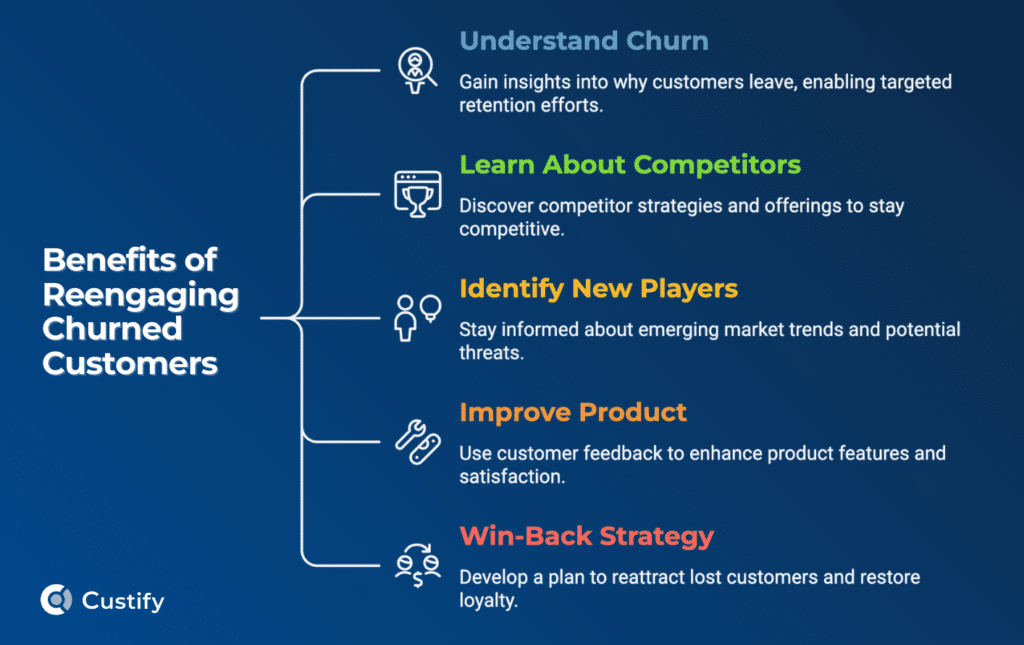
2. Re-engage Churned Customers with a Clear Win-back Plan
Even with all the improvements above, churn still happens: it’s simply a fact of business, particularly in SaaS. But client relationships shouldn’t end with churn. If you’ve got a good relationship with customers that churned, that’s something you can leverage. Here’s how:
- Re-engage with churned customers. This practice has been shown to provide value regardless of win-back status. The simple act of conversing without the formal business-client relationship can lead to unexpected and vital insights about your market.
- Set clear goals: having a simple conversation, getting an inside scoop about a competitor, or attempting a win-back – which is it? Determine the ideal contact for each scenario and prep before the call. If necessary, provide an incentive such as a voucher so former clients actually respond and show up.
- Schedule next check-in: even if a conversation peters out and doesn’t lead to anything tangible, you can always check back in after 6 months. Gauge their sentiment regarding the current vendor and ask if they’re amenable to a follow-up – you might have another chance to win them back.
- Scale the process. This type of strategy should be commonplace in SaaS. The more competitive your industry, the more value you can get from the conversations. If you see the value, attempt to repeat the process with other churned clients.
3. Use Expansion Signals to Grow Healthy Accounts
Proactivity is the modus operandi of customer success. But it doesn’t begin and end with retention and churn prevention tactics. You can be proactive about expansion too:
- Use AI to surface opportunities. It’s a new age with new tactics: use AI customer success agents to analyze all account signals and determine opportunities for upsells, rightsizing, and cross-sells.
- Build CSP automation flows. Automatically spot signals and add accounts to curated CSQL lists (customer success qualified leads). Advanced customer success automation flows can also directly engage customers, send personalized messages, and ping lead CSMs about revenue-growth opportunities.
- Be targeted and specific with your pitches. You want to present expansions as opportunities for your customers to optimize their features, the services they pay for, or the entire subscription. Remember: value delivery is the game; if you’re not increasing value for the customer, the price increase won’t make sense. By practicing personalized, supportive upselling, you can improve retention by up to 75% and overall company profits by 30% (McKinsey).
Upsells and cross-sells will increase your recurring revenue and expansion MRR, both of which contribute to the overall goal of growing your business. Incentivizing referrals can be another way of leveraging your existing customer base to increase your revenue. At the end of the day, aim for a growth rate of around 30% (higher or lower based on SaaS funding stage).
💡 Important Note: How to Measure Growth
- Track Customer Growth Rate (CGR)
- Track Compound Annual Growth Rate (CAGR)
- Track adjacent growth indicators like: CAC, CLTV, LTV:CAC, ARPA, Churn Rate, Retention Rate, Expansion Rate, Revenue Growth
- Review your metrics and compare with benchmarks for your specific industry and funding stage.
4. Close the Feedback Loop with CSAT, NPS, and CES
On average, most customers won’t announce their departure – only 4% of dissatisfied customers actually reach out to a business. The rest simply leave. Churn is a natural process, so if you’re not sending out surveys as a regular practice, you might never know why they walk out the door.
Surveys like CSAT and NPS are commonplace in SaaS. Others like Customer Effort Score tell you a lot about your CX. To use these and other surveys to boost revenue, you should be intentional in your work:
- Determine which surveys make the most sense for your type of product, market, and customers.
- Always include an open-ended field for customers to provide feedback or more information about their response.
- Centralize survey responses and customer reviews, then generate action items – you can use AI agents to automate this step.
- Close the customer feedback loop. Act on relevant feedback, loop in Product and other relevant teams, and then reach back out to customers after implementing their suggestions.
- Repeat the process. This should become a natural motion of your SaaS: gather feedback, generate action items, implement changes, reach back out to customers. This simple trick will increase alignment with customer value expectations and give them a good reason to sing your praises, bring in referrals, and leave positive reviews.
The best CS teams do not treat feedback as research. They treat it as an operating signal. When customer feedback is connected to health scores, renewal risk, product priorities, and CSM tasks, it becomes part of how the business protects and grows revenue.
Irina Vatafu, Head of Customer Success, Custify
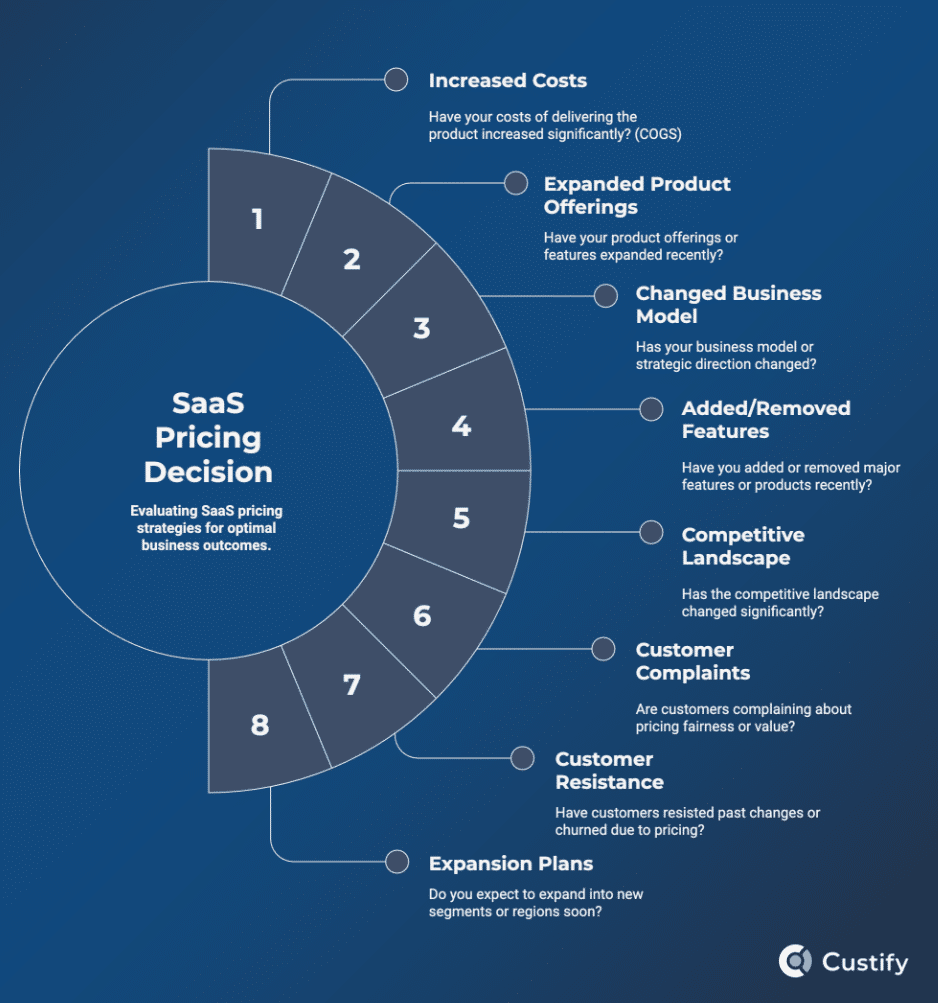
5. Change Your Pricing without Adding Churn Risk
We arrive now at one of the most common avenues for revenue growth: price changes. I’m no stranger to this topic – in customer success, it’s already a hot debate since CSMs usually have to deal with the aftermath of a price increase. And therein lies the question:
How do you make price changes while preventing downgrades and encouraging upsells?
The answer is deceptively simple and echoes my earlier point: optimize value delivery. Here’s how to work strategically when considering price changes:
- Determine what the price change will be: why you want to make it, what customers want, what type of change makes the most sense, and finally what the exact change will be.
- Implement the change: communicate with your team, create a well-thought-out strategy (including common issues, risk assessment, customer sentiment, etc), soft launch, then full launch with accurate, in-depth tracking.
- Communicate the change: figure out the messaging before launch, then communicate it effectively when the moment comes. A lot rests on finding the correct verbiage, so involve your best copywriters and zero in on the best way to announce your new pricing strategy.
- Plan for the worst: not everyone may appreciate the price change. If that happens, you need to be prepared. CSMs need to be briefed on how to respond to potential complaints. Sales reps need to know how to pivot their pitch to match the new price point. And most importantly: you need to be flexible. If downgrades and churn start to spike, don’t hesitate to reconsider.
Read more: How to make price changes
6. Use Value Realization to Prove Customer Outcomes
Optimizing value shouldn’t just be a mantra for all your customer success tactics. It should also be a tactic onto itself, designed to increase customer satisfaction and revenue at the same time. Go step by step:
- Run a gap analysis. Figure out all the disconnects between your value delivery and customers’ value expectations: identify knowledge gaps, policy gaps, delivery gaps, communication gaps, and customer gaps.
- Understand customer value expectations. Using the gap analysis, customer success needs to determine what your customers’ desired outcomes look like, then communicate those across your organization, making sure they guide all your collective efforts.
- Lower time to value. Clients must see value as soon as possible and reach that coveted “a-ha moment.” Consider adding immediate value upon signup (such as an extensive KB, a free course, or guided product setup) and minimize time to first value obtained from your product or service (that aligns with customer expectations).
- Target all customer stakeholders. Use a Stakeholder map and attempt to deliver value that satisfies both the stated customer outcomes and the tangible outcomes higher-up stakeholders would value. Be smart, don’t just blindly try to serve what customers say they want. Instead, intuit what they actually want based on customer communications, product signals, AI summaries, and what other stakeholders might appreciate based on their role in the customers’ organization. It’s a high-wire act, but the results will speak for themselves.
Value realization isn’t just a core concept of customer success; it’s also a direct feature we’ve added to Custify: using our Customer Value Map and the aforementioned Stakeholder Map, you can now see exactly who expects what type of value and then track the delivery of that value, all from your CS dashboard. You can now save time on QBR prep, automatically act on value drops, and flag accounts where value delivery is at-risk or stalled.
7. Launch New Products or Features based on Customer Data
We arrive at another common tactic for increasing revenue. Launching new products, features, or services may seem like an obvious choice, but if you don’t start from customer feedback and think about it strategically, it could end up costing you more in the long run.
To approach such an initiative correctly, you need:
- Good data. Start with your customers: what do they want? What added feature or new product would they appreciate? What’s their goal or the issue they want to solve? I’ve already outlined a few ways to gather good data here, but probably the most useful one here would be to set up the feedback loop.
- Clear goals. Once you validate your data points, set goals for your new offer and make sure they align with what your customer research has uncovered.
- Great execution. The task then moves onto your product team: engineering the solution, testing it internally, obtaining feedback, and testing it with a few key accounts. The product process plays a key role in making sure the product actually works and ends up generating revenue long-term.
- Good launch. Lastly, you need a launch strategy. If you shadow drop a new product or feature, it’s not going to get noticed unless you’re already a multi-billion dollar company with dedicated customers. For the rest of us, prepping a marketing strategy is mandatory. Your messaging and launch efforts will ensure the new offer lands the way you want it to.
Remember that up to 95% of new products fail due to a mix of poor launch timing, inadequate testing, limited market size, or inaccurate messaging. So getting all of this right before the actual launch is the only way to guarantee an increase in revenue long-term.
8. Use Social Proof and Brand Consistency to Support Revenue
But it’s not all about product, sales, and success – sometimes it’s about marketing. Case in point, a recent survey shows 68% of companies say brand consistency increases revenue growth by up to 20%. So, in order to grow your revenue, you have to optimize all your customer touch points, and the first one will always be marketing-related.
But optimizing your messaging, graphics, and social media is just the first step. Marketing is also about staying apprised of current market trends, industry dynamics, and competitor activity so you don’t get left behind. This is also something you can now do automatically with Custify’s AI agents.
Lastly, but most importantly, don’t forget about social proof! Your happy customers are your most important assets, and you should showcase them all throughout your marketing materials. Case studies, video testimonials, quotes, and more can be leveraged to give your online presence a facelift, and increase revenue by up to 62% per customer.
How Custify helps SaaS teams increase revenue from existing customers
Increasing revenue is a multi-pronged approach: while specific, purposeful tactics to drive growth can help immensely, ensuring you deliver customer value at scale might be more impactful and sustainable in the long run.
The best ally in optimizing your value delivery is a powerful customer success platform such as Custify:
- Customer health scores allow you to prevent churn, see accounts primed for expansion, gauge the effect of pricing changes, and bookmark accounts for testimonials.
- Custify AI agents help gather customer feedback, transform knowledge into actionable insights, and analyze customer sentiment and value delivery.
- Sending surveys directly from Custify can help nail down that feedback loop, understand customer sentiment, and tell you what new features customers would like to see.
And this is just a sample. To get a full breakdown of how Custify can support you in your efforts to increase revenue, request a 15-minute demo here.