How do you optimize customer experience in this new AI-enabled world?
AI tactics can make CX improvements faster, more tailored to your specific customers, and more intentional. Instead of moving sluggishly through mountains of misc customer feedback to find insights you can actually turn into real improvements, AI can help quickly flag relevant feedback and improve CX at scale.
Today I’ll review how you can use AI to improve customer experience, moving through tactics such as showing customers their progress in real time to automating low-touch engagement and surfacing hidden churn signals from a range of signals (including market trends and complex customer sentiment calculations). I’ll also highlight some critical CX pitfalls when using AI, and tell you how to avoid those. First, however, let’s see what a snapshot of good customer experience looks like amidst the current AI landscape.
What Is AI Customer Experience?
AI customer experience means using artificial intelligence to understand customer behavior, personalize engagement, resolve issues faster, and guide teams toward the next best action.
In SaaS, AI improves customer experience by helping customer success teams track account health, detect churn risk, analyze sentiment, summarize feedback, and route customers to the right human agent or automated workflow at the ideal moment in their journey.
For SaaS teams, AI customer experience is closely tied to the way your customer success software stores account context, health data, tasks, notes, and customer history.
What Does Good Customer Experience Mean in the Age of AI?
There is no doubt that AI is already of use in customer experience. Whether it’s just a simple chatbot or a more advanced customer success tool, AI is firmly integrated within customer engagement flows. The data supports this: just 32% of CX professionals currently don’t use any form of AI.
But how do customers view this? What do they expect from AI, and how much should it be integrated into CX workflows? And what are the main concerns? We’re seeing clear signs from a selection of recent research papers and surveys.
What Customers Fear about AI Integrations in CX:
Customers have significant doubts about AI adoption in CX:
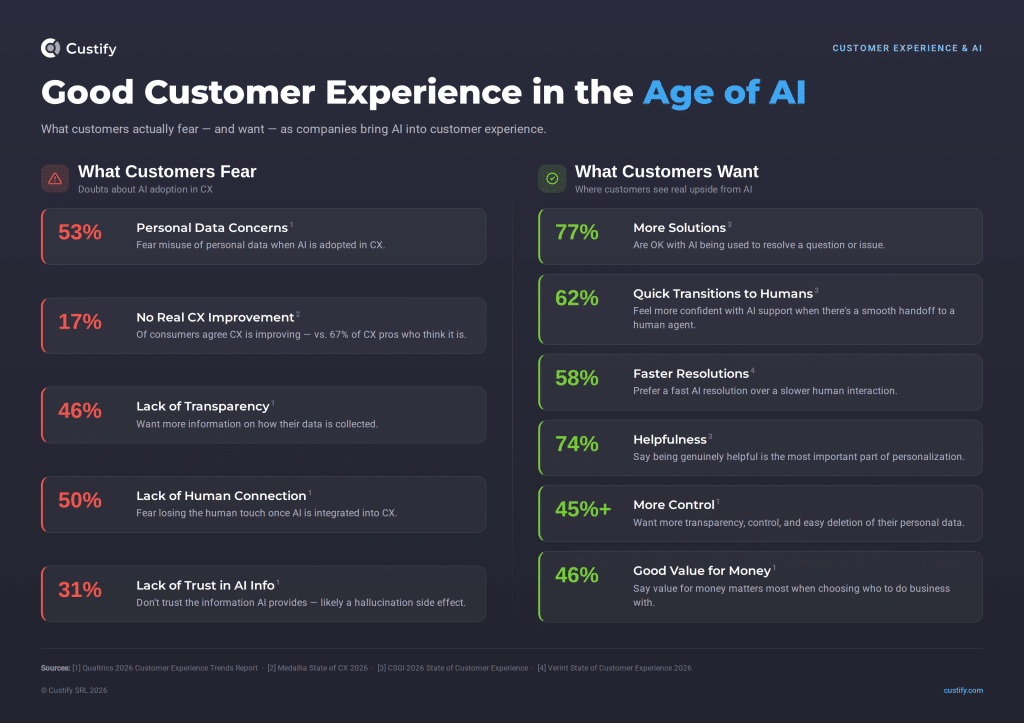
- Personal Data Concerns. 53% of customers fear misuse of personal data when it comes to AI adoption (Qualtrics 2026 Customer Experience Trends Report).
- No Improvements in Actual CX. While 67% of CX professionals believe customer experiences are improving, just 17% of consumers agree (Medallia State of CX 2026). If companies want AI to help, they need to make sure the experience actually improves.
- Lack of Transparency. 46% of customers want more information about how their data is collected (Qualtrics).
- Lack of Human Connection. 50% of customers fear the lack of a human connection when dealing with companies that integrated AI into their CX (Qualtrics).
- Lack of Trust in the Information Provided. What’s interesting is that 31% of customers also said they don’t trust the information provided by AI (Qualtrics). This likely comes as a side effect of widespread AI hallucinations.
What Customers Want from AI CX Improvements:
It’s not all negative, however. Plenty of customers can see the benefits of AI in CX:
- More Solutions. 77% of customers say they’re OK with AI being used in CX for “resolving a question or issue” (CSGI 2026 State of Customer Experience).
- Quick Transitions to Human Agents. Furthermore, 62% would feel more confident in using AI customer support solutions if there’s a “smooth transition from AI agents to human agents” (CSGI).
- Faster Resolutions. It’s not just about what AI can do; it’s also about how fast it can do it. 58% of customers admitted they’d prefer an AI agent that can quickly solve their issue versus interacting with a human agent (Verint State of Customer Experience 2026). This is also a clear sign that customers care more about reaching a resolution than they care about AI adoption.
- Helpfulness. A common use of AI in CX is to personalize customer interactions. 74% of customers say the most important part of personalization is that it’s helpful (CSGI).
- More Control. Over 45% of customers want more transparency over personal data use, more control over how it’s used, and the ability to delete info easily (Qualtrics).
- Good Value for Money. Finally, 46% of customers say “good value for money” matters most when choosing to do business with an organization (Qualtrics). However, AI will fit into that; business leaders must ensure their offer remains a good value-for-money proposition.
7 Ways to Use AI to Improve Customer Experience
1. Let Customers See Their Progress in Real Time
Showing clients how far along they are towards their destination is a simple way of improving CX. A recent development of AI tools is the ability to detect customers’ progress in real time based on centralized CSP signals. Then, all that’s left is to effectively communicate this progress. Here’s a clear workflow that runs you through all the necessary steps:
- Understand customers’ desired outcomes, assign metrics and KPIs, and track those inside your customer dashboards.
- Get a tool that can show you customer progress through playbooks, lifecycles, and value realization steps. We recently added AI-assisted value mapping to Custify, allowing CSMs to now track customer value realization directly on their dashboards.
- Create advanced customer portals that include information about customer goals: progress through value realization steps, overview of current tasks, lifecycle stages (i.e., progress through onboarding and implementation flows).
- Communicate goal achievement. Either share the portals where customers can check their own progress, or present those in QBRs using the customer portal as backup and with the assistance of AI meeting prep agents.
2. Focus on Critical Accounts Using AI Sentiment Scoring
Now that natural language processing is integrated into most SaaS workflows along with AI, sentiment scoring and analysis have become commonplace. Most SaaS tools have some way to gauge customer sentiment effectively. In Custify, we introduced sentiment scoring, SWOT analysis, churn risk summaries, and more, all easily accessible in your customer success dashboards.
These tools can help teams obtain a deeper understanding of their accounts and thus focus on the ones that actually require their attention. To do so effectively:
- Set up your accounts to effectively monitor their goals, product activity, and progress.
- Centralize customer signals and communications into your preferred tool for sentiment scoring.
- Check customer sentiment periodically (daily, weekly, monthly, or whenever there is a clear change – based on your engagement model).
- Set up automatic flows to notify you of significant changes in customer sentiment and prioritize stepping in with tailored solutions for those accounts (AI can also suggest responses, follow-ups, and solutions).
3. Automate Low-Touch Customer Engagement Operations with AI Teammates
New AI agents can also act as de facto teammates, handling basic support requests, customer engagement, and routing. These new efficiencies can enable companies to proactively automate low-touch actions. Implementing predictive and self-service support tactics is a proven tactic to improve CX, with 84% of customers more willing to do business with companies that have them.
Predictive support is an area where AI shines, as it can effectively:
- Monitor accounts
- Identify issues
- Cross-check rules
- Propose tactics
- Attempt solutions
- Log account actions
Furthermore, AI agents can take these steps automatically, enabling enhanced CX and customer support at scale. Understanding the different types of AI chatbots can help businesses choose the right solution for their customer experience strategy. Depending on the use case, AI chatbots can answer common questions, qualify leads, provide personalized recommendations, or assist customers throughout their journey with fast, automated support.
4. Surface Hidden Churn Signals with Advanced AI Agents
AI agents can also help in the endless search for potential churn. Let’s face it – the reasons for churn keep growing and diversifying. While some are obvious, others are mystifying and confusing. Here’s what we can do to enable better tracking of potential churn signs:
- See hidden customer health issues. With AI-enabled customer health agents, you can spot classic churn reasons before they spiral out of your control.
- See market trends and how they could affect your accounts. Many times, customers churn for reasons that could be external to your business. AI agents can spot them early and help you take steps to prevent churn.
- Analyze direct customer feedback. AI can be extremely helpful in transforming large text inputs into actionable tasks. So, if you’ve got large quantities of customer feedback, you can quickly get real recommendations and tasks that you can assign to relevant teams like Product or Customer Support.
Spotting churn signs early with the help of AI is a simple and effective way to improve CX and become more aware of common customer issues.
5. Prioritize Decision-Makers with AI-Assisted Stakeholder Maps
CX can be a complex game in B2B. Unlike more traditional customer relationships, in B2B you’re often serving a nebulous group of stakeholders championed by one or two points of contact. The decision-makers that pay the invoice can be far removed from daily operations.
And therein lies another advantage AI can bring to your workflows: the ability to identify silent decision-makers and create a clear map of stakeholders. With such a map available directly on your dashboard, you can tailor engagement strategies and value realization to the people who would have the most impact on your customer relationships. Sometimes, the difference between account retention and churn lies in a simple rethinking of your priorities.
6. Let AI Agents Save Time for Personalized Customer Interactions
AI can also help with routing customer support requests and engagement tasks to the correct CSM or support agent. You might say: IVRs and smart routing have been a classic CX tactic for a long time; what can AI agents do better? Here’s just a sample:
- Smart AI chatbots can solve issues quickly, customize messages to be as useful as possible, and then ensure smooth transitions to human agents, only when and if necessary.
- Integrating your customer success AI agents directly with Slack or Teams can help CSMs ask questions about customers before, during, or after interacting with them, improving efficiency, potentially growing the personalization of the engagement, and reminding agents of critical account information.
- AI agents can further improve your customer engagement workflows by suggesting overall improvements based on common support issues, feature requests, and customer sentiment.
AI should not make CSMs disappear from the customer relationship. It should remove the busywork around the relationship. When AI summarizes account context, turns conversations into follow-up tasks, and flags risk signals early, CSMs spend less time chasing information and more time making the customer successful.
Irina Vatafu, Head of Customer Success, Custify
7. Optimize Your Customer Journey by Analyzing Friction Points with AI
Lastly, if your AI agents are complex enough (such as Custify AI), they can be used to analyze every touchpoint in your customer journey and determine:
- Which points have the biggest impact on the customers’ goals.
- Which points cause the most frequent issues.
- Which of the most common issues frequently lead to customer churn.
- Where you could add features, seats, or add-ons to improve expansion through upsells, cross-sells, or rightsizing.
The biggest advantage when using AI to improve customer experience comes from its ability to review large sets of data very quickly and come up with insights that humans might miss. Those insights could end up being what sets you apart from your competitors when it comes to serving customers and delivering on their desired outcomes.
Where AI Helps and Where Humans Remain Critical
| AI can help with | Humans stay critical for |
|---|---|
| Account summaries | Escalation decisions |
| Sentiment analysis | Angry or high-risk customers |
| Low-touch routing | Strategic renewals |
| Churn signal detection | Pricing and contract conversations |
| Journey friction analysis | Enterprise account relationships |
| Playbook suggestions | Trust repair after a bad experience |
5 Common Mistakes of Using AI in CX and How to Avoid Them
- Replacing Humans with AI. Probably the most common mistake when adopting AI agents for customer experience is to entirely replace human support workers and CSMs with AI. The reason? AI may be able to handle simple requests, but how many support requests actually fall into this category? Humans are not just necessary as a fallback option, but as trainers for the AI and to be able to resolve advanced support requests quickly and more efficiently than AI.
- Not Providing a Smooth Transition to Human Agents. Earlier, we saw that 62% of customers say they’d be more confident using AI if there’s a smooth transition to human agents (CSGI). It’s not simply that a human agent needs to be available when necessary, but the transition to that agent must be quick and seamless.
- Using AI to Deflect vs Resolve Issues. Without proper rules and training documents, many AI agents will default to deflection instead of providing solutions to customers. I.e., AI agents will close issues too quickly, forcing customers to return with the same issue, often on a different channel to attempt to dodge the same AI agent. This is not an increase in efficiency, but a drastic worsening of the overall customer experience.
- Hallucinations. Also, without proper rules and training, AI agents can hallucinate, leading to mistakes, poorly implemented solutions, and poor customer experience. Simple cross-check steps in the logic can typically solve these issues, along with constant updates to the AI model in use.
- Ignoring Data Privacy & Security. Lastly, data security and privacy regulations must be observed when using AI for CX improvements. Your customers must feel that you are treating their data with due diligence, and they should always have the option to delete any personal data you might have about them.
Custify AI Brings You Closer to Flawless CX
With Custify’s AI-first customer success platform, CX practitioners, CSMs, and business leaders can unite around a single source of truth about their accounts and start using advanced AI agents:
- AI Customer Health Agents. Advanced analysis of customer health and sentiment directly from your Custify dashboard.
- AI Market Analysis Agents. Custify AI monitors your accounts’ markets and gives you timely updates on important shifts and trends.
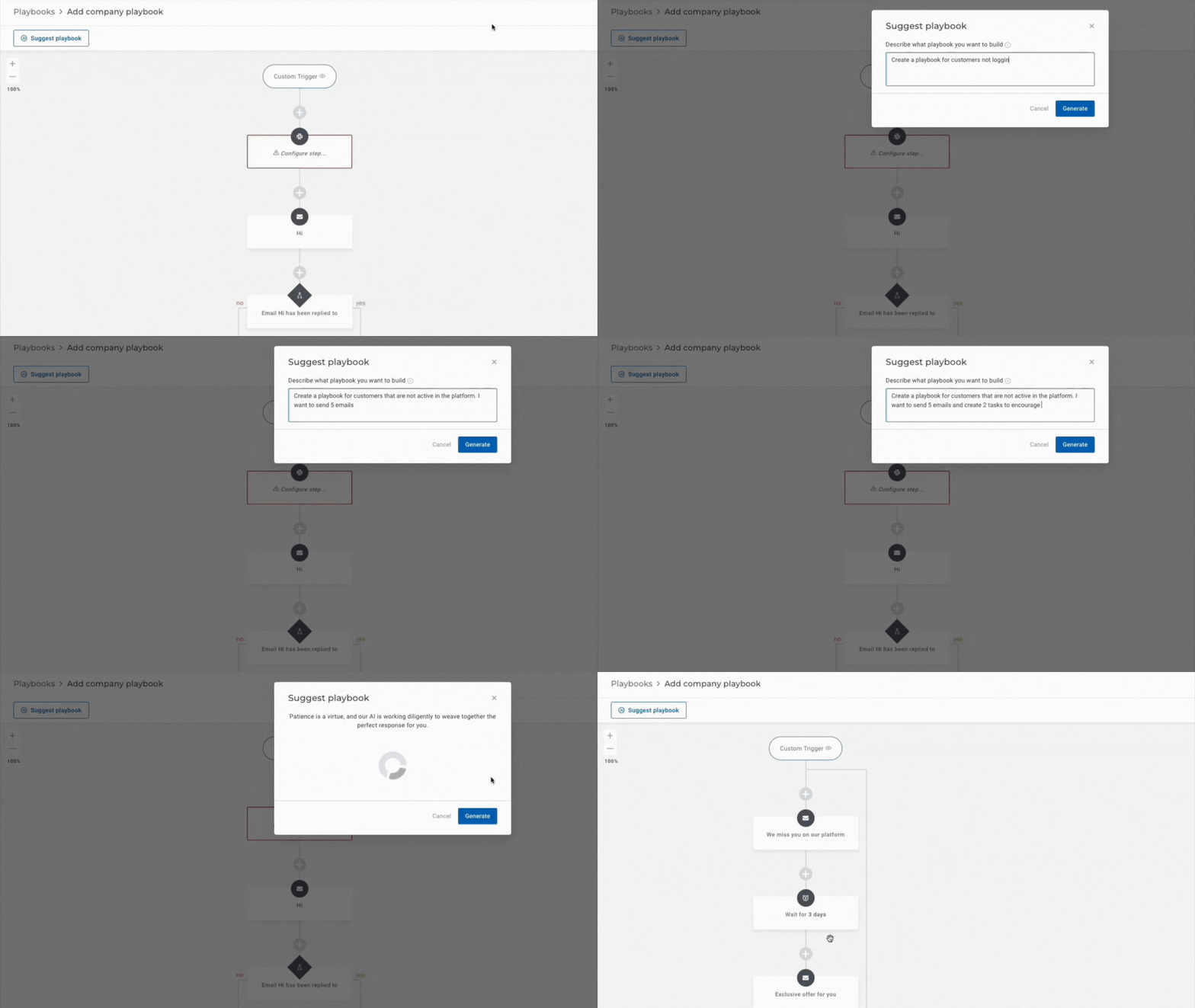
- AI Playbook Generator. Generate automation flows with a simple prompt, adjust them to your account specifics, then deploy them with speed and precision.
- AI Assistant. Talk to Custify AI wherever you work: in the Custify platform or directly on Slack. Ask about account specifics, health scores, tasks, meetings, and anything in between.
- AI Onboarding and Setup. Simplify your CS workflows – simply upload all your customer information and documents into Custify. The platform learns and then sets itself up.
- + more – we’re constantly expanding our list of features and discovering new ways to make CSMs’ lives easier.
Want to see Custify in action? Schedule a call with our team, and we’ll walk you through it.