So, the deal closed, and the prospect turned into a customer. What now?
The next logical step is to manage the account and attempt to service the customer as best as possible. To do that, you need a good account management tool.
In this article, I’ll walk you through the best account management platforms you can pick. Together, we’ll explore the definition of an account management tool, and why there’s some general confusion regarding what qualifies as one. I’ll also go into how you should choose one that makes perfect sense for your business, user engagement model, and customer success needs.
What Is Account Management Software?
Account management platforms are software tools designed to help build and maintain relationships with clients. Account managers use these tools to increase customer engagement and retention, decrease churn, and grow revenue. The core features of account management tools include customer health scoring and signal monitoring, helping teams optimize customer journeys and touchpoints to best serve customers and deliver value.
Types of Account Management Tools
Traditionally, there’s been some confusion about where a CRM ends and an account management tool begins. Add to this customer success platforms, which are a specific type of account management tool, and the lines blur even further. Let’s dispel some of the confusion with some simple definitions:
- Core Account Management Tools. Account management tools are dedicated to facilitating the sales process, managing existing accounts, and orchestrating the post-sale relationship. Essentially, the features in an account management platform typically lean towards servicing accounts, assisting sales, and enabling CS.
- CRMs and other Sales Platforms. CRMs, while abbreviated from “customer relationship management,” are more geared towards salespeople – essentially helping them keep track of leads, handle new MQLs and SQLs, and providing a centralized dashboard to orchestrate growth. While CRMs have added more and more AM-focused features, these platforms remain rooted in the sales process.
- Customer Success Platforms. I believe it’s safe to say CSPs are simply a step further from account management tools. They tend to have some of the same features, just kicked up a notch and supplemented by other advanced CS features such as automation flows, AI agents, customer portals, and more. Essentially, all CSPs are account management tools, but not all account management tools are CSPs.
Other tools that account managers use include: planners, scheduling tools, work management platforms, and several AI assistant tools. While many of these, especially those targeting B2B SaaS, added account management features, they do not fit the broader category and would best be labeled as account-management-adjacent tools.
Who Uses Account Management Tools?
Account management tools are primarily used by Account Managers, but do also serve sales reps, customer success managers, marketing specialists, and C-level executives.
Best Account Management Software Tools
Key Takeaways
- Account Management tools are specifically designed to manage the post-sale relationship and feature deal strategy development, account planning, health monitoring, and customer journey orchestration.
- Many popular CRM platforms have been adding account management features to essentially serve as an all-in-one dashboard for marketing, sales, and account management.
- Customer success platforms qualify as account management tools but are more advanced and designed for careful monitoring of customer signals, automation, and churn prevention.
- Account managers typically use other software solutions as well, including planners, schedulers, work management platforms, and AI meeting agents. These tools are AM-adjacent and will not be included in this list. Examples include: Monday, Fathom AI, Calendly, Asana, Wispr Flow, Cal, Fireflies AI, and more.
Included on this list:
- 6 Core Account Management Tools
- 3 Customer Success Tools
- 3 CRM Platforms
Account Management Tools Overview
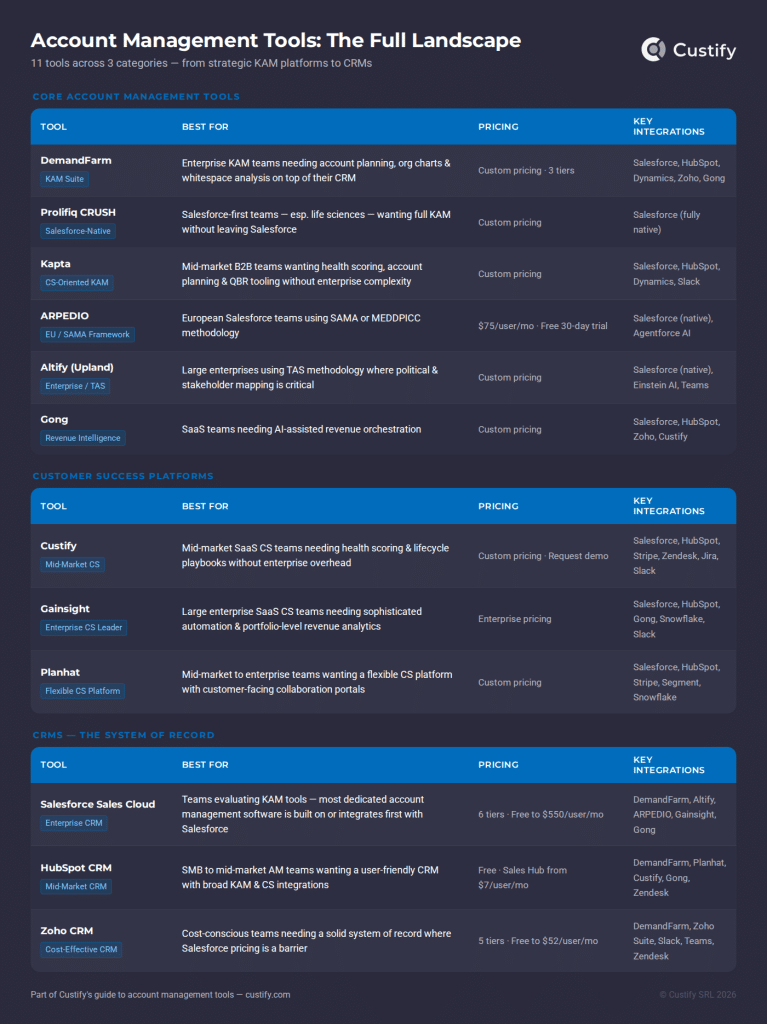
| Tool | Best for | Pricing | Key Integrations |
|---|---|---|---|
| Core Account Management Tools | |||
| DemandFarm | Enterprise KAM teams needing account planning, org charts & whitespace analysis on top of their CRM | Custom pricing, 3 tiers | Salesforce, HubSpot, Dynamics, Zoho, Gong |
| Prolifiq CRUSH | Salesforce first teams, wanting full KAM without leaving Salesforce | Custom pricing | Salesforce (fully native) |
| Kapta | Mid-market B2B teams wanting health scoring, account planning & QBR tooling without enterprise complexity | Custom pricing | Salesforce, HubSpot, Dynamics, Slack |
| ARPEDIO | European Salesforce teams using SAMA methodology | $75/user/month, free 30-day trial | Salesforce (native) |
| Altify | Large enterprises using TAS methodology where political & stakeholder mapping is critical | Custom pricing | Salesforce (native) |
| Gong | SaaS teams needing AI-assisted revenue orchestration | Custom pricing | Salesforce, HubSpot, Zoho, Custify |
| Customer Success Platforms | |||
| Custify | Mid-market SaaS customer success teams that manage renewals, health scores, product signals, and expansion | Custom pricing, request demo | Salesforce, HubSpot, Stripe, Zoho, Jira, Slack |
| Gainsight | Large enterprise SaaS CS teams needing sophisticated automation & portfolio-level revenue analytics | Enterprise pricing | Salesforce, HubSpot, Gong, Snowflake, Slack |
| Planhat | Mid-market to enterprise teams wanting a flexible CS platform with customer-facing collaboration portals | Custom pricing | Salesforce, HubSpot, Stripe, Segment, Snowflake |
| CRM Platforms | |||
| Salesforce Sales Cloud | Large enterprise teams | 6 tiers, from free to $550/user/month | DemandFarm, Altify, ARPEDIO, Gainsight, Gong |
| HubSpot CRM | SMB to mid-market account management teams | Free, Sales Hub starts at $7/month/seat | DemandFarm, Custify, Planhat, Gong, Zendesk |
| Zoho CRM | SMB to mid-market teams that need a low-cost CRM | 5 tiers, Free to Ultimate at $52/user/month | DemandFarm, Zoho Suite, Custify, Slack, Teams, Zendesk |
Category Winners:
- Best customer success platform for account management: Custify
- Best key account planning tool: DemandFarm
- Best revenue orchestration tool for account managers: Gong
- Best Salesforce-native account planning tool: ARPEDIO
- Best enterprise customer success platform for account management: Gainsight
- Best CRM base layer: Salesforce
- Best CRM for SMBs and mid-market SaaS: Salesforce

1. DemandFarm
Category: Account Management Tool
Best for: Enterprise sales and KAM teams managing complex, multi-stakeholder accounts
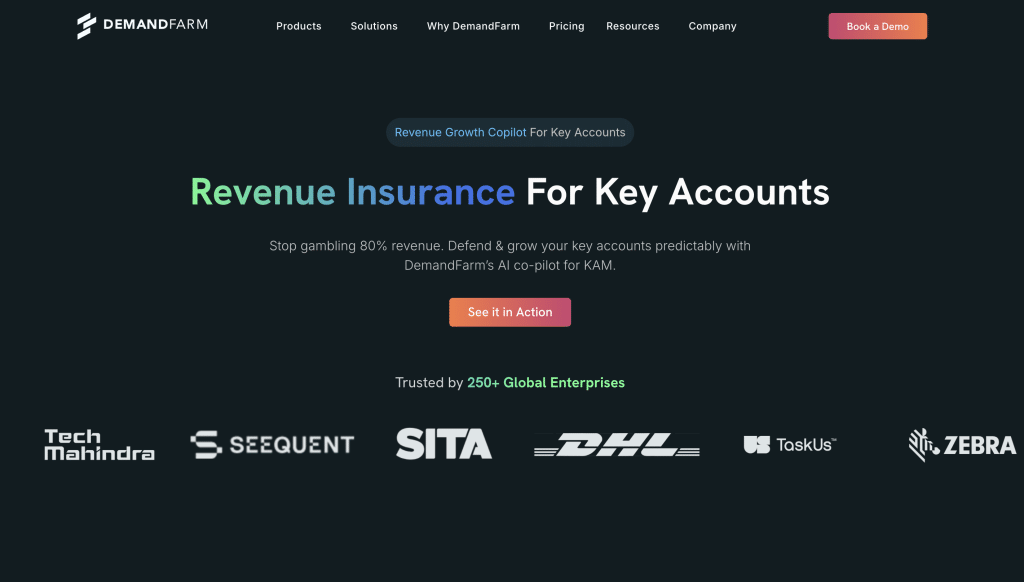
DemandFarm is a dedicated key account management tool that sits on top of your existing CRM solution rather than replacing it, acting as an additional layer for account planning. The main advantage of DemandFarm is its easy-to-use dashboard, which helps both Sales and Account teams focus and visualize customer relationships clearly, surfacing revenue growth opportunities that align with strategic goals and accounts.
How DemandFarm Works
DemandFarm offers three modular products: Account Planner, Org Chart, and Opportunity Planner, all of which integrate with existing CRMs to pull in live account data. Account managers then build and maintain account plans, stakeholders, and opportunities, as well as analyze and mitigate risks with KAM AI. DemandFarm also gives account representatives the option to run in-app QBRs with real-time data, all without switching between systems.
Pricing
DemandFarm pricing has three tiers: Small Business, Mid-size Business, and Enterprise, all three with custom pricing. KAM AI is bundled on top of existing plans upon request.
Integrations
DemandFarm integrations include: Salesforce (native), HubSpot CRM, Microsoft Dynamics 365, Zoho CRM, Pipedrive, LinkedIn Sales Navigator, Gong, Slack, Microsoft Teams, Gmail, Microsoft Outlook
2. Prolifiq CRUSH
Category: Account Management Tool
Best for: Salesforce-first enterprise teams
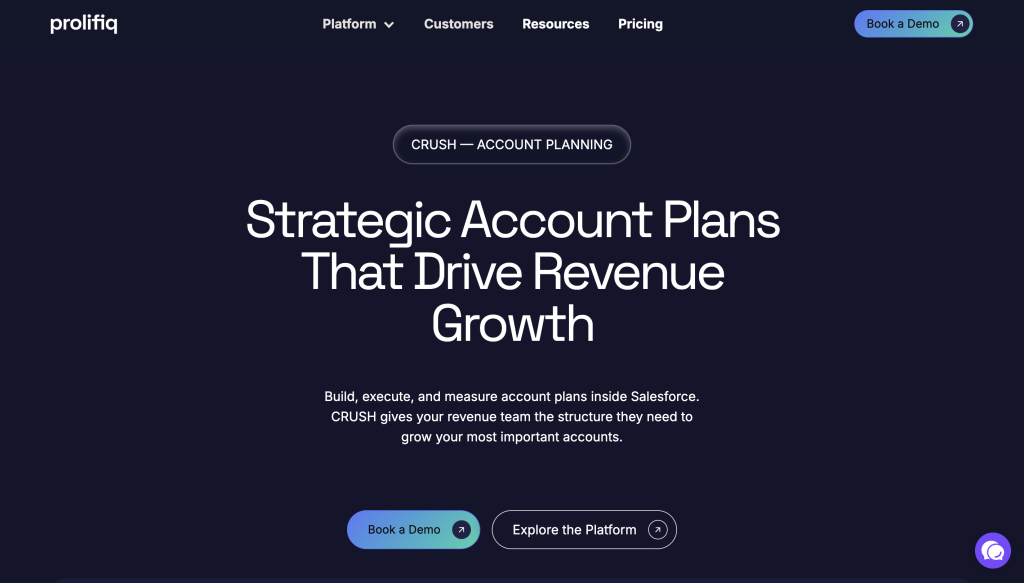
Prolifiq CRUSH is a Salesforce-native key account management suite built to manage account plans, org charts, whitespace matrices, and objectives directly within Salesforce. CRUSH enhances collaboration within Salesforce and on Slack, effectively leveraging existing account data to optimize opportunity management, sales productivity, relationship mapping, forecasting, and more. While Prolifiq was recently acquired by Verne, the product remains actively sold and supported via Salesforce AppExchange.
How Prolifiq CRUSH Works
Installed natively within Salesforce through the AppExchange, CRUSH adds structured account plan templates, drag-and-drop stakeholder relationship maps, opportunity analysis, whitespace heat maps, health scores and ROI, and QBR exports (to PDF/PPT) directly inside Salesforce or to Slack. All reports and dashboards behave like standard Salesforce objects.
Pricing
Prolifiq CRUSH features custom pricing, although the AppExchange entry lists the add-on at $40/user/month, with a free, 30-day trial available.
Integrations
Prolifiq CRUSH integrations include: Salesforce (fully native, all data stored as standard Salesforce objects)
3. Kapta
Category: Account Management Tool
Best for: Mid-market B2B teams with dedicated account managers
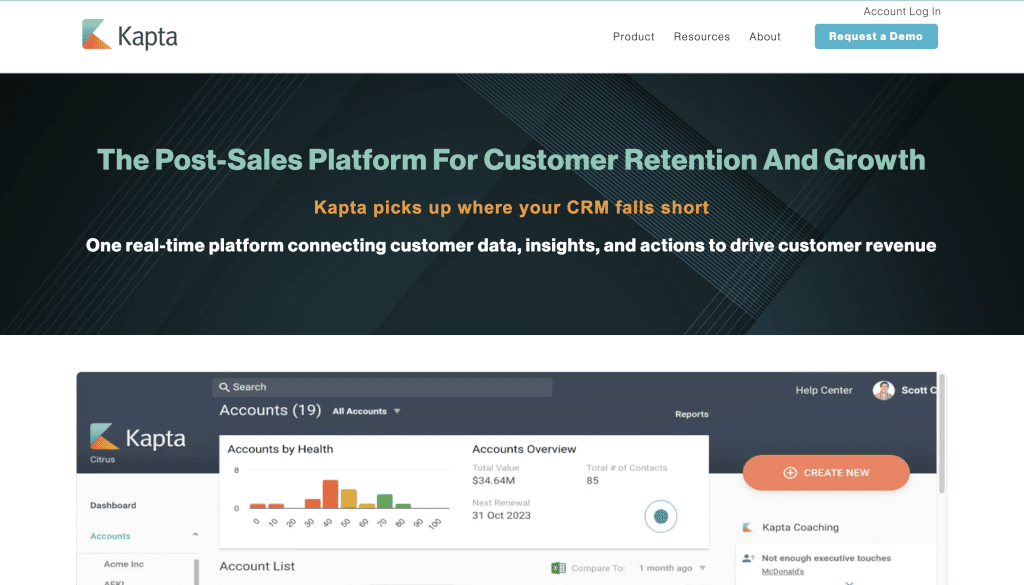
Kapta is a key account management platform designed for B2B organizations looking to move beyond generic CRM workflows and into structured, relationship-first account management. Unlike the previous tools on this list, Kapta approaches account planning from a customer success perspective, emphasizing retention, expansion, and long-term relationship management. Its focus is on account health scoring, SWOT-based account planning, and QBR automation.
How Kapta Works
Account managers are able to keep an overview of their accounts from a single dashboard designed to center retention insights, relationship strength, stakeholder maps, and other account details such as meeting and QBR history, goals, risks, and expansion paths. The platform’s Health Scores aggregate engagement data into clear metrics to flag at-risk accounts proactively.
Pricing
Custom pricing available only after the demo call; no other official pricing information available.
Integrations
Kapta integrations include: Salesforce (Premium tier), HubSpot, Microsoft Dynamics 365, Microsoft Teams, Zoho CRM, Slack, Mailchimp, ConnectWise
4. ARPEDIO
Category: Account Management Tool
Best for: Mid-market and enterprise Salesforce shops
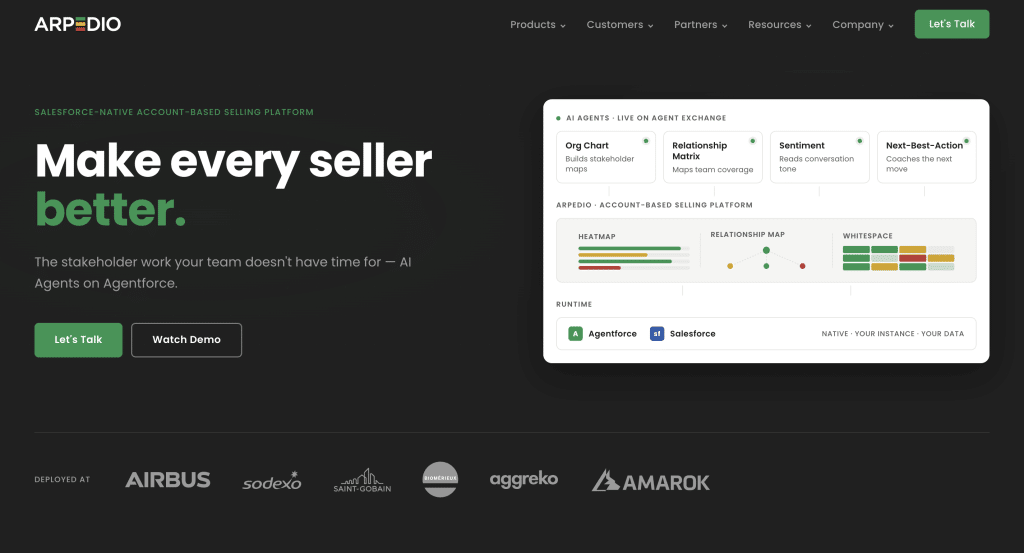
ARPEDIO is an account-based selling platform that operates entirely inside your team’s existing Salesforce instance, with no separate application required – the second such tool on our list so far. It is built on the SAMA 7-step strategic account management framework, covering customer discovery, strategic account planning, value optimization and delivery, and outcome management. ARPEDIO includes stakeholder relationship mapping, white space analysis, and MEDDPICC-qualified opportunity management.
How ARPEDIO Works
Installed as a managed Salesforce AppExchange package, ARPEDIO surfaces accounts that need immediate action, helping move deals forward with suggested actions, expansion opportunities, and structured account plans. Similar to other account management tools, ARPEDIO allows you to track org charts, stakeholder heat maps, white space matrices, and key account health scores, with the added benefit of working directly in your Salesforce instance, requiring no data migration.
Pricing
Salesforce AppExchange lists ARPEDIO as starting at $75/user/month, with a free trial available for 30 days.
Integrations
ARPEDIO integrations include: Salesforce (fully native)
5. Altify (Upland)
Category: Account Management Tool
Best for: Large enterprise teams (500+ employees) needing Salesforce-native account management
Altify, now part of Upland Software, is one of the category’s veteran account management platforms, having pioneered structured account and opportunity planning through target account selling (TAS) and other frameworks. As yet another entry built natively on Salesforce, Altify covers relationship mapping, opportunity management, account whitespace management, and sales process coaching. Altify was recently acquired by Upland Software, yet remains available on the Salesforce AppExchange as of July 2026.
How Altify Works
Runs natively inside Salesforce, adding structured account plan records, relationship maps, opportunity coaching workflows, AI-enabled deal management, pipeline visibility, and actionable buyer and customer insights on top of existing CRM data. The Sales Manager view allows users to directly assist teams, identify risks, and provide real-time coaching.
Pricing
Custom annual subscription fee.
Integrations
Altify integrations include: Salesforce (native), Microsoft Teams
6. Gong
Category: Account Management Tool
Best for: Mid-sized SaaS teams looking for AI-assisted revenue orchestration
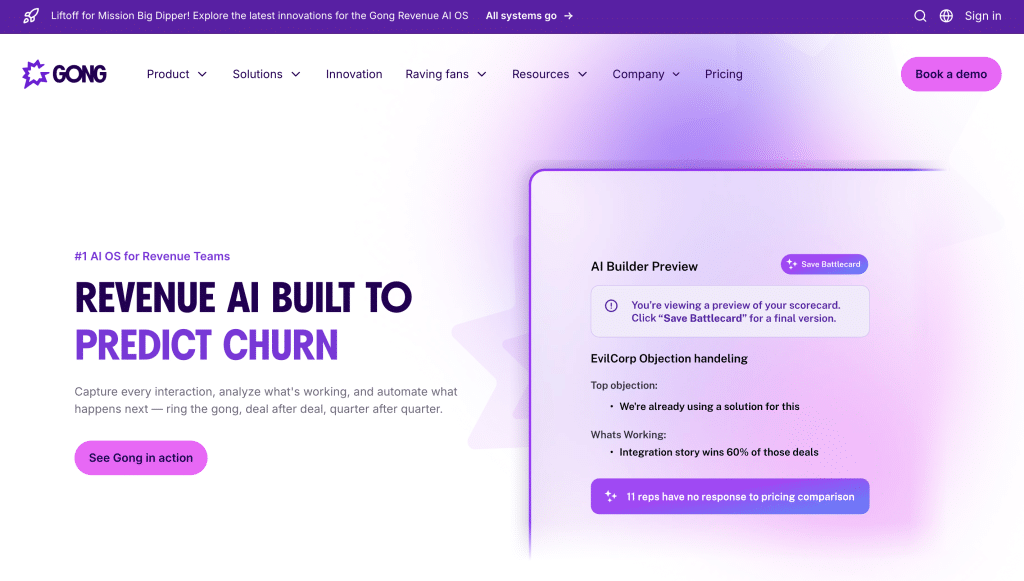
Gong is an AI-enabled revenue enablement platform divided into three core products: Gong Engage, Forecast, and Enable. All three tools serve account management needs to varying degrees, with Gong Enable being the most relevant for our current list. In Enable, account managers can analyze customer conversations, optimize engagement, and practice customer meetings with AI role-play agents.
How Gong Works
Gong can integrate directly with your CRM solution, allowing account managers to pull conversations, meetings, customer signals, and account data. Gong then uses these for initiative tracking, coaching, AI role-play calls, meeting reviews, team insights, and market insights.
Pricing
Gong features a custom pricing model that varies based on your team size and the specific features you want.
Integrations
Gong integrations include: Talkdesk, Custify, Survicate, HubSpot, Google Meet, LinkedIn Sales Navigator, Dialpad, Zendesk, Zoho CRM, Freshworks, Salesforce

7. Custify
Category: Customer Success Platforms
Best for: Mid-market SaaS customer success teams that manage renewals, health scores, product signals, and expansion from one account view
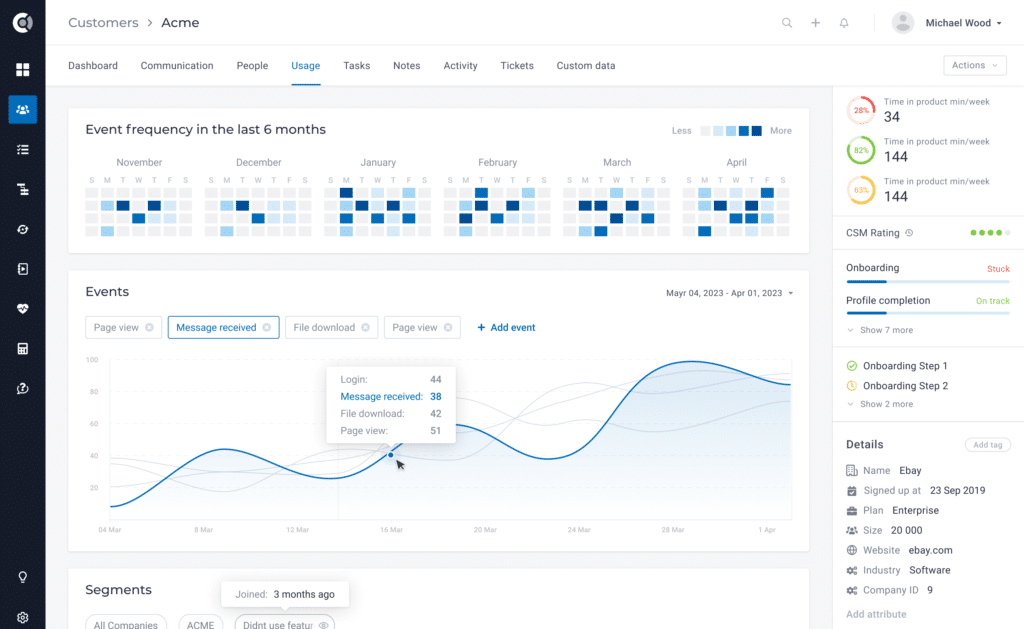
Custify is a customer success platform designed to help teams signal hidden churn signals, grow customer relationships, and drive expansion in their existing accounts. Our Customer 360 dashboard centralizes customer health data, AI overviews, sentiment scoring, value delivery maps, and stakeholder maps, giving account managers and CSMs a full picture of their accounts. Custify lets you then automate playbooks, build advanced, shareable customer portals, and set up advanced customer success AI agents.
How Custify Works
Custify aggregates data from CRM, product analytics, billing, BI tools, data warehouses, meeting assistants, project management, support tools, and more into unified customer profiles with configurable health scores. Advanced automated playbooks trigger tasks and communications based on health changes, customer signals, or lifecycle events. Custify AI assists in sentiment analysis, churn risk analysis, customer summaries, platform setup and data ingestion, and prompt-based playbook generation.
Pricing
Our platform comes with flexible pricing that adapts to your needs. Schedule a call with our team so we can understand your use case and needs and come up with a personalised offer.
Integrations
Custify integrations include: Salesforce, HubSpot, Zoho CRM, Zendesk Sell, Gong, Stripe, Chargebee, Google Sheets, Zapier, Segment, Slack, Microsoft Teams, Intercom, Notion, AWS Redshift and Athena, Azure Synapse, Gmail, Pylon, Fathom, Asana, Jira
8. Gainsight
Category: Customer Success Platforms
Best for: Enterprise B2B SaaS and technology companies with a dedicated Gainsight admin
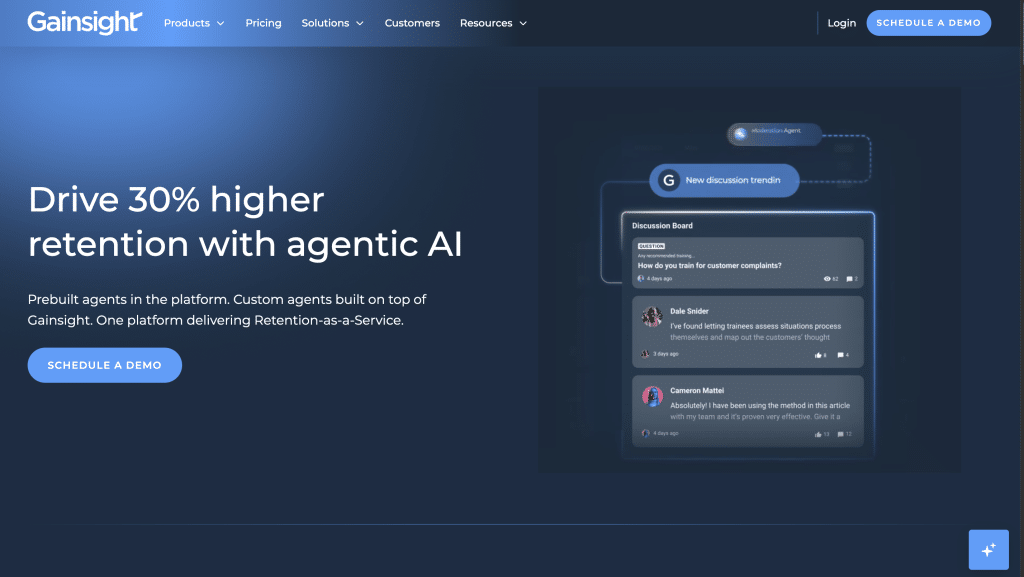
Gainsight is an advanced customer success platform catering to large-scale enterprises and customer success teams. It provides comprehensive account health scoring, customer journey orchestration, lifecycle automation, revenue intelligence (NRR, GRR, churn forecasting), and CS team management capabilities.
How Gainsight Works
Gainsight pulls data from CRM, product analytics, support, and billing into a unified account view with configurable health scores. CSMs and account managers can automate lifecycle playbooks, outreach, and internal tasks based on account status changes. The biggest downside of Gainsight is the complexity of setting everything up and maintaining the platform, which requires a dedicated Gainsight admin according to most user testimonials. For more information about this platform, see our Gainsight alternative page.
Pricing
Enterprise pricing; typically five- to six-figure annual contracts for large teams.
Integrations
Gainsight integrations include: Slack, AWS Redshift, Intercom, Segment, Jira, Freshdesk, Zapier, Pipedrive, Salesforce, HubSpot, Miro, Zoho, SurveyMonkey
9. Planhat
Category: Customer Success Platforms
Best for: Mid-market to enterprise B2B teams
Planhat is a customer success and revenue platform known for its clean, flexible data model and strong usability. It covers account health scoring, lifecycle automation, customer portals, and revenue analytics (NRR, expansion, churn), and is designed to be accessible for both CS and account management teams with a less-heavy implementation overhead compared to Gainsight.
How Planhat Works
Planhat centralizes account data from CRM, product usage, billing, and support into a single dashboard. CSMs can use the platform to configure health metrics, drive automated playbooks, and build workflows. Customer portals give customers and account managers visibility into success metrics and shared goals.
Pricing
Custom, quote-based pricing.
Integrations
Planhat integrations include: Anthropic, Salesforce, HubSpot, Zendesk, Slack, Microsoft Teams, Zapier, Google Drive, Jira, Segment, Mixpanel

10. Salesforce Sales Cloud
Category: CRM Platforms
Best for: Large enterprise teams
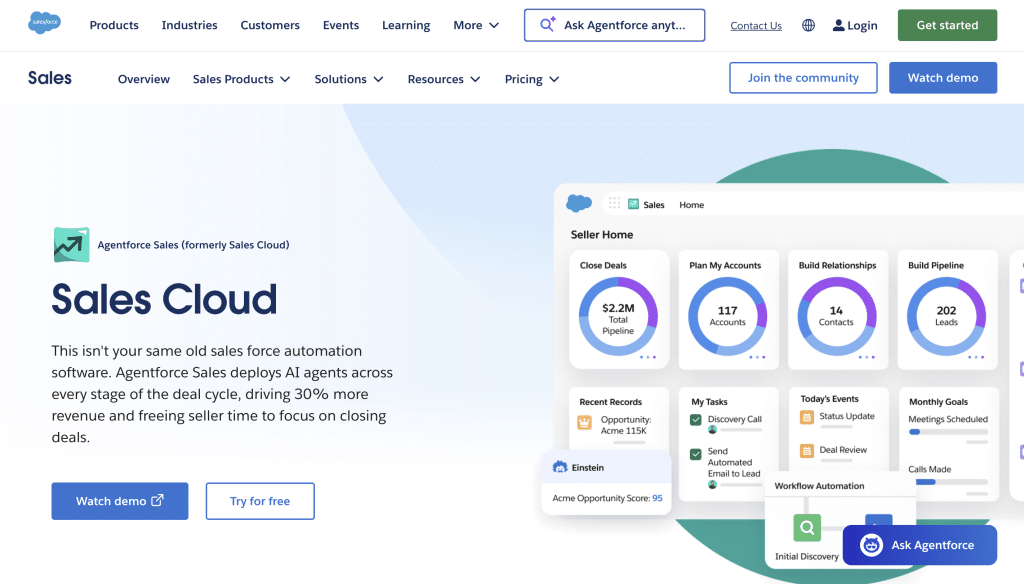
Salesforce Sales Cloud is the world’s largest CRM solution, used by the vast majority of enterprise account management teams as their main system for keeping track of accounts. While not designed specifically for strategic account management, it nonetheless acts as the foundational data layer for most dedicated KAM tools (including many of the ones we mentioned above). While Salesforce’s recent transition to full AI agents and support has been criticized, it remains the most relevant CRM in this list.
How Salesforce Sales Cloud Works
Salesforce Sales Cloud (now Agentforce Sales) tracks accounts, contacts, opportunities, and activities in a centralized database. For account management specifically, it offers account activity management, account plans, and lead management. The newest version of Salesforce includes forecast and pipeline management, apart from its strategic reports and dashboards. Whether Salesforce is useful for key account management really depends on the dedicated tools you choose to extend it — DemandFarm, Altify, ARPEDIO, and Custify all integrate with Salesforce.
Pricing
Salesforce Sales Cloud pricing comes in 6 tiers:
- Free (basic account management)
- Starter Suite – $25/user/month
- Pro Suite – $100/user/month
- Enterprise – $175/user/month
- Unlimited – $350/user/month
- Agentforce 1 Sales – $550/user/month
Integrations
Salesforce integrations include: DemandFarm, Altify, ARPEDIO, Gong, Gainsight, Custify, Slack, Microsoft Teams, Outlook, Gmail, LinkedIn Sales Navigator, Tableau, Marketo, HubSpot
11. HubSpot CRM
Category: CRM Platforms
Best for: SMB to mid-market account management teams
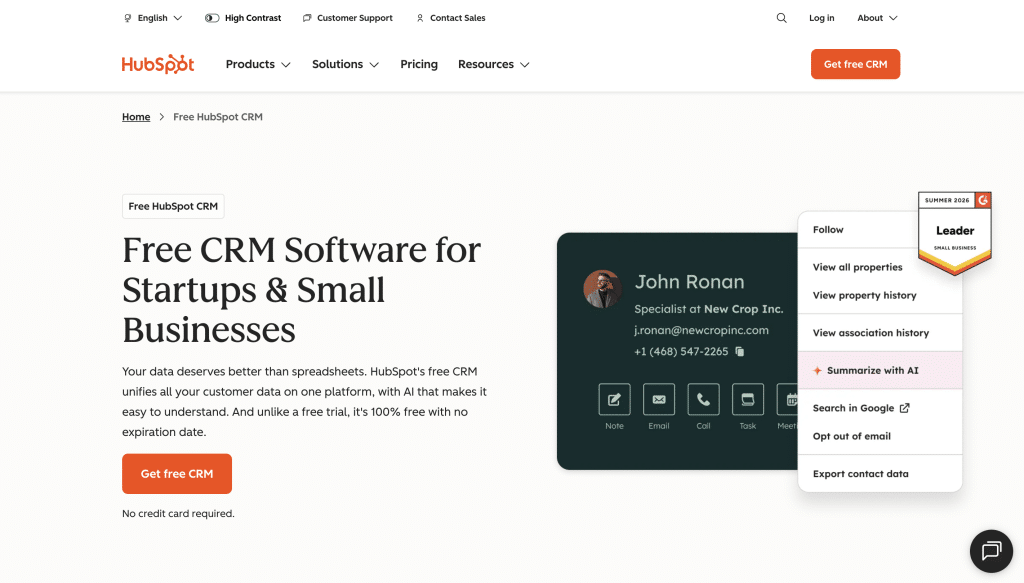
HubSpot CRM is likely the most well-known and adopted CRM for mid-market B2B companies. It functions as a primary way to maintain customer records for account management teams that want to avoid the complexities and price tag of Salesforce. HubSpot’s free tier and ease of use have made it ubiquitous. It also helps that it integrates with multiple KAM and CS tools (DemandFarm, Custify), making it relevant as both a standalone option and an integration partner.
How HubSpot CRM Works
HubSpot CRM tracks contacts, companies, deals, and activities in a single database. For account management, relevant features include company hierarchies, contact association, deal pipelines, and activity timelines. The biggest advantage of HubSpot is that the CRM itself is free, with the option to bundle the Sales Hub on top of it, adding meeting intelligence, scheduling options, playbooks, pipeline management, and advanced sequencing.
Pricing
The HubSpot CRM is free, with the optional addition of the HubSpot Sales Hub starting at $7/month/seat (annually), $100/user/month for the Professional tier, or $150/user/month for the Enterprise tier.
Integrations
HubSpot integrations include: DemandFarm, Revegy, Custify, Slack, Gmail, Outlook, LinkedIn Sales Navigator, Gong, Intercom, Zendesk, Stripe
12. Zoho CRM
Category: CRM Platforms
Best for: SMB to mid-market teams that need a low-cost CRM
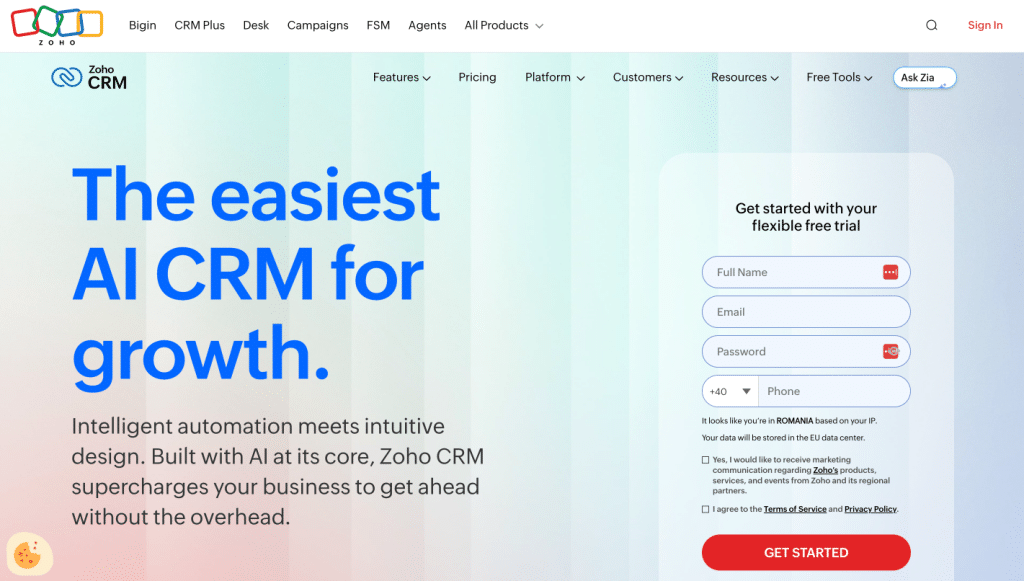
Zoho CRM is a full-featured platform popular among SMB and mid-market teams, usually chosen for its affordability and broad feature set. For account management, features include account hierarchies, contact management, deal tracking, and a built-in canvas view for account visualization.
How Zoho CRM Works
Zoho CRM allows your team to manage accounts, contacts, and deals with customizable pipelines and account views. Its Canvas feature lets account managers build custom record layouts. Recently, Zoho added Zia, an AI assistant that can uncover lead and deal insights.
Pricing
Zoho CRM offers a free tier for up to 3 users. Paid CRM plans include more advanced features, including the AI assistant:
- Standard $14/user/month
- Professional $23/user/month
- Enterprise $40/user/month
- Ultimate $52/user/month
Integrations
Zoho integrations include: DemandFarm, Zoho Suite (Desk, Campaigns, Analytics, Books), Custify, Slack, Microsoft Teams, Gmail, Outlook, Mailchimp, Zendesk, Salesforce (data migration)
How to Find the Best Account Management Tool
Seeing as there’s no shortage of choices regarding account management tools and platforms, your best bet is to either:
- Decide based on your existing CRM, then pick the option that best matches your needs.
- Decide based on your precise needs, then adapt based on your choices.
- Or simply pick the best account management solution and see how you can integrate it into your tech stack.
You might not need to search long or make hard decisions, however, seeing as most of the tools we’ve reviewed do integrate with each other.
Which Type of Account Management Tool Do You Need?
If you’re unsure which type of tool you need, or even if you actually need a CRM, let’s break it down:
Do you need a CRM? CRM platforms are almost essential for keeping track of your customers, particularly if you operate in SaaS, B2B, or any software niche for that matter. The only other option you have would be to build a custom tool or use spreadsheets, which is not very effective. Fortunately, you have free options to choose from when it comes to CRM solutions.
Do you need Account Management Tools? Core AM tools are not always necessary – it will depend on how much you want to optimize your sales process and whether those efficiencies could be gained by other means – such as through the CRM directly or, in more advanced use cases, with the help of your customer success tool.
Do you need a Customer Success Platform? Operating without one is manageable early on, but it doesn’t scale. You’ll quickly find yourself buried under a mix of spreadsheets, CRM exports, emails, and scattered customer documents. If you’re just starting out or budget-constrained, you can wait. But if you already have an extensive customer base and product signals to track, a CSP is the logical next step to centralize customer data, prevent CSM burnout, and keep churn in check.
How Custify Can Help Scale Account Management
Automating advanced account management processes is the simplest way to scale and service more customers, delivering value and driving expansions.
Custify gives you the tools to both centralize customer data and use it to generate automation flows that seamlessly integrate into your workflows, freeing time and headspace so your CSMs stay locked in on key accounts.
Custify AI in particular can enhance this by:
- Quickly understanding customer context. Custify can now be set up quickly by simply uploading all your customer knowledge. The platform learns and sets itself up with your guidance.
- Summarizing your accounts. Custify dashboards now contain a clear view of account history, customer sentiment, and health scores, with churn risk analytics and follow-up recommendations.
- Building shareable customer portals. Working directly with your customers is much easier when you have a shared dashboard you can customize to add key account info, ongoing tasks, lifecycle progress, and more.
You can now rethink account management with a tool that automates busywork, sorts through key accounts, and sets priorities based on your precise rules. Reach out for a quick demo, and our team will walk you through the next steps.