In business terms, white space designates the opportunities and areas where a company can innovate, strengthen its offerings, and expand revenue, either from a product or a customer success perspective.
In my experience, it’s a process that often requires deep customer success knowledge. That’s why today we’ll review how teams can use CS data and tactics to find white space faster, more effectively, and map previously hidden opportunities.
In this article, I’ll outline the core definition of a white space analysis before moving on to its benefits to sales and company-wide, and how it can help identify product expansion opportunities. For the main part of the article, we’ll go through the typical white space analysis motion, from business review to opportunity mapping, all viewed through a customer success lens. Towards the end, we’ll cover common challenges and solutions. Lastly, I’ll also provide a free-to-use white space analysis template in spreadsheet format.
What Is a White Space Analysis?
White space analysis is the process by which a company identifies areas of improvement related to missing features, unmet customer needs, upsell and cross-sell potential, or other expansion opportunities.
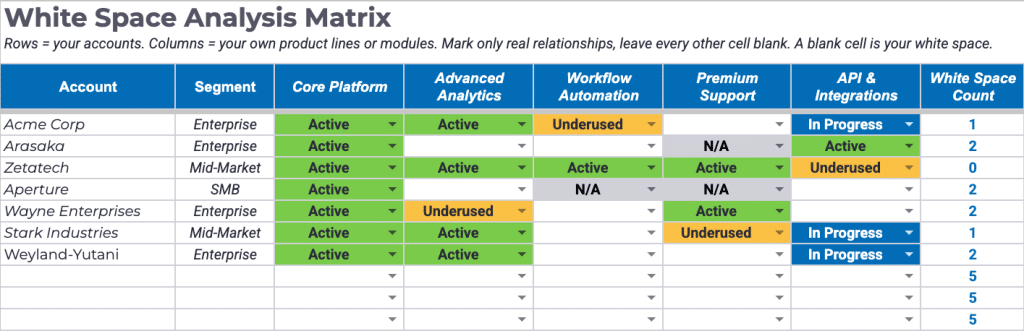
The logic is simple: by analyzing your current business offer, customer base, and competitor offering, and then mapping findings on a matrix, you can uncover empty cells (literal “white space”) where you could have additional features, services, products, or improvements to existing ones.
The process of white space analysis has been traditionally reserved for sales, account, or C-level teams. However, I would argue customer success is as important, maybe even vital, to the success of the white space opportunity mapping, providing critical customer context and knowledge derived from their CSP dashboards, AI agents, and experience actually communicating with customers.
What are the benefits of conducting a strategic white space assessment?
Conducting a white space analysis brings several benefits to the company as a whole, as well as to your Sales team who, depending on your findings and action plan, might have an easier time landing deals. Let’s zoom in:
- Higher win rate on expansion deals. Filling in white space through feature auditions and other product improvements will, first and foremost, make life easier for your current portfolio. Existing accounts close significantly faster than new prospects.
Helps: sales team, account managers - Shorter sales cycles. Opportunities lead to improvements, lead to less white space, more decisive prospects, and shorter sales cycles. When your leads know exactly what they want, and that your product has it, salespeople don’t have to spend as much time in discovery.
Helps: sales team - Lower risk of churn. White space analysis leads to better products, more customer value, and stickier accounts.
Helps: customer success team - Clearer product roadmap. Product teams can use white space analyses to validate customer demands and needs, leading to clearer goals and a more well-defined product roadmap.
Helps: product team - Higher net revenue retention. NRR factors in expansion revenue, and since existing accounts will expand at a faster rate when you fill in white space, it results in a better overall NRR.
Helps: customer success, sales, financial, leadership - Better resource allocation. White space analyses also allow you to focus on accounts with the biggest potential for growth.
Helps: leadership, financial, customer success
How can white space analysis help identify new product opportunities?
One of the key benefits of white space analysis, briefly touched on at point 4 above, is that it unlocks new product opportunities. How? Simple: the analysis reveals product gaps. You then map those gaps and determine where you can eliminate white space through product improvements.
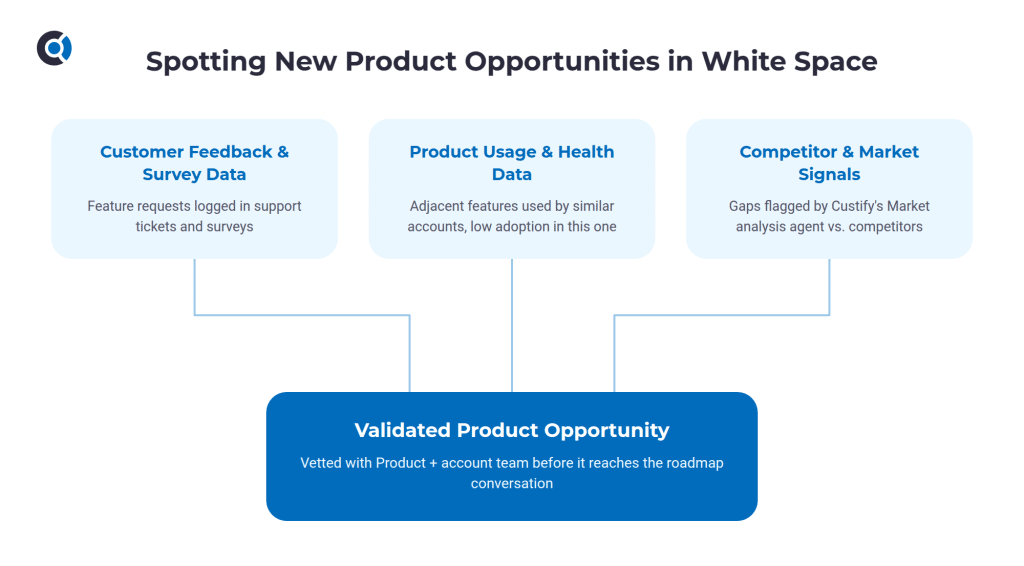
During a white space analysis, validated product opportunities come from a combination of:
- Customer Feedback and Survey Data. Your customers will tell you what they want through support tickets and survey responses.
- Product Usage and Customer Health Data. Even clearer signals can be found in customer success data: how they use the product, how often they use specific features, the overall adoption rate, and more.
- Competitor and Market Reviews. Your market can also tell you what you’re missing. A simple review or AI-assisted analysis (such as through Custify’s Market Analysis agent) can reveal critical gaps and opportunities.
What Are the Steps for Performing a Comprehensive White Space Analysis?
White space analysis is a classic sales process. What’s new today is how much more granular the analysis can get thanks to customer success data and AI agents trained on that data. The typical process looks like this:
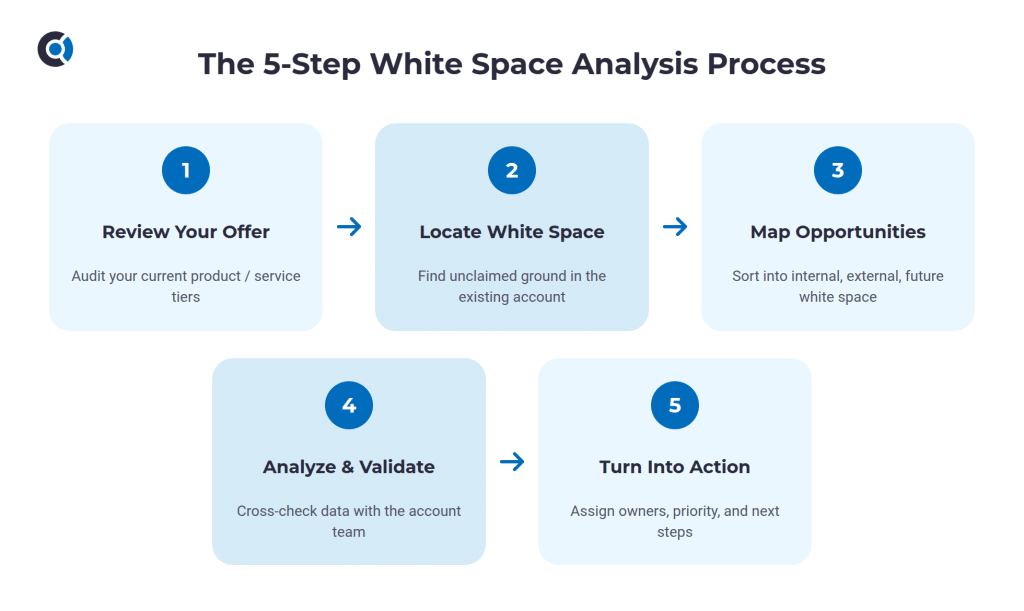
1. Review Your Business, USP, and Identify Your Current Offer
To ensure you’re looking for realistic opportunities, you first need to review your understanding of your business. It’s natural to default to assumptions about your own USP or brand, so validation against customer and market realities is the natural first step to a white space analysis.
Here’s an example of things to look for:
- Products and services you offer.
- Products and services that are most successful.
- Types of accounts in your portfolio, segmented by: industry, relationship length, product type, business size, etc.
- Changes in the market and how they might affect your USP
2. Locate White Space in Existing Portfolio
Looking at your portfolio is the second step. For every customer, try to answer the following questions:
- Have they adopted our core product/platform?
- Do they have any add-ons?
- Are they upgraded to the highest subscription tier?
- What additional value could we provide (i.e., integrations, new features, rightsizing, etc)?
- What additional stakeholders are we aware of?
This process requires deep account knowledge, customer success expertise, and analysis skills. Customer success can either own this part or the entire process, but must be involved at least at this specific stage, as a customer success platform is essential in providing a single source of truth for all necessary data and spotting white space moving forward.
For example, using Custify, CSMs are able to query our Expansion AI Agent for information regarding clear opportunities within their existing portfolio. The Stakeholder Map can also help identify account units and stakeholders with decision-making authority:

How does surveying customers fit into the process?
Surveying customers is a great way to find white spaces in your portfolio faster. While some in the SaaS space view surveys as a separate tactic that can inform white space analyses, I personally think it is extremely beneficial to conduct surveys earlier on in the process. Surveying at this step helps:
- Keep customer records up to date. Recent estimates show about 91% of B2B companies say their CRM data is inaccurate, with 40% of it becoming obsolete every year.
- Uncover both internal and external white space. Surveys don’t simply uncover what customers might want new from your product or services, but may also give you insights into your competition and what new developments, products, or features your existing customers might’ve seen.
- Expand existing accounts through clear, targeted action plans. You might have some quick wins available, for example, if you have or are soon to launch features these customers would like.
Below are some examples of customer survey questions that could inform your white space analysis and subsequent opportunities.
| Survey question | What it surfaces | Type |
|---|---|---|
| Which upcoming features would most affect your team’s workflow? | Feature-level demand ranking | Internal |
| What are you using another tool for that you wish this product could also do? | Unmet needs beyond current scope | External |
| Which teams beyond your primary users would benefit from access? | Untapped internal buying centers | Internal |
| What’s the biggest gap between what you need and what any tool offers today? | True market-level gaps | External |
| Are there workflows you’ll need in the next 6–12 months with no solution yet? | Forward-looking demand | Future |
| Have your needs, champions, and desired outcomes been updated recently? | ROT data (redundant, obsolete, trivial), better foundation for expansion | Future |
3. Map the White Space Opportunities You Identify
Now you’ve got a clear idea of your offerings and customer needs. It’s time to actually do the split and map white space. I recommend using a white space spreadsheet or template (see below).
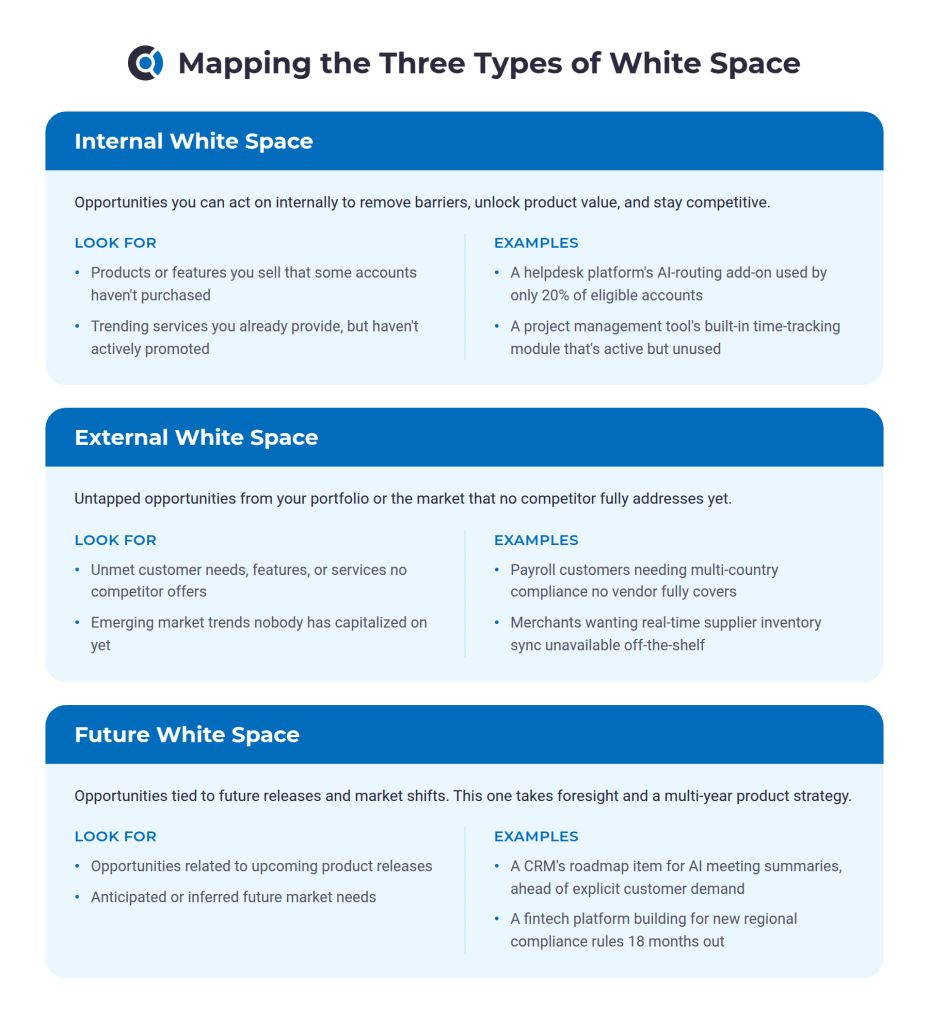
You should also have a clear understanding of the three types of white space and what you’re looking for:
- Internal White Space. Essentially, internal opportunities: tactics your business can act on internally to remove market barriers, unlock product opportunities, and stay competitive.
Look for: products or features you sell that some of your accounts haven’t yet purchased, or new trending services on the market that you already provide. - External White Space. Untapped opportunities either from your existing portfolio or from the market.
Look for: unmet customer needs, features, products, or services none of your competitors offer, or market trends. - Future White Space. Identifying future opportunities requires experience, strategic foresight, an extensive future product strategy (ideally, a 5-year strategy), and a keen eye for market developments.
Look for: opportunities related to future product releases, anticipated or inferred future market needs, or hidden market gaps.
4. Analyze White Space Opportunities
After identifying all white space opportunities, you’ll likely be left with an extensive list and no clear plan to move forward with either one.
To proceed, you need to compare your findings against actual sales expansion data and vet the results with an experienced account manager or sales rep. Why? Simple: data can pinpoint white space, it can show you what you should be doing, but it can’t tell you the reality of the situation or why that white space exists in the first place. That’s something only someone with experience can do.
Specifically, your team can look at advanced customer signals and instantly know what it means. Here are some examples:
| Data signal | Source | What it tells you |
|---|---|---|
| Feature usage frequency | Product usage data | Confirms real adoption gaps vs. assumed ones |
| Health score trend | CS platform | Flags whether the account has bandwidth for this conversation now |
| Expansion MRR history | CRM / billing data | Shows appetite and precedent for buying more |
| Support ticket themes | Helpdesk data | Surfaces recurring unmet needs in the customer’s own words |
| Stakeholder map coverage | Stakeholder Map feature | Reveals buying centers not yet engaged |
| Competitor mentions | Market analysis agent | Flags external pressure that could speed up or block expansion |
At the end of this process, you should be left with a much more manageable and actionable list of white space opportunities.
Identifying New Product Opportunities
This is the point at which findings can be compared with competitor offerings. If a particular product area could be expanded to match the competition and unlock opportunities, it’s an opportunity to improve the product through feature expansions and additions.
Since we’re living in the agentic AI age, I’d recommend the following workflow that could help speed things up:
- Find a customer success platform that supports LLM integration through an MCP connection, such as Custify.
- Connect your preferred LLM through the MCP so that it can access live customer data from your CSP.
- Review all product-related white space using AI – it can now help you validate product proposals with proof from your actual accounts.
- Additionally, more advanced CSPs find new market trends and competitor news, which can then be queried through the connected AI engine, making the whole white space analysis process significantly more efficient.
5. Turn Opportunities to Action
You may be looking at the process and asking when you’re going to get to actual tactics you can implement based on your analysis.
Look no further; this is the point where findings become assigned tasks. To devise an action plan based on your findings, think of tactics along these lines:
- Connect with existing customers and see where you can eliminate white space.
- Target new audience segments with specific marketing materials regarding their needs.
- Design new features to specifically address white space you identified previously.
- Talk directly to customers or prospects to validate white space against real-world scenarios.
The following table features some examples of findings and corresponding recommended actions, including the owner and how much effort each action would take.
| Finding | Recommended action | Owner | Effort |
|---|---|---|---|
| Account uses core platform, not the Customer Portal | Offer a scoped trial of the Portal at the next QBR | CSM | Low |
| Several tickets request a feature that doesn’t exist yet | Log as validated demand for Product, cite ticket volume | CSM → Product | Low |
| Stakeholder map shows an unengaged department head | Loop in AM/sales for a warm intro via the existing champion | AM / CSM | Medium |
| Competitor recently launched a feature this account has asked about | Flag to Product via the Market analysis agent, prep CSM messaging | Product / Marketing | Medium |
| Health is strong, but expansion MRR is flat | Schedule a dedicated expansion conversation, don’t fold into a routine check-in | CSM | Low |
| Account is underusing onboarding resources (non-product opportunity) | Point to existing training content instead of pitching a new module | CSM | Low |
Note: not all white space opportunities need to result in product additions or changes either. Low-cost changes and other underestimated brand solutions can have a good impact while keeping spending at a minimum.
How to Overcome Common White Space Analysis Challenges
Below are some common challenges and solutions when conducting a white space analysis.
1. Data Scattered across CRM / Product / Support Tools
It’s common in business for data hygiene issues to show up specifically when you begin a complex process like a white space analysis.
Proposed solution: centralize customer signals in a single, customer 360 view/dashboard before beginning your white space analysis.
2. Sales and Customer Success Conflicts
Sales and CS can disagree often, and on several things. Issues typically stem from handoff conflicts or unclear, unaligned goals.
Proposed solution: set shared goals and KPIs, particularly for customer health and account expansion. Should be standard practice, but should at least be done before a white space analysis.
3. Stale Account Data and White Space Maps
It’s very easy for data to become obsolete, particularly in SaaS and SaaS B2B. When it comes to white space analyses, it can happen whenever an account makes any internal changes.
Proposed solution: conduct recurring white space analysis tied to the frequency of QBRs or specific health score changes (build calculated metrics that can directly tell you whether your analysis is obsolete).
4. Validating Product Gaps against Business Goals
Sometimes the white space you find doesn’t match your business/product goals.
Proposed solution: have clear business goals and a product plan before moving into a white space analysis. Any white space must then be validated against those goals, and any product decisions will have to show potential ROI before being implemented.
5. Common Budget and Expertise Business Challenges
If you’ve ever started a project such as a white space analysis, you know these types of things can spiral out of control and become a never-ending resource drain.
Proposed solution: set project limits, owners, dependencies, assess risks, and keep white space analysis lean, and budget it per quarter/year.
6. Ownership Ambiguity between Sales and CS
Since white space analysis is typically a Sales process, but I’ve argued for a lot of CS ownership and involvement in this article, the result can cause conflicts and ambiguity that, in time, can become costly.
Proposed solution: assign a project owner, and then an owner for every finding that becomes an opportunity you plan to act on. Even lesser white space can be put on the back burner, with an assigned CSM, Sales rep, or AI agent to monitor developments and signal whenever it becomes a bigger opportunity.
How Working with a White Space Analysis Template Can Help
Working based on a template can significantly decrease the amount of time allotted for your white space analysis. The only drawback is that you’ve got to fill in the template with your company-specific information, such as accounts, regions, products, product features, etc. However, that’s something you’d have to do for any white space analysis – a template just gives you a good starting point.
White Space Analysis Template for SaaS
I researched existing templates extensively and decided the best way to help would be to offer an editable spreadsheet template. The most basic way to use the template below would be to feed it into your LLM, provided you have an existing CSP MCP connection. However, you can also fill it in manually.
Most importantly:
- Don’t forget to first go through the results yourself.
- Determine the opportunities based on the identified white space (second sheet).
- Then go through both sheets with an experienced account manager or sales representative to validate all your findings.
You can review the white space template spreadsheet here. Simply make a copy and add your details. Here’s a glance at the template:
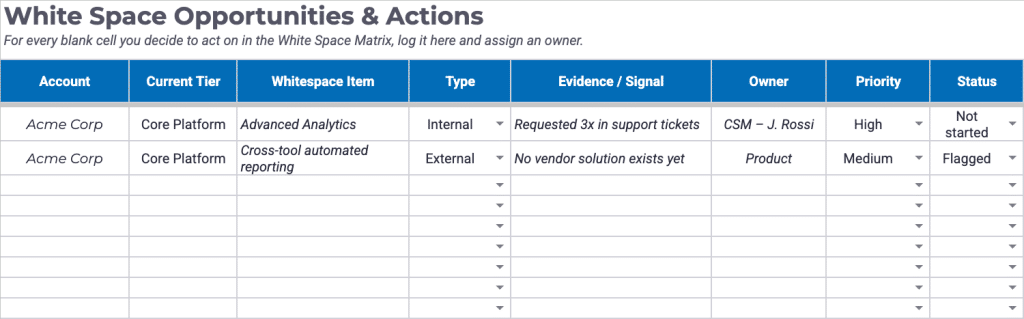
Attached to the document, in the second sheet, is a template for assigning opportunities and actions based on identified white space. Here’s how it looks:
Important mentions for both spreadsheets:
- To enable editing and make your own version of the spreadsheet, make a copy of the file in your own Google Drive folder.
- I went with an account-based layout instead of a geographical one (with regions, offices, etc) because it’s more universal and works particularly well for SaaS companies.
- To fill in, mark cells when real relationships exist. All remaining cells should be blank – these are your white space, and they should by design be white. Cells feature conditional formatting and will update automatically based on the values in the Legend.
- For missing products/features, add columns. You can replace accounts with account departments, regions, or buying centers. For additional accounts/regions/buying centers, add rows.
- After the white space analysis is concluded, move all white space opportunities to the “Opportunities and Actions” tab, where you can set an owner, priority, status, and type (external, internal, future).
How Custify Helps Eliminate White Space and Grow Revenue

In Custify, you can say goodbye to drawn-out white space analyses. It’s never been easier to find actual opportunities and product gaps in your SaaS. The whole workflow is now AI-assisted and efficient:
- Add your data, customer context, and customer success knowledge in Foundation. Custify learns and sets up the platform based on your existing processes, knowledge, and portfolio.
- Connect the Custify MCP and automatically build the white space analysis. By connecting your favorite LLM to Custify, you can directly fill in the white space template regularly. This also helps avoid stale data.
- Use AI agents to validate white space. After building the spreadsheets, you can first validate white space findings with in-depth customer summaries. The best part? Use natural language to ask about white space, and Custify will automatically trigger the right agents. You can also review accounts and create renewal forecasts and churn risk triage.
- Assign tasks and start working on opportunities. Custify also allows you to set tasks automatically so you and your team can start on those opportunities faster.
To see a live demo of how Custify works across all these steps, get in touch with our team.