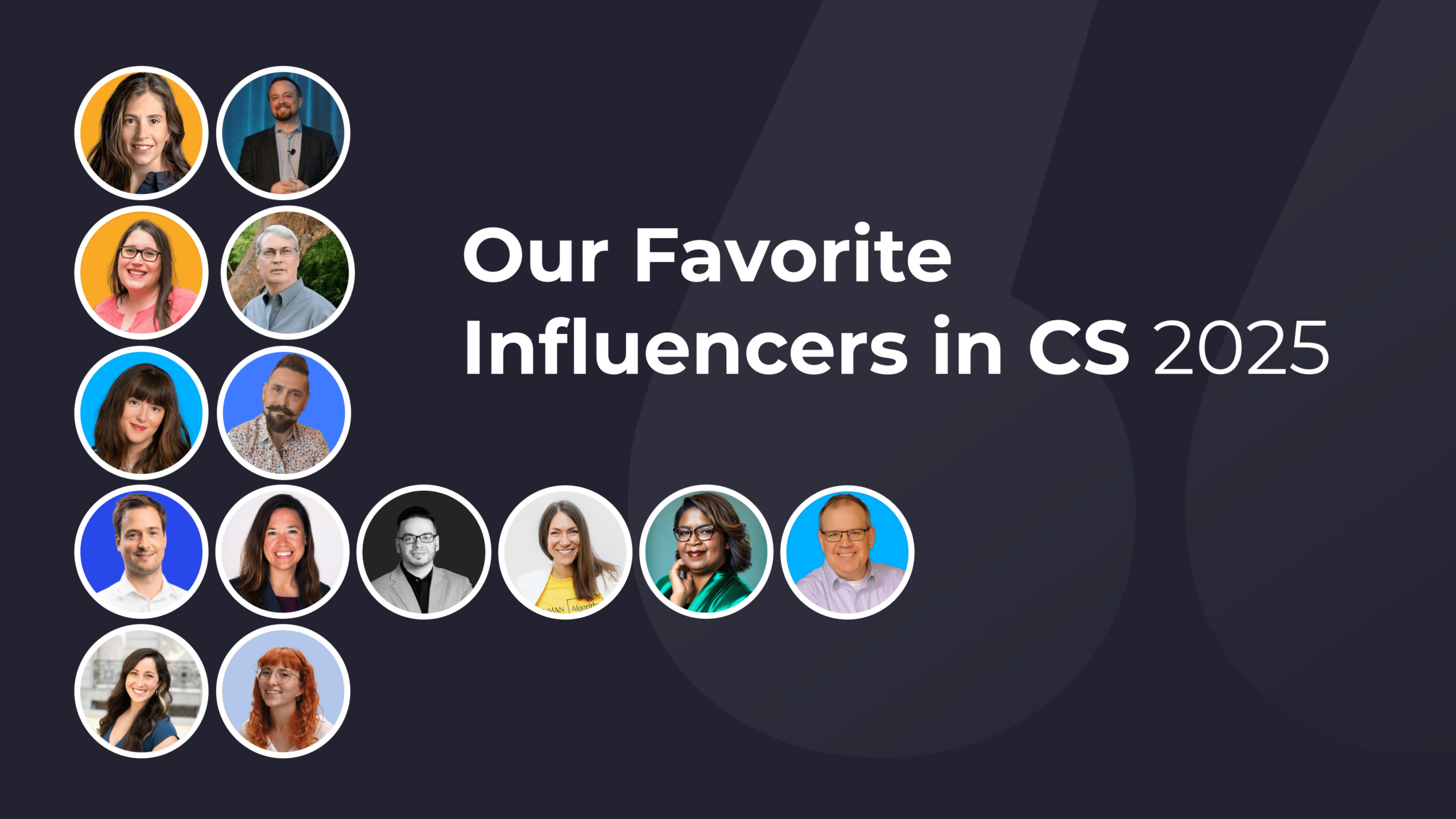
If 2025 is anything to go by, we’re in for an eventful 2026 in customer success. It will be a year where customer success puts a new spin on an old playbook. In the article, we’ll highlight opinions from CS leaders about growing challenges.
Customer Success in 2026 will be shaped by lessons from 2025, including AI misuse, workflow fragmentation, security concerns, and ongoing team strain. The industry is shifting toward context-aware AI, renewed focus on product adoption, and clearer accountability, while CS leaders warn against over-automation, rising customer expectations, poor data hygiene, and losing sight of outcomes.
Success in 2026 will depend on specialization, stronger ownership of customer outcomes, careful AI adoption, and a return to value realization as the core of customer success.
Customer Success Trends in 2026: From Goals to Fears
1. More Accent on Implementable, Context-Aware AI CS Solutions
We’ve seen cookie-cutter LLM implementation, and we’ve seen what true AI-native solutions can deliver. The difference is stark and revealing. With true AI implementation, you are able to:
- Create fully-customizable AI-powered automation playbooks that take account signals into consideration.
- Get context-aware account summaries that include key insights, churn risk, and more.
- View real-time sentiment trends, risk scores, and early warnings with potential suggestions on how to act.
- Talk to AI like a true customer success assistant. When your CSP knows exactly what’s happening with an account, you can directly ask it for an update – simple, no need for extra steps.
In 2026 and beyond, CS will be more aware of how useful their AI solutions actually are and choose accordingly.
By 2026, the biggest CS failure will not be missing AI, it will be scaling the wrong decisions faster. Too many teams use AI to automate activity instead of accountability. More scores, more summaries, more alerts, but no one owns the outcome. AI should make bad assumptions painfully visible, not hide them behind confidence and volume. If your CS system cannot explain why a customer is stuck and what exact action changes that, it is just expensive noise.
– Philipp Wolf, CEO at Custify
2. Renewed Focus on True Product Adoption, Particularly for SMBs
According to recent studies, 52% of SMBs still face significant challenges with product adoption. As we move into 2026, CS teams are already refocusing on better adoption strategies: from more personalized, CSP-assisted onboarding flows to a wider range of native integrations.
CSMs are also taking advantage of new tools to delve deeper into product insights and understand customer lifecycles better. Thanks to increasing experience in handling complex customer use cases, it’s becoming easier for CS as a whole to identify issues before they escalate and act proactively by assisting customers directly (either through automated steps or manual check-ins).
3. Trusting Human Experience while Leveraging AI Systems
With the rapid advancement and market saturation of AI, CS teams are turning to human experience backed by AI assistants and templates:
We have to keep trusting our human experience when building customer and team experiences. AI helps, but it needs a human in the loop, every time. Templates are a good place to start, but they need judgment in application. Advice from peers or the internet, or other training can be wonderful, but it requires discernment for your unique company or scenario. Customer Success is not one-size-fits-all, and that’s actually what makes it great and successful. We can’t try to force everything into one, neat box and expect it to work. Art and science remains.
– Kourtney Thomas, Head of Customer Success at TakeUp
My concern for 2026 is not AI replacing CSMs, it is AI standardizing them. When every team uses the same templates, the same recommendations, the same playbooks, critical thinking erodes. Customer Success only works when someone understands the exceptions, the constraints, and the uncomfortable trade-offs. AI should remove busywork, not judgment. Teams that outsource thinking to systems will still be surprised by churn, just faster.
– Irina Vatafu, Head of Customer Success at Custify
4. Conversation and Sentiment Analytics On the Rise
One key area where we’re seeing advancement in AI-assisted CS automation is sentiment analytics. More and more sentiment scoring and analysis tools are entering the market with interesting, novel ways of tracking customer behavior and emotions across vastly different signals and communication channels. The sentiment analytics market is projected to grow to $11.4 billion by 2030, at a CAGR of 14.3%.
Sentiment analytics appear to be the most useful and ubiquitous implementation of AI across CX and CS workflows and solutions. And with good reason – understanding customers stands at the heart of customer success and experience, and doing so at scale (especially for low-touch engagement models) can be incredibly valuable for all parties involved.
A word of caution, though: AI tools can occasionally make very dramatic judgments about a customer’s situation, so it’s always good to leave CSM notes regarding your accounts. In Custify, our CSP, all accounts can have CSM notes that can override or work alongside other signals.
5. Experience Orchestration: A Holistic Approach to CX
It’s not just sentiment analytics, though. Companies are also benefiting from next-gen infrastructure, modern data architecture, and increased interconnectedness through a more holistic approach to integrations.
All these together have increased experience orchestration. Customer-facing teams are no longer working in silos, isolated from one another or from the company at large. Instead, they are using the tools at their disposal to track vital success metrics, share actionable insights, and ensure visibility for all stakeholders.
6. Ensuring Success Teams Continue to Be Value Drivers
Ensuring Success teams (inclusive of Success, Onboarding/Education, and Support) continue to be value drivers. AI automation has helped in some areas to create space for Success teams to spend more time on value-generating activities. However, the definition of “value” is where Success teams might be struggling. This could range from figuring out how to appropriately assess the quality of an AI-driven workflow, working more cross-functionally, upskilling on product functionality, understanding the principles of values-based selling to guide customers when there are changes in packages or pricing…the sky’s the limit!
– Karen Lam, Director of Customer Support at Top Hat
7. Reorganizing Customer Success and Specialized CSMs
In my company, we had a reorganization of the team for this year, and we attributed accounts depending on the CSM’s strengths.
Now each CSM has a specialty (upsell, support, data analysis, product adoption), so that we focus on what everyone is the best at, instead of having a customer portfolio given to us just regarding MRR, and we will work all together for the different topics that clients have during their contract.
– Ninon Noblet, Customer Success Manager at Click2Buy
Customer Success talks a lot about outcomes, but many teams still avoid technical ownership. In 2026, that will break. Products are more complex, integrations are deeper, and customers expect CS to understand architecture, not just workflows. The danger is turning CS into polite support with better tooling. Strong teams will challenge product decisions early and say no to custom work that creates long-term drag. Weak teams will keep saying yes and slowly drown in complexity.
– Andrei Blaj, Co-founder at Atta Systems
8. Staying Focused on Customer Outcomes
In 2026, the defining CS challenge will be whether highly technical teams can stay outcomes-oriented as products grow more complex.
FDEs and technical CSMs are being pulled deeper into architecture reviews, security conversations, and production-level troubleshooting. That work is valuable, but it’s dangerously easy for CS to become a reactive extension of engineering rather than an owner of customer outcomes.
The teams that win will be the ones that treat technical depth as leverage, not identity. They’ll use it to influence design decisions early, simplify adoption paths, and reduce long-term operational drag for customers. The teams that lose will confuse activity for impact and drown in bespoke support.
In short, technical CS in 2026 isn’t about knowing more. It’s about knowing where and when to apply that knowledge so customers succeed without needing you in the room forever.
– Manuel Harnisch, Fractional CCO and Customer Success Leader at topSERV Fractional
In regulated industries, outcomes are not about adoption curves or feature usage. In 2026, the real CS challenge is restraint. Customers want fewer clicks, fewer alerts, fewer chances to make mistakes. Success is measured by what does not happen, delays avoided, errors prevented, cognitive load reduced. If CS cannot articulate that value, it becomes a reporting layer instead of a strategic function.
– Anca Radosu, Customer Success Manager at Medicai
9. A Time of Trials for Customer Success Leadership
The general sentiment from CSMs over the past year has been one of being stuck:
- Stuck between purpose-led customer success mastery and endless meetings with higher-ups that only drag workflows and do not bring value.
- Stuck between explaining why customer success has value and actually doing the work that delivers that value.
- Stuck between diagnosing customer churn and preventing it through proactive engagement.
- To counteract these tendencies, CS leadership needs to lead with empathy, bring receipts as to the value of their work, and document everything they do.
10. Great Expectations: Customers’ Tolerance Levels Are Decreasing
As CS has evolved, CX has improved, customers have learned to expect more from the companies they do business with, and tolerate less.
[Our focus of CS in 2026 will be] ramping up scaled success for our lower value customers.
– Ben Cook, Head of Customer Success at Beacon CRM
The hardest truth for Customer Success in 2026 is that many problems cannot be fixed post-sale. CS is often asked to compensate for weak qualification and inflated promises. That is not a strategy, it is damage control. Teams that improve retention will do it by pushing back on bad-fit customers and unclear value propositions, even when it hurts revenue in the short term. CS needs veto power, not just responsibility.
– Vlad Bodea, Co-Founder BentoMDM
11. Bare Minimum Is Now Mandatory: Functioning Software with No Bugs
We live in the age of enshittification. More and more software products are falling victim to tightening budgets, haphazard leadership, lack of vision, scope creep, feature creep, bloated and confusing UIs, and many, many bugs. This trend is making customers react more viscerally when something breaks.
Let me explain: when a client chooses to do business with you, they trust you to not fall victim to the same issues plaguing SaaS platforms today. If you do and start repeating this all-too-familiar pattern, it’s doubly disappointing because that customer made a conscious decision to trust you, and you let them down. Regaining that customer’s trust at this stage is next to impossible.
This is where customer success needs to step in and determine precisely what customers expect and what they want to avoid from the very beginning of their relationship. The goal? To instill trust, deliver customer outcomes, and safeguard retention.
12. Observing Data Hygiene Principles
Data hygiene and governance continue to be a cornerstone of good customer success. A single skewed datapoint can easily lead to inaccurate conclusions that snowball into bad decisions and missteps.
For me, still the biggest concern is quality of data, and what I’ve noticed at the CSC summit, a lot of people were also talking about data quality. As if the data is wrong, you can’t do anything with it, and in my company, this is still the biggest challenge.
– Ania Kierczynska, Customer Success Manager at Entirely
13. Back to the Basics of Customer Success
There is one unifier, however, amid such a complex and divisive time in CS. It’s delivering value to customers, the one key function of CS that has not shifted in any meaningful way since the early days.
Customer success leaders and their higher-ups are realizing, or getting reminded, that value realization is still the core principle behind CS. All other efforts – from AI to experience orchestration, from product adoption to sentiment analytics – must serve this fundamental goal.
How to Prepare for 2026 in Customer Success
To better prepare for Customer Success in 2026, here is a set of targeted things you can do:
- Analyze any new AI solution you’re planning to adopt, look for user opinions, and see if it actually does what it purports to do.
- Rethink your product adoption playbooks: see if there are issues, potential improvements, and make changes accordingly.
- See if and how you can use sentiment analytics in your day-to-day customer success workflows.
- Reorganize customer success to ensure you’re focused on customer outcomes and that you’re assigning CSMs based on their specialties.
- Ensure your customer experience stays top-of-mind to prevent the degradation of your product.
Want to take your product and CS to the next level? Schedule a demo with the Custify team, and we’ll walk you through the steps you need to take.