It’s easy to understand why customer relationships are important. We may be working in SaaS, but we’re also typically customers of other SaaS. In fact, because we’re so familiar with this space, we know the kinds of relationships that turn us away from a product, service, or company.
The gist of it is this: connection breeds familiarity, and familiarity sells.
If you’re entirely disconnected from the person or organization behind the products you purchase, you’re less likely to further that relationship by making a new purchase or continuing your subscription.
In this article, I’ll review the renewed importance of customer relationships today and why it’s growing, looking at some hard numbers and studies that analyze current global growth trends and market demands. Then we’ll move to some real-life examples from the diverse world of customer success professionals. You’ll see a wide range of real-world scenarios and what leaders now do differently to improve their customer relationships.
What’s the Importance of Customer Relationships Now?
Customer relationships matter because they increase retention, reduce churn risk, improve expansion likelihood, and make customers more loyal while budgets tighten and the pressure of growing revenue increases.
Amidst an outlook of growing economic uncertainty, where customer acquisition costs have surged 222% over the past 8 years, the importance of customer relationships today seems to be growing exponentially. Existing customers not only provide a stable foundation for the business to continue to exist, but they also act as stepping stones for continued growth.
Customer demands are also simultaneously increasing. Rising inflation leads to more cost-conscious customers, who now increasingly chase better value-for-money deals. Furthermore, as more companies focus on improving customer experience with new AI tactics (among other methods), customer expectations will only continue to grow.
Why the Importance of Customer Relationships Is Growing?
Looking at the overall economic landscape, the importance of customer relationships looks to be growing as a direct effect of a combination of several factors:
- Retention costs less than acquisition. According to the latest estimates from Genesys, acquiring new customers costs between 5 and 25 times more than retaining existing customers.
- Sales cycles have lengthened. It now takes more time for a prospect to become a customer, especially in B2B SaaS. Since 2022, sales cycles have lengthened by 22%.
- Top SaaS perform far better than everyone else. If you’re not a top-performing SaaS already, chances are you’re going to struggle. Recent benchmarks show that if your LTV:CAC ratio is below 3:1, your acquisition costs are already too high. At the same time, top SaaS operate between 4:1 and 6:1.
- Acquisition costs are skyrocketing. Modern buyers do more research and opt for platforms like Reddit to get their information. Pair that with how digital ads are pricing many businesses out, and how organic tactics – such as social media and SEO – are becoming less effective due to the rise of AI, and it quickly becomes clear why acquisition costs jumped by 222% over 8 years.
- Rising consumer demands. Customers today expect and will accept nothing less than exceptional value-for-money. With rising inflation, approximately half of global consumers are now actively more cost-conscious value seekers, a category that now includes 35% of high-income consumers.
- Stagnating growth on a global scale. While pre-pandemic global economic growth averaged over 3%, we have not seen a significant rebound due to compounding world crises, the most recent of which are expected to slow economic growth to 2.5%.
- Growing economic uncertainty. Even before the recent escalating global conflicts, the IMF predicted that the growing economic uncertainty would affect growth.
The world is now dominated by a new doom loop. For every new negative news item that pushes consumers towards the edge of uncertainty, inflation rises, consumers become more wary, spending decreases, growth stagnates, layoffs ensue, and earnings miss their mark. This leads to additional negative stories, which snowball into more uncertainty, and the cycle repeats itself.
Amidst these compounding effects, economic growth remains constrained, marketing tactics become ineffective and unaffordable, and acquisition costs rise, leading existing relationships to become disproportionately valuable. I believe this post sums it up well:
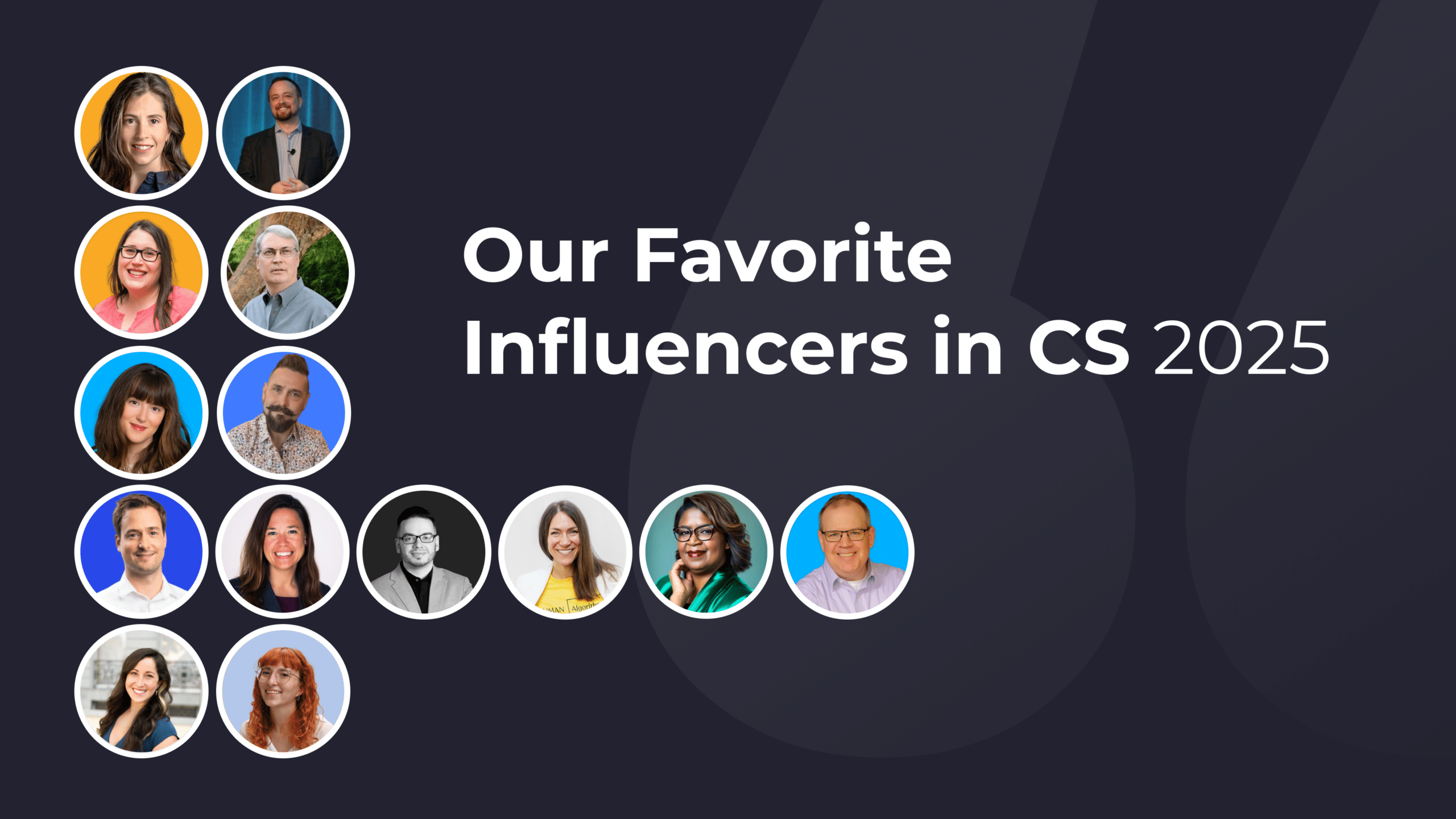
Let’s now turn to what leaders in the customer success space are now doing differently to build stronger, more resilient customer relationships:

How to Build Stronger Customer Relationships – CS Leaders Answer
1. Build an Outcome-based Relationship Building System
One thing I’m doing differently is treating “relationship building” as a system, not a series of touchpoints.
We’ve moved from generic health scores to outcome‑based success plans for each account: clear value milestones, the signals that tell us whether they’re on track, and specific plays that trigger when those signals change. Instead of just asking “are they using the product?”, we ask “are they achieving the outcomes we agreed on?” and make that the backbone of our cadence.
The second shift is using AI to give customers more of us, not less. We automate the busywork—notes, summaries, light reporting—so CSMs have more time for deeper conversations, better discovery, and proactive strategy. When customers feel we consistently understand their context and show up with ideas instead of status updates, the relationship gets much stronger, very quickly.
Gayan Perera, Senior Customer Success Consultant, proSapient
2. Begin by Setting the Right Expectations
In my experience (and not sure it’s really different from what others are doing), setting the right expectations from the get-go is the strongest point.
Whether you’re talking about net-new or existing customers, it never hurts to:
a. Show the value net-news signed up for and build momentum.
b. SBRs/ EBRs/ QBRs for new and existing customers to keep all power metrics surfaced so the customer doesn’t lose momentum, and has clear visibility into next steps, and how the next 6-12 months look like for them.
Point b is usually great for pre-renewal conversations, but also for keeping the momentum at any milestone of the customer journey.
I also enjoy showcasing success stories and testimonials. Here, it all depends on how many industries your software interacts with. The more diverse you can get them, the better for all cohorts 💡A customer advisory board is also a great differentiator from other companies. The CAB is plugged directly into your product roadmap, and you have a voice of your customers chiming into keeping the product or service you’re offering market fit.
Jon Knight, Customer Success Leader, Synder
3. Provide a Tailored Service that Understands Market Realities
I really try to provide a tailored service and be available whenever help is needed. I also make an effort to understand the market so I can follow up at critical moments, creating greater awareness of the customer’s needs.
By doing that and being an active listener, you gain a real understanding of the customer’s situation and build a stronger, more trusting relationship.
Sara Vera-Cruz Quintas, Head of Customer Success, VESSELINDEX
4. Analyze Usage Patterns and Move to Proactive, Signal-based Engagement
Honestly, we stopped treating relationship building as a series of check-in calls and started treating it as a system.
In enterprise AI and agentic search deployments, the complexity is high and customers move fast. By the time you schedule a QBR to discuss a problem, it’s already become a crisis.
What I’m actively working toward is feeding product telemetry directly into a health scoring model , actual usage patterns, query performance, adoption signals , rather than relying solely on what customers tell you in calls. What customers say and what the data shows are often two very different things. These models surface risk and expansion signals before customers even articulate them.
That shift – from reactive check-ins to proactive signal-based engagement, is what I believe separates good CS from genuinely strategic partnerships.
The system creates the consistency. But the human still has to show up – that part never gets automated.
Nanditha Hebbar, Vice President, Head of Delivery & Customer Success for North America, ChapsVision
5. Focus on Real, Data-driven Value and Conversations
A bit of context: I’m a founder managing customers directly in our early days. And interestingly, the learnings from my own account management overlap almost entirely with what my customers (who are CS managers themselves) are experiencing with their customers.
Here’s the reframe that changed things for me: a strong customer relationship isn’t built on coffee chats or dinners. Those are nice, but they’re a reward for value delivered, not a substitute for it.
One of my customers recently told me: “Dhiraj, ever since we started having data-driven conversations with our customers, they show up to calls more consistently and more engaged, and our relationships with them have genuinely strengthened.”
The reason makes sense when you think about it. Your customers have to justify internally what they’re spending and what they’re achieving. They need data to do that: ROI proof points, KPI movement, usage trends. When you bring that to them proactively, you’re doing two things at once. You’re confirming that they’re actually getting the outcomes they signed up for, and you’re making it easier for them to defend your product internally.
That’s the foundation of a real relationship. Once that’s in place, a coffee or a lunch adds the cherry on top, but it can’t do the heavy lifting on its own.
Dhiraj Patel, Co-Founder & CEO, RetainSure
6. Meet Your Customers Where They Are and Be Curious
Meet your customers where they are at, versus forcing them down a playbook/path designed for the “average” customer. There is no magical “average” customer, but everyone designs a process for them. Instead, create guide-rails and then let your CSMs and CSEs do what they should know how to do best, use their curiosity to help customers achieve success as they define it.
Manuel Harnisch, Fractional CCO & Advisor, topSERV Fractional
7. Make Sure Customers Don’t Have to Repeat Themselves
Right now, I’m focusing more on the small moments where trust is usually lost: the follow-up after a call, the risk someone mentioned once, the promise a CSM made and still needs to keep.
A strong customer relationship isn’t built only in meetings, but in making sure the customer does not have to repeat themselves. AI is useful here as it helps keep account context cleaner, summarize long histories across multiple CSMs, and turn conversations into clear next steps. The human part is still the relationship and AI just makes it harder for the team to forget what matters.
Irina Vatafu, Head of Customer Success, Custify
8. Make Customer Relationships Less Dependent on Heroic CSMs
I’m trying to make customer relationships less dependent on heroic CSMs. If only one person knows what is happening in an account, that is not a relationship strategy, but a bus factor with a smile.
Good CS should make the customer feel remembered by the org as a whole, not just their CSM. That means better notes, better account summaries, better follow-up, and fewer surprises before renewal.
The relationship gets stronger when the customer sees the same context, same logic, and same type of customer care every time they talk to you.
Philipp Wolf, Founder & CEO, Custify
9. Bring Customers Into the Messy Middle Earlier
At Atta Systems, we’re bringing customers into the messy middle earlier. Not when the feature’s already polished. Not when the deck looks perfect. Earlier, when the thinking is still flexible.
This simple change allows the conversation to shift. A finished idea gets polite feedback, a rough idea gets useful feedback, and so on.
Customers tell you what would break in their workflow, what their team would ignore, and which part sounds good in theory but dies in daily use. That kind of honesty is where customer relationships become stronger and you start treating them less like rows in a spreadsheet and more like partners in the product.
Andrei Blaj, Managing Partner, Atta Systems
10. Close the Loop Faster When the Work Is Urgent
Since we work in healthcare tech, I’m much more careful with clarity after every customer conversation. Clinic teams need fewer open loops, not extra meetings.
When something affects intake, imaging, scheduling, or reporting, the relationship depends on how fast we translate the conversation into action. Who owns the next step? What changed? What is blocked? When does the customer hear back?
I know this type of customer success isn’t necessarily glamorous, but it helps us follow through. In a busy clinical environment, that’s a big part of what makes the customer feel safe working with you.
Anca Radosu, Customer Success Manager, Medicai
11. Say the Uncomfortable Thing Before the Rollout
I’m doing fewer vague check-ins and more expectation checks.
Since we work in MDM, the relationship is tested during rollout. A policy fails, a device behaves differently than expected, someone asks about compliance, or an IT admin discovers that the real world is less tidy than the demo.
So I prefer to say the uncomfortable thing early. What Bento MDM controls, what the customer’s IT team still owns, what needs testing, where end users may push back. IT teams forgive limits, but they rarely forgive surprise limits.
Radu Scarlat, General Manager, Bento MDM
12. Make Trust Visible in the Payment Flow
In fintech, trust starts when money moves.
Right now, we’re focusing on making payment status, reconciliation, account ownership, and exceptions easier to understand. When a transfer is unclear, customers don’t want a nice update. They want the truth, fast.
For platforms that pay creators, drivers, contractors, or merchants, the customer relationship depends on whether the payment flow feels reliable rather than like a mystery. No chasing. No detective work.
Alex Negru, CEO, SmartIBAN
How Custify Helps Teams Build Stronger Customer Relationships
Strong customer relationships depend on account context. A CSM needs to know what changed, what was promised, what is at risk, and what needs follow-up before the customer has to explain it again.
Custify’s AI-first customer success platform helps CS teams keep that context in one place and act on it with speed and efficiency. Customer relationships do not break in one big moment, but through small misses: a delayed follow-up, a hidden risk, a renewal conversation with missing context, or when customers have to repeat themselves.
With all the context centralized, Custify surfaces hidden signals and helps by:
- Summarizing account histories. Custify AI summaries give CSMs a clearer view of account history, customer health and sentiment, churn risk, recommendations, and next steps.
- Generating automation flows. AI-generated playbooks give teams a starting point for repeatable, proactive customer success processes, such as renewals, onboarding, or risk response.
- Summarizing conversations and context. Custify AI can also summarize lengthy customer conversations and meetings and update account context.
- Suggesting follow-ups. Custify can then suggest follow-up tasks, helping CSMs turn meetings, emails, and Slack discussions into action items.
- Building customer portals. Portals give customers a shared view of key information, progress, tasks, and meeting summaries.
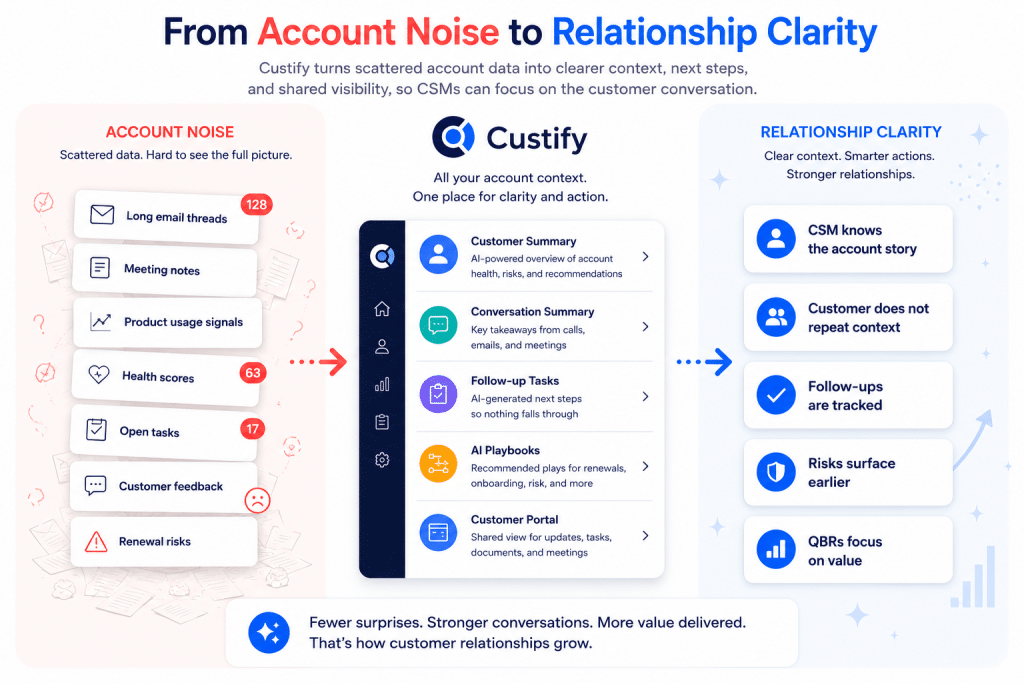
With a powerful, automated, and AI-enabled CSP at their disposal, CSMs can work more intelligently and focus on tasks where human intuition is vital. Through enriched customer context, faster follow-ups, and increased risk detection, your team can turn strong customer relationships into a repeatable CS motion. Reach out to our team to learn more.