Most businesses today, like many consumers, navigate through a maze of subscriptions. If you want to stand out and keep churn low for your SaaS, you need to be smart and build a comprehensive SaaS renewal management plan. That means proving value, showing meaningful ROI, and then having a clear renewal forecasting system in place to handle that as your company grows.
So, in this article, I’ll take a look at SaaS renewal management: what it means, why having it matters in SaaS, how it relates to other business areas, what type of metrics you should look at, and who’s typically in charge of renewals. Lastly, we’ll check out some clear best practices and tools that can get you along your journey to perfect renewal management.
What Is SaaS Renewal Management
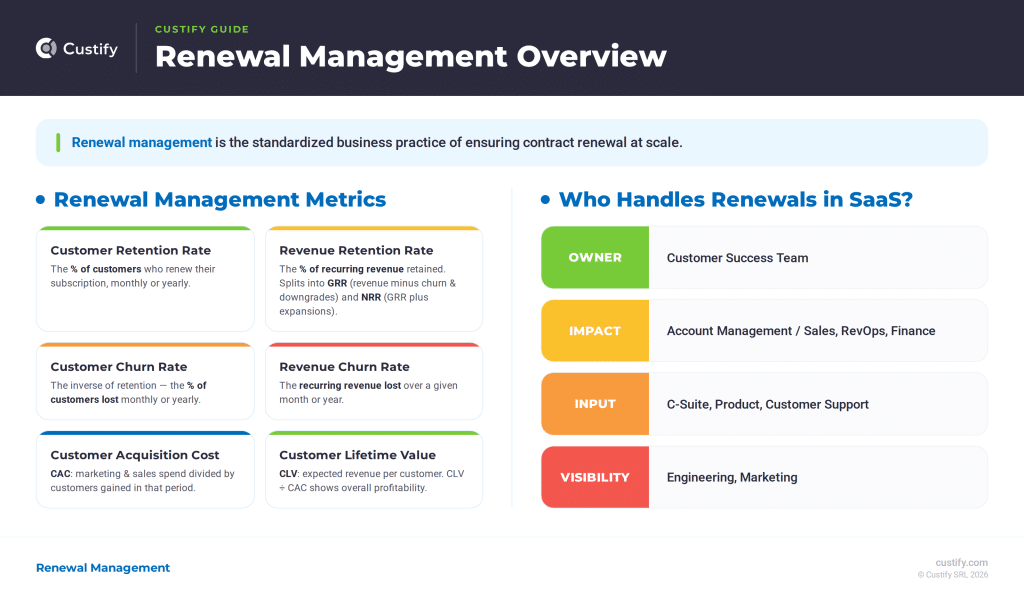
SaaS renewal management is the standardized business practice of tracking, securing, negotiating, and forecasting contract renewals at scale. It implies building a comprehensive, easily scalable process that includes customer service and support, value delivery, automation, proactive engagement, and every customer journey stage from onboarding to upsells and renewal.
Renewal Management in SaaS vs Other Areas
Renewal management is most common in subscription businesses and subscription as a service (SaaS) businesses, yet is in no way exclusive to such companies. However, with the rise in software businesses and online platforms, SaaS companies have led the charge in terms of renewal management best practices in recent years.
Why Do Renewals Matter in SaaS?
The logic is simple – renewals matter in SaaS because they keep the business afloat through a steady revenue stream. The SaaS market can be particularly volatile, depending on segment, with recent SMB benchmarks reporting 4.1% monthly churn and 39% annual churn.
To counteract early high churn rates, the ultimate goal in SaaS should always be growth. However, if retention rate drops and renewals stagnate, the business won’t have a stable foundation to support its growth. As such, if a SaaS business has no process in place to secure renewals at scale, revenue will drop, fiscal uncertainty sets in, and growth stagnates.
Important SaaS Renewal Management Metrics
To accurately track renewals, SaaS businesses typically look at a range of metrics:
- Customer Retention Rate. Tracks the percentage of customers who renew their subscription, either on a monthly or yearly basis.
- Revenue Retention Rate. Tracks the percentage of monthly or yearly revenue that a business is able to retain. This one can be further split into Gross and Net Retention Rate, where GRR tracks base revenue by subtracting churn and downgrades, while NRR adds expansions in.
- Customer Churn Rate. A direct inverse of customer retention rate, customer churn rate tracks the percentage of customers lost on a monthly or yearly basis.
- Revenue Churn Rate. Tracks recurring revenue lost on a monthly or yearly basis.
- Customer Acquisition Cost. Tracks all direct expenses and overhead associated with acquiring a customer. CAC usually includes things like marketing and sales costs over a specific period, divided by the number of customers gained over that same period.
- Customer Lifetime Value. Tracks how much revenue the average customer is expected to bring in. If you divide this by your CAC, you get a ratio that tells you how profitable your business is.
SaaS Renewal Management vs Customer Retention
While the two may seem similar and have similar goals, retention is more about the ongoing effort to keep customers successful and manage customer churn proactively. Renewal management represents the entire process of securing renewals, from forecasting to the actual renewal, involving prep work, negotiation, and completing contract details. Retention efforts have a large impact on the eventual renewal, but are just a part of renewal management, however important.
Who Handles Renewals in SaaS?
Renewals are generally managed by customer success managers together with account managers. While other teams like Sales, Engineering, and your C-suite might have visibility or influence over the renewal process, it’s usually automated and managed through a customer success platform, such as Custify, connected with a billing platform like Stripe or Chargebee.
CSMs usually set up their CS dashboards and automations to proactively check accounts a period of time before renewal and notify them of any issues that might harm renewal prospects. Finally, as more CS platforms integrate AI agents, the process of proactive engagement for renewal is becoming smoother and more streamlined as AI agents are able to identify signals faster and may even spot signs that humans can miss, allowing CSMs to intervene with more speed and efficiency.
What Are Some SaaS Renewal Management Best Practices?
1. Follow Clear Customer Journey Stages
To ensure effective renewals at scale, your SaaS renewal management process needs to follow clear stages. Fortunately, one such path exists already in your organization: it’s called the customer journey, and you’d be surprised how well the renewal process can fit onto it.
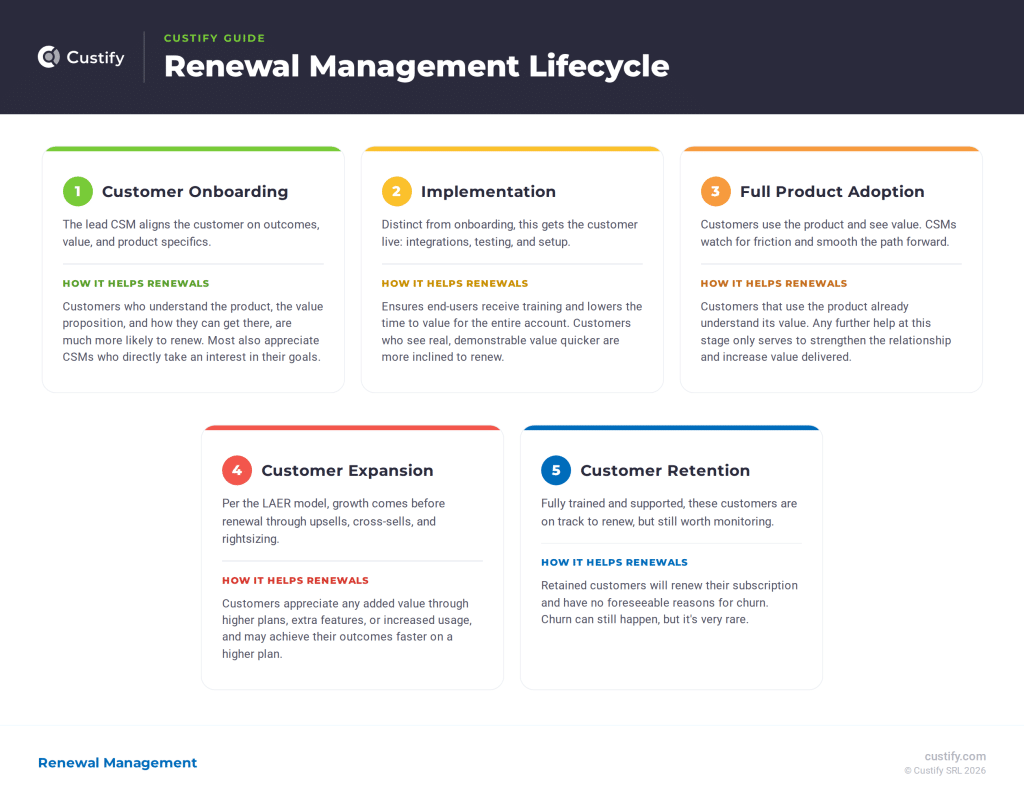
Build your renewal process lifecycle along key customer lifecycle stages:
- Customer Onboarding. Ensures customer alignment on outcomes, value expectations, and product specifics. This stage is typically handled by the lead CSM who works side by side with the client to move them forward towards adoption.
- How It Helps Renewals: customers who understand the product, the value proposition, and how they can get there are much more likely to renew. Most also appreciate CSMs who directly take an interest in their goals.
- Implementation. Implementation is a distinct process from onboarding, particularly in SaaS. It has to do with getting the customer up and running with the product, facilitating integrations, and performing tests.
- How It Helps Renewals: ensures end-users receive training and lowers the time to value for the entire account. Customers who see real, demonstrable value quicker are more inclined to renew.
- Full Product Adoption. The adoption stage is where customers have started using the product and are achieving value through it. This stage is where CSMs need to be on the lookout for any potential issues, stepping in to reduce friction, enable progress, and smooth out the customer’s journey towards their goals.
- How It Helps Renewals: customers that use the product already understand its value. Any further help at this stage only serves to strengthen the relationship and increase value delivered.
- Customer Expansion. Growing your accounts should come before renewal, as we’ve seen in our review of the LAER model for customer success. Expansion is the stage where you attempt upsells, cross-sells, or rightsizing tactics. In some cases, lower-tier subscriptions can actively impede customer value achievement, so custom plans could be needed to ensure they get all the mandatory features and stay within their budget constraints.
- How It Helps Renewals: customers appreciate any added value through higher plans, extra features, or increased usage, and may achieve their outcomes faster on a higher plan.
- Customer Retention. Customers who’ve reached the retention stage have already received most of the possible training and support, and are on the right path to renewal. Monitoring should still be done to ensure nothing negatively impacts their progress.
- How It Helps Renewals: retained customers are more likely to renew their subscription and have no foreseeable reasons for churn.
2. Build a Repeatable 120-Day SaaS Renewal Timeline
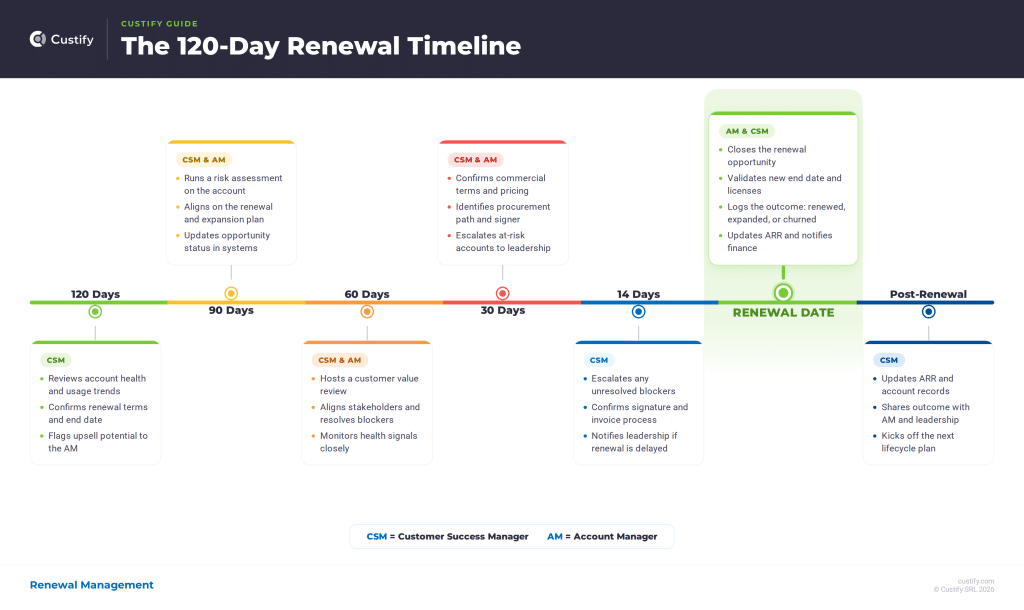
Once you have clearly defined your customer journey stages and related renewal best practices, build a repeatable renewal management process. I recommend using a clear 120-day SaaS renewal timeline that includes:
- What to do 120 / 90 / 60 / 30 / 14 days out from renewal
- What to do on the day of the renewal
- What to do immediately after and in the weeks / months following renewal
Here’s an example of a customer-success-focused renewal timeline:
3. Automate SaaS Renewal Management as Much as Possible
Using modern software solutions, such as a customer success platform, CSMs can automate the renewal lifecycle and help customers pass smoothly from one stage to the other by surfacing risk, standardizing renewals, and reducing manual work. The advantages of using a CSP for SaaS renewal management automations are:
- Full Data Visibility. CSPs often act as a centralized source of truth for customer data.
- Advanced Automation Capabilities. CSPs already offer a wide range of possible triggers, actions, dependencies, and other automation options. Many of these are specifically designed to facilitate renewals.
- AI-native Workflows. CSPs like Custify offer a full suite of customer success AI agents that can help monitor customer sentiment scores and stakeholders and automatically inform the lead CSM of any sudden changes.
How to Automate Renewal Management?
Automating renewal management can be done in a few simple steps:
- Centralize Data. Gather all your customers’ data in a single platform that can help you orchestrate renewals.
- Determine Flows and Triggers. Figure out what you want to automate, what the triggers are, and what should happen for each automation flow.
- Automate Communication. Ensure your customer communication channels are integrated into your automation solution. Then you can simply add steps to seamlessly send messages directly to your customers’ preferred channels, with pre-approved messages or context-aware, AI-drafted ones that can be approved on a case-by-case basis.
- Distribute Tasks. Task distribution is another automation option that can unlock new efficiencies. Simply create and assign tasks programmatically.
- Sync Invoicing. Lastly, make sure your automations also cover contractual changes by integrating your invoicing and payment system. Automating contract changes and financial record updates can help save time and deliver value to customers faster and more efficiently.
Examples of Automated SaaS Renewal Management Actions
| Trigger / condition | Automated Action |
|---|---|
| Upcoming renewal in 90 days, low health score (<70) | Create retention tasks, notify lead CSM, start playbook for renewal risk |
| Upcoming renewal in 60 days, high health score (>80) | Create expansion tasks, notify lead CSM, begin playbook for upsells / cross-sells |
| Customer champion has left or changed | Flag stakeholder risk, notify lead CSM, begin relationship building playbook, gather ROI proof |
| Overdue invoices before contract renewal | Draft email reminders, notify CSM and Financial, start billing reminders playbook |
4. Manage Customer Escalations and Support
The next step to a proper SaaS renewal management pipeline is to do the actual work of delivering value and serving your customers. All the automated processes in the world won’t save your accounts from churning if you don’t pay enough attention to their support requests and escalations.
- Ensure your support team is trained to handle customer escalations.
- Loop in customer success to help manage advanced issues and approvals.
- Support customers throughout their lifecycle: all customer requests should be taken seriously, regardless of customer journey stage.
By working directly in your customer success platform, you can lower the load on your customer support team and proactively implement solutions, either by having CSMs manually step in, or by allowing AI agents to directly try out fixes for specific, lower-stakes customer issues.
How to Implement Proactive Renewal Management?
Here are a few easy methods to preemptively secure renewals during a customer’s journey:
- Monitor Accounts and Gather Data. Specifically, you’re looking for data on customer churn in general, including sentiment scoring, churn likelihood, previous accounts that have churned, and product signals that can be directly tied to churn.
- Set Up Alerts and Engage. With all the data regarding churn signs, build automations that quietly look for those signs among your accounts. Then, add in logical next steps, such as:
- Engaging with the account
- Implementing pre-approved fixes
- Documenting all customer engagement activity
- Notifying the lead CSM
- Send Proactive Product Update Messages. You can also be proactive about new product features and updates, ensuring customers don’t get caught by surprise when an update hits.
- Proactive Billing Emails. Lastly, but maybe most importantly, you can also prevent a good amount of involuntary churn due to billing issues by sending out renewal reminders, expired card warnings, and dunning emails relating to older, overdue payments.
SaaS Renewal Signals and Recommended Actions
Sometimes account signals can have a very clear impact on your renewal prospects. The following is a breakdown of simple renewal risk signals and how to respond to each.
| Signal | Example | Why it matters | Recommended action |
|---|---|---|---|
| Product usage | Usage dropped by 30% | Churn risk | Manual CSM review and check-in |
| Health score | Global health dropped from 85 to 60 | Negative account metrics | Run playbook for at-risk accounts |
| Customer support | 3 escalations left unresolved in queue | Poor customer experience | Add note and escalate to lead account CSM |
| Stakeholder update | Champion left the company | Severe customer relationship risk | Nurture new relationships, redemonstrate value add |
| Sentiment score | Multiple contentious calls and emails | Hesitancy at the moment of renewal | High-level, CSM-led internal discussion |
| Monetary | Downgrade or consistently smaller invoices | Lower budget leads to low usage & renewal risk | Rightsizing conversation with champion |
| Customer value | Missed customer outcome targets | Low ROI can lead to renewal hesitancy | Trigger value recovery playbook, notify lead CSM |
| Market | Press release or news item about layoffs | Lower budget, tech stack reevaluation, churn risk | Account review, with stakeholder mapping |
5. Develop an Outcome-driven, Customer-first Approach
Above all, CSMs should lead the SaaS renewal management effort with purpose, making sure all stages are outcome-driven and customer-first, and all internal teams, particularly customer-facing ones, are aligned on those outcomes. That means:
- Full alignment on customer goals during the onboarding process.
- Outcome-driven implementation, facilitating platform setup in accordance with stated goals.
- Keeping customer goals front and center during all customer interactions.
- Holding QBRs and EBRs to periodically check on progress towards customer goals together with the client and relevant stakeholders.
- Demonstrating value addition early on during the customer’s lifecycle and continuing to add value wherever possible throughout it.
6. Follow a Renewal Forecasting Model
Forecasting is a key part of SaaS renewal management. It helps predict revenue based on how many current subscriptions will renew, expand, downgrade, or churn over a specific future period (usually quarterly).
Forecasting moves your renewal process from reactive to proactive by factoring in historical account data and comparing it against current customer signals.
To build a renewal forecasting model:
- Gather all the renewal information you’ve compiled up to this point, with particular focus on historical churn and retention signals.
- Analyze patterns either manually or with AI and determine which signals are most likely to lead to churn.
- Compare these signals against your current account data and see the evolution of your accounts and renewals over the last quarers.
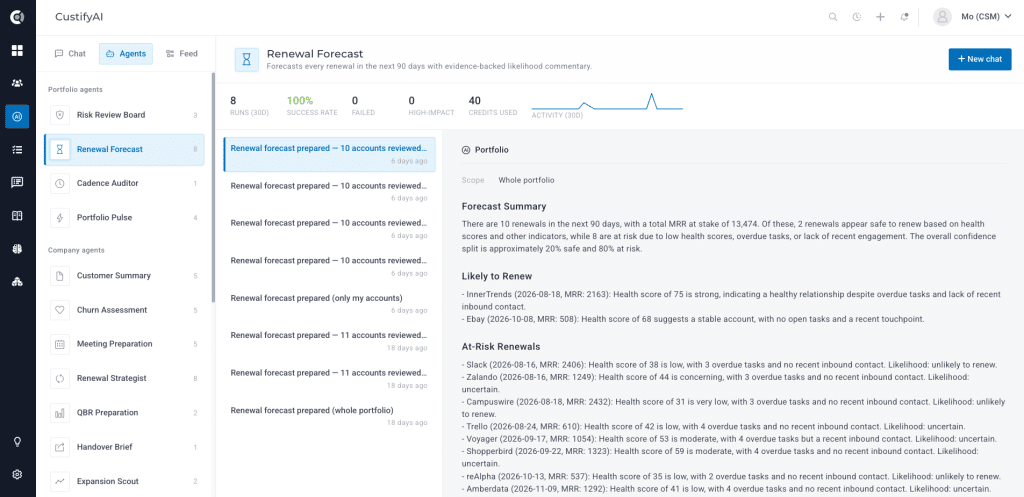
- Build a forecast model for the following quarter(s) based on your findings and how accounts have been evolving. You can manually compare health scores over time for your entire portfolio or use an AI renewal forecasting agent to do it automatically.
Examples of SaaS Renewal Management Tools
1. Customer Success Platforms: Custify

Custify is a customer success software tool that serves as a central hub for SaaS renewal management. From the fully customizable dashboards to the extensive health scoring system, complex automation engine, shareable customer portals, and advanced AI agents, every feature is perfectly tuned to keep your customers happy and your renewals steady.
Key Features for Renewal Management:
- Custify AI. Our new AI agents can assist you directly in our platform or on Slack.
- Renewal Forecast Agent. Get a complete breakdown of renewal prospects for your entire portfolio or specific accounts.
- Churn Assessment Agent. See how likely the customers in your portfolio are to churn.
- Customer Health Agents. Always-on agents that monitor your customers and surface churn signals early.
- Market Analysis Agents. Keep an eye out for press releases, headcount changes, champion changes, important news, or other external, market-influenced reasons for churn.
- Agentc Teammates. Talk directly to Custify AI, and it will automatically decide which agents to use to complete your request.
- Customer Portals. Build custom, white-label, shareable customer portals to share with your customers during QBRs, allowing you to align on lifecycle progress, value realization, current tasks, and upcoming meetings.
- Automation Engine. Custify’s automation engine can quickly generate engagement playbooks using simple prompts. Triggers range from simple health score changes to complex calculated metrics, AI sentiment score changes, and more.
Never get blindsided by churn again. Custify keeps you aware of your customers’ activity, surfacing hidden risks and acting on them before they spiral out of control.
2. Account and Billing Tools: Stripe
Stripe is an account and billing platform that helps automate the entire subscription renewal lifecycle, sending invoices, dunning notifications, automatic card updates, and more. To effectively manage SaaS renewals at scale, billing platforms are not simply good to have; they are almost mandatory.
Key Features for Renewal Management:
- Automated invoicing. Stripe generates invoices and automatically charges your customer on a fixed schedule.
- Dunning management. Stripe not only sends out dunning emails, but also uses machine learning to reattempt payments at the correct time.
- Automated card updater. Stripe syncs with all major credit and debit card networks and updates details for expired or replaced cards.
- Tax and compliance. Applies local sales taxes and adheres to local security policies by default. Sales tax software like Sphere can also help streamline tax calculations and compliance across jurisdictions.
3. CRM Platforms: HubSpot
HubSpot can also assist in your efforts to manage renewals at scale. You can use dedicated renewal pipelines to automatically trigger actions and tasks relating to contract renewals. While not as advanced as a customer success platform, HubSpot can be a good starting point and can then seamlessly integrate with your CSP to feed accurate renewal data points and help you get your renewal process in check.
Key Features for Renewal Management:
- Renewal Pipelines. Allows you to separate ongoing contracts and sales deals based on renewal timelines.
- Automated Workflows. Generate renewal tasks months in advance from the moment a customer signs and a deal is won.
- Tracking Contract Dates. Allows you to assign contract end dates directly in the customer records and pass on that information to your CSP or other renewal management platform.
- Revenue Forecasting. Tracks renewals and monthly recurring revenue, signaling revenue churn, retention rates, and any unexpected changes.
Let Custify Help You Keep Renewals In Check
Struggling to maintain visibility on customer renewal lifecycles? Custify can provide full renewal forecasts whenever you need them directly on Slack or in the platform itself. You can also track churn risk and other relevant health scores directly from your Custify dashboard.
Reach out, and our team will guide you through our extensive SaaS renewal management features.