Strategic account planning involves building internal, account-specific plans for your top customers. Account plans typically include elements such as stakeholders, desired outcomes, current outlook, and upcoming tasks.
It’s easy to conflate strategic account plans with other, similar customer success tactics or plans, such as the joint success plan or QBR (quarterly business review). However, they are not the same, as I will explain further down.
This guide covers the eight elements of a successful strategic account plan, the process of creating one, and ends on a worked example built on a clear template I prepared, which I will also share with you. We’ll also look at the current state of strategic account planning, drawing on testimonials from customer success industry leaders, including their take on efficiencies unlocked by AI. We’ll then end on mistakes to avoid and tools that can help in building strategic account plans.
What Is Strategic Account Planning?
Strategic account planning is the business process of preparing and following internal account plans for key strategic, usually high-value customers. The tactic combines customer data, value realization, and customer engagement to enable customer retention, growth, and renewals.
While the head of CS generally orchestrates the account planning strategy, specific account plans are typically owned by the lead CSM for each account, as they have access to most data points and customer knowledge needed to build a successful plan. A customer success perspective also helps grow accounts, as CS generally owns the post-sale part of the plan: adoption, value realization, retention, and renewal.
A meta-analysis of strategic planning shows that the process improves organizational effectiveness and performance across both private and public sectors, on an international level. However, of the newly unlocked benefits of strategic account planning, a few stand out:
- Helps create goals and metrics for customer success. Approaching every account with a clear plan in mind will help CSMs get a better picture of the value and outcomes their customers are after and how to measure success.
- Proactively address client needs. Built into the framework of customer success, proactivity is a simple customer engagement concept that has CSMs reach out before customers escalate issues, sometimes even anticipating their needs. When building strategic account plans, CSMs can easily spot churn precursors and common friction points within their customers’ journey.
- Promotes long-term retention and growth. The main goal of an account plan is to deliver value and grow accounts. Creating a coherent, buttoned-down strategy of building account plans at scale supports increased retention and account growth.
Strategic Account Plan vs Joint Success Plan vs QBR
There is some confusion between strategic account plans, joint success plans (which I’ve covered before), and the traditional quarterly business reviews that we’re used to in customer success.
The simplest way to tell them apart: strategic account plans are internal and focus on candid assessments of your accounts. Joint success plans are shared with customers and are strategic collaborations. Quarterly business reviews are simple meetings where customers and their assigned CSMs review outcomes and progress towards them (including, if applicable, their progress through the joint success plan).
| Strategic Account Plan | Joint Success Plan | Quarterly Business Review | |
|---|---|---|---|
| Audience | Internal: CSM, account manager, CS leadership | Shared with the customer | Customer sponsors and users, in a meeting |
| Owner | CSM or account owner | CSM with the customer's counterparts | CSM, with an account manager or executive sponsor when relevant |
| Purpose | Plan account retention and growth | Align on customer goals, resources, strategy, risks, and tasks | Review customer progress, value delivered, health, task progress |
| Internal Signals (SWOT, churn risk, sentiment score, etc.) | Yes | No | No |
| Review Schedule | Daily / Weekly / Monthly | During check-ins or reviews | Quarterly |
| Outcomes | Enabling customer outcomes, success, and growth | Joint progress towards customer goals | Status of customer value realization and next steps |
Who Owns Strategic Account Plans: Customer Success, Sales, or Account Management
It’s generally accepted that the lead customer success manager (CSM) for an account owns the strategic plan for it, especially when the desired outcomes are customer success (CS), retention, and growth.
Account managers and sales reps might contribute commercial context and assist in expansion efforts, or in some cases lead the plan (when the CS function is non-existent, incipient, or has limited resources).
Lastly, customer success leaders tend to keep an overview of the portfolio and determine how the strategy is executed across the portfolio. An executive sponsor can also give you an edge over the competition: a research paper from SAMA and Columbia University found that only 52% of organizations have a formalized executive sponsor program.
| Function | Role in Strategic Planning | Owns |
|---|---|---|
| CSM | Health, usage, adoption, sentiment, renewal date, open tasks | The plan itself and the retention/expansion outcome |
| Account manager / Sales representative | Contract history, commercial relationships, white space | Expansion pursuit and negotiation |
| Support and product | Open tickets, feature requests, roadmap commitments | Follow-through on value delivery and customer goals |
| Executive sponsor (internal) | Executive-to-executive relationship | Escalation and sponsor outreach |
| Head of customer success | Portfolio view across accounts | Which accounts get a plan, and the review of top accounts |
What Goes Into a Strategic Account Plan?
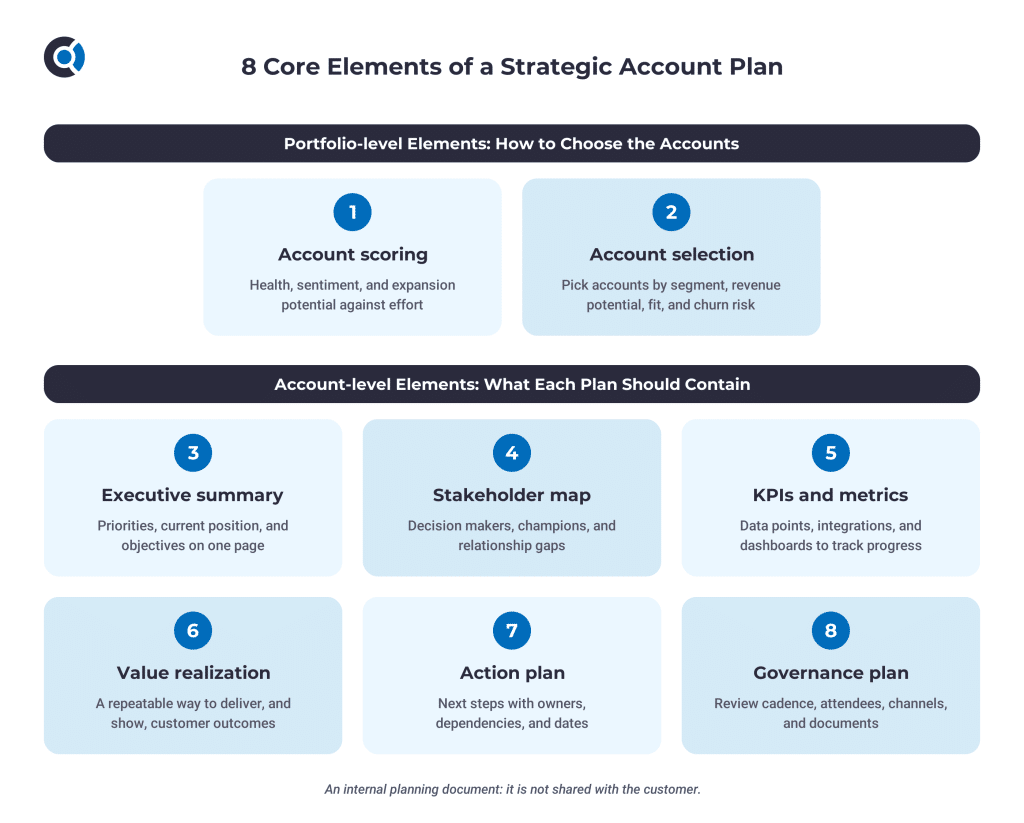
In brief, a strategic account plan contains the following elements: executive summary, stakeholder map, KPIs and metrics, value realization, action plan, and governance plan.
On a broader, portfolio level, you must also consider an account scoring system and an account selection system.
Portfolio-level Elements: How to Choose the Accounts
- Account scoring system. Meaning sentiment scoring, expansion scoring, simple health scoring, or other, or all at the same time. The goal is to see the potential of an account as well as get an idea of the amount of work that needs to be done to get the account to renewal and growth.
- Account selection system. A clearly defined method of selecting accounts to execute strategic plans for (by specific criteria such as segment, revenue potential, strategic fit, growth potential, churn risk, and SWOT analysis). While selecting accounts, aim to get a clear picture of each account, including ongoing tasks, dependencies, and owners.
Account-level Elements: What Each Plan Should Contain
- Executive summary. A summary of the chosen account’s strategic priorities, the company’s position, and objectives.
- Stakeholder map. A map of stakeholders is required for strategic account planning to work. A single champion puts everything at risk. Gartner recently indicated that B2B buying groups range from five to 16 people – so even if retention groups can be smaller, one champion will clearly not be enough for any serious renewal conversation. Stakeholder maps aim to clarify:
- who else in the customer’s org has decision power
- who else do you have a relationship with
- which relationship can be further developed to ensure mutual success
- KPIs and metrics. All the necessary data points to track the progress and success of your strategic account plan. Determine and secure necessary integrations. Ensure data visibility across stakeholders. Set up customer success dashboards.
- Value realization process. Use a value delivery system that works at scale and can be applied to specific account scenarios, goals, and outcomes. Simply make customer outcomes part of your regular process with any account.
- Action plan. The value delivery process then helps you come up with a clear action plan for everyone involved. When applying the method to your selected accounts, everyone should have a straightforward list of next steps, upcoming tasks, and dependencies.
- Governance plan. Includes QBR/meeting/review schedules, attendees, communication channels, and necessary documentation.
How to Develop Strategic Account Planning with Customer Success Built-in
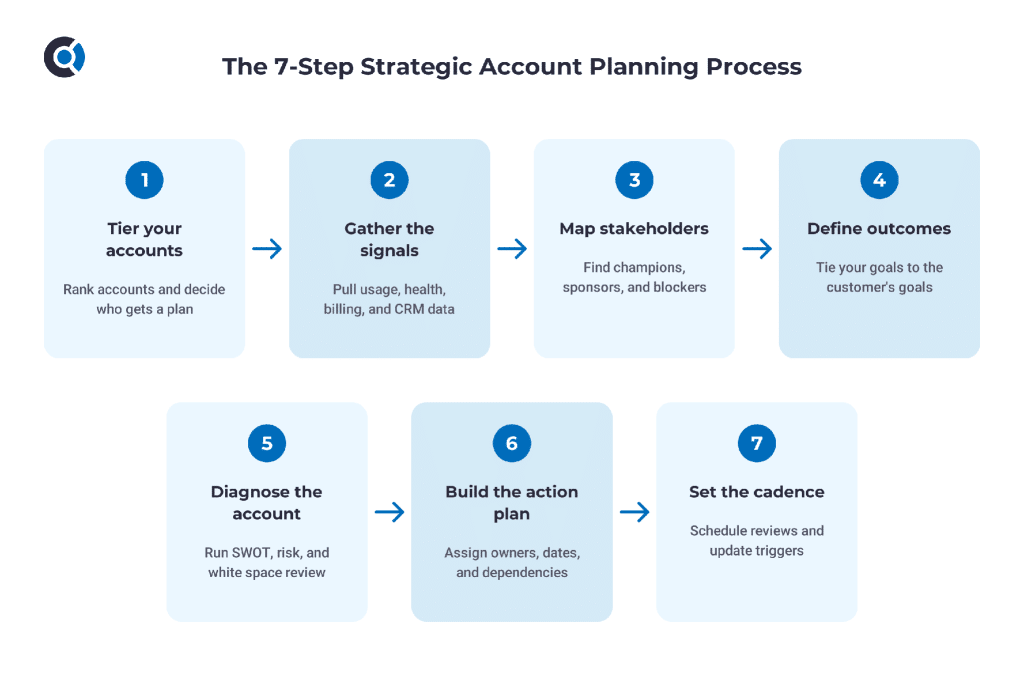
Strategic account planning involves seven core steps: tier your accounts, gather the signals, map stakeholders, define outcomes, diagnose the account, build the action plan, and set the review cadence.
1. Tier your accounts and choose who gets a plan
Use the agreed-upon scoring system to tier your accounts. Then either work on account segmentation to obtain clearly-defined cohorts, or apply journey orchestration to your entire portfolio. The end result is simple: you can clearly tier your accounts, from high-touch, high-ARR, and best-fit customers to retained, low-touch, low-ARR clients.
Your account selection system should tell you where the threshold is between accounts that receive full strategic plans and the rest.
2. Gather the signals
If your customer success platform is set up correctly, you might already have all the needed information in one dashboard. Regardless, once you know who you’re building strategic account planning for, you need:
- Full visibility into product usage
- Complete set of thought-out customer health scores
- Billing and account data
- Progress towards value realization
- Other customer success metrics and notes (such as custom CSM ratings and notes)
3. Map stakeholders
Then, take the time to determine your stakeholders for each strategic account plan. Stakeholders include:
- External stakeholders. When most CSMs speak of stakeholders, they’re referring to the ones inside the customer’s organization. This includes the account champion, key decision-makers, and other contacts within the company.
- Internal stakeholders. It’s common to overlook internal stakeholders. However, your customer success team doesn’t work in a vacuum. Mark down anyone in your organization that has a direct stake in the success of the account. Examples include: account manager, sales rep, CEO, other CSMs.
4. Define outcomes
For each strategic account plan, aim to set two to three clear outcomes that would make customers happy. These could be either intermediate value additions as part of the customer journey, or they could be the ultimate goals of the customer as they choose to do business with you. The important thing is that they are real value adds, not something vague or resembling value.
Then, connect these outcomes to your own internal goals for those accounts – typically retention and growth – represented through clear, measurable targets. You should then know exactly what efforts would result in the most progress towards those targets. Not only that, but through the strategic planning framework, your team will also already be on the same page and know what actions to take.
5. Diagnose the account
Accounts may get a strategic plan at different stages of the customer journey. Some may just be starting out with you – which is ideal since you can then plan their journey meticulously. Others may be halfway through their journey and need a full diagnosis of their progress. To perform an account diagnosis:
- Gather all the facts: account information, the stakeholder map, the customer outcomes, and the full sets of customer data you have access to.
- Begin the review: look at a SWOT analysis, determine the churn risk, build a white space analysis, generate a sentiment score, set up advanced calculated metrics and health scores, ask relevant CSMs for their honest input.
- Diagnosis: analyze the results together and diagnose where the customer is and what you could do about it.
6. Build the action plan
Any account diagnosis is only as useful as the actions it triggers. Take all the outcomes, risks, and opportunities identified and determine the exact actions you can take for each.
- A value realization plan will help you define a path towards customer outcomes.
- A risk assessment matrix can tell you what to do to alleviate the most impactful and likely risks, while dismissing ones that are not likely to happen.
- An expansion strategy can help you leverage untapped opportunities proactively, anticipating the moments customers will need extra features and stepping in with a personalized offer when they happen.
7. Set the cadence and keep the plan up to date
Lastly, any worthwhile strategic account plan will have a clear cadence for reviews and updates. Plans that stay the same and get followed blindly will quickly become stale and may lead to unwelcome surprises from clients – think poorly timed upsell messages, unforeseen churn, lost champions, etc.
So: set a clear timeline for reviews – either based on milestones, time, or just triggered by specific customer actions. When the review notifications trigger, go in with a clear view of your accounts and update the plan, essentially repeating the steps on this list until the new version is based on customer truth.
Strategic Account Planning Example + Template
The following is a hypothetical example of a logistics SaaS client. I went with a simple outcome and simplified account details to illustrate the layout and main scope of a comprehensive strategic account plan.
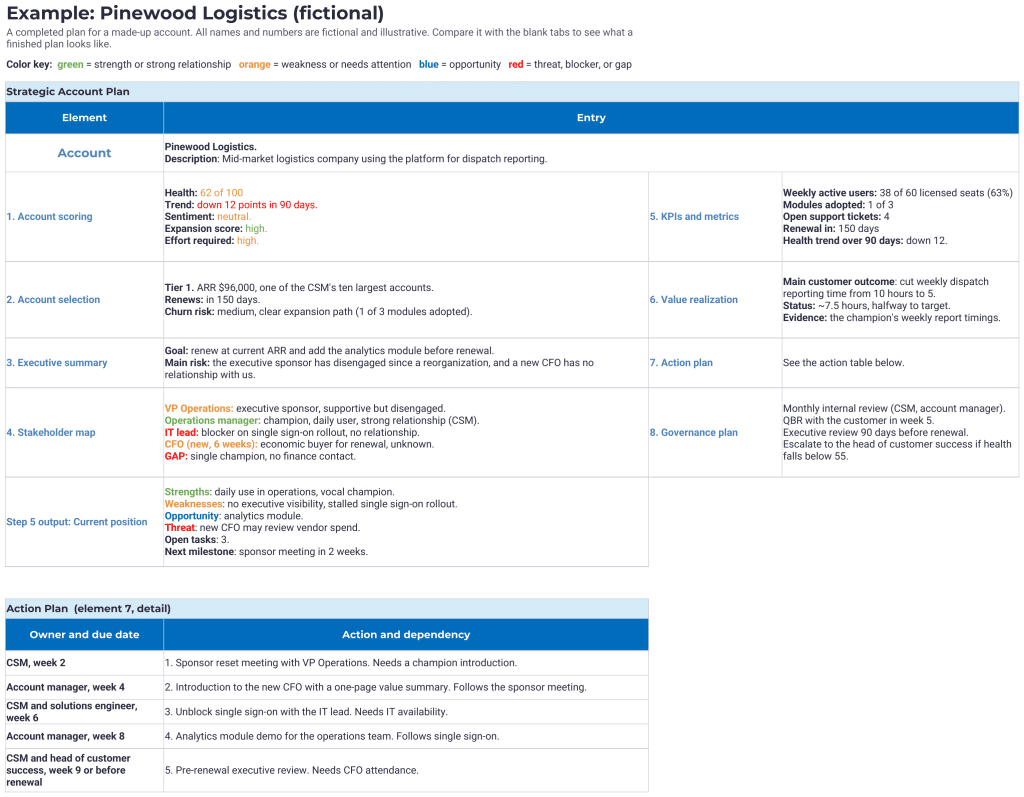
You can manually review the example yourself, as I included it as a separate sheet in the Strategic Account Plan Template linked below. Notice that it follows the clear logic outlined above – from selecting the account to mapping stakeholders, checking account metrics, understanding customer outcomes, the account’s current status, and the corresponding action plan.
Strategic Account Planning Template
I prepared a full spreadsheet to act as a template for your strategic account planning initiative. Every sheet contains various elements that go into a strategic account plan (which we’ve listed previously). The template is designed so you can fill in the details of your accounts and get a clear picture of your stakeholders, SWOTs, and churn risk through some simple formulas.
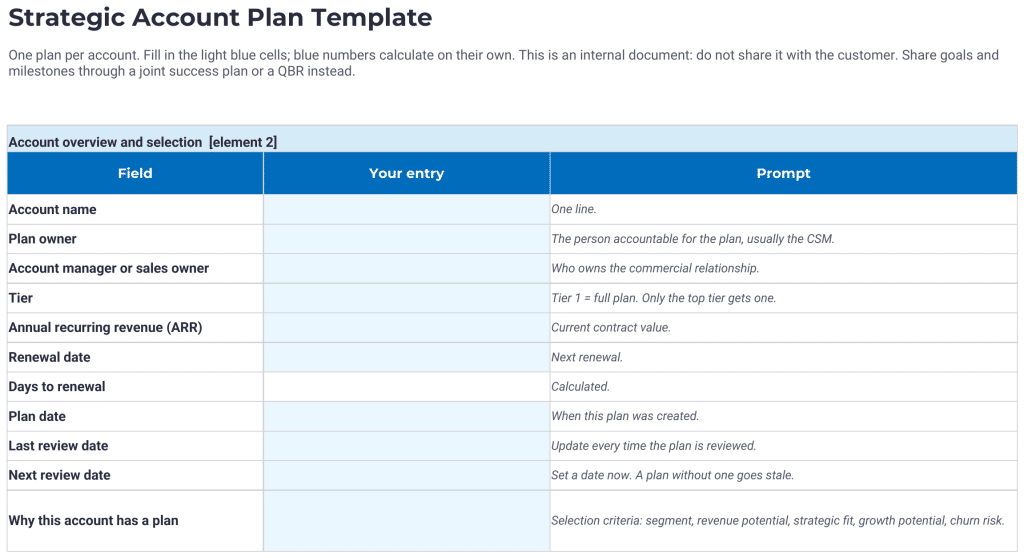
Make a copy of this strategic account plan template to use it.
One of the fastest ways to apply this to your accounts is by integrating the Custify MCP with your preferred AI model.
Why Strategic Account Plans Fail
Most strategic account plans that fail do so because of one or more of the following:
- Lack of updates. A common reason why account planning fails. The fix: set a review date and triggers that prompt updates (such as champion change, health drops, renewal window approaching).
- No ownership. When the entire plan does not have a person in charge, it can quickly lead to confusion, lack of resources, lack of accountability, and overall slow progress. The fix: determine one owner for each plan and separate owners for each named action in each plan.
- Single-threaded accounts. Accounts with only one champion on the stakeholder map are often most at risk. The fix: flag single-threaded accounts and attempt to develop additional relationships with other stakeholders.
- Not backed by data. Out-of-date customer health data can plague your strategic account plans just as much as any of the previous issues. The fix: pull metrics live from your customer success platform or data warehouse, or update numbers on a set schedule.
- The plan is too broad. Applying a single strategic account planning strategy to your entire portfolio or even a segment of customers can be a recipe for confusion. The fix: tier accounts and customize strategic plans either for the top tier level or per account (depending on your engagement model).
- Visibility and alignment issues. When the team doesn’t have visibility into the strategic account plans, it can create confusion and lead to misalignment on customer goals. The fix: share every element of the plan with internal stakeholders and ensure everyone is aligned on next steps.
- The plan ignores key milestones. Sometimes, CSMs may be lost in the process of building out a strategic plan and disregard fast-approaching renewal dates. The fix: anchor the plan firmly on renewal dates and ensure related risks are represented and have planned contingencies.
CS Leaders Answer: How Is Strategic Account Planning Changing and How Does AI Help?
I aimed to dig deeper into how strategic account planning has evolved, especially since AI has become embedded into a majority of business processes over the last couple of years. The answers varied, but are, to my mind, quite informative as to the process as a whole:
1. Advanced Customer Touchpoint Planning, Assisted by Automated Execution and AI Performance Analysis
The biggest change has been moving from ad hoc customer contact to a structured and tier-based system of customer touchpoints.
We’ve defined which touchpoints each customer should receive, when they should happen, and how follow-ups work across onboarding, performance reviews, renewals, and NPS or risk signals.
Each CSM receives tasks in HubSpot, supported by ready-to-use, personalised email templates based on the specific event and customer context. Follow-up sequences stop when a customer replies or books a meeting.
Customer tiers determine the level of engagement, ensuring the right balance between personalised support and scalable processes.
Automation ensures consistent execution, while AI-assisted performance analysis helps identify meaningful opportunities for customers.
The expected outcome is better portfolio coverage, fewer missed touchpoints, earlier risk detection, and more time for CSMs to focus on conversations that create real value.
– Tim Mushumba, Customer Success Manager, Hypernode
2. Unlocked Efficiency and Faster QBRs, while Enterprise Accounts Keep Steady
What I’m seeing with my customers is below:
AI has entirely revamped how CSMs manage SMB and mid-market, but AI hasn’t really changed a lot when it comes to Enterprise/Strategic accounts.
It does help, as AI can create QBRs faster, manage your cross-team communication, and keep all context in one place, but I see CSMs always on their top game with enterprise and strategic accounts with or without AI.
I would say key changes that AI brought specifically to strategic account management are following:
-
-
-
- managing multiple stakeholder conversations around implementations and initiatives
- creating QBRs faster
- automating key information to different internal POCs
-
-
– Dhiraj Patel, Founder and CEO, RetainSure
3. A Better Understanding of Customer Goals
The biggest change for me is starting with the customer’s goal.
We need to know what they want to achieve, measure that outcome from our side, and define the behaviours and signals that tell us whether we’re moving in the right direction.
AI helps me get a quick overview of an account, identify patterns and triggers, and spot changes in the company or in the market.
This helps me act faster, adjust our approach when needed, and avoid losing momentum with the customer.
For me, AI is not replacing strategic account planning. It’s helping me make better decisions, faster.
– Sara Vera-Cruz Quintas, Head of Customer Success, VESSELINDEX
4. AI Makes It Easier to Spot Account Changes, but CSMs Are Still Responsible
If the account plan only comes out before a QBR, it is probably a reporting document. A strategic plan should be active between meetings. It should show which relationships need attention, which customer goals are drifting, and what could put the next renewal at risk. AI makes it easier to spot changes in customer behavior. The responsibility still sits with the CS team: decide what to do about them and act in time.
– Philipp Wolf, CEO, Custify
5. Customers’ Use of AI Actually Hindering Their Progress
Biggest issue is still customers knowing exactly what they want to do and accomplish!!! Still so often. Also ensuring that goals are tied to a number and not just “make X better” because that’s not real success planning.
Where does AI come in on the customer side? We’ve had a few customers use AI to formulate their own success trajectory or plan adoption, but then they actually LOOK at the plan and don’t understand it or can’t execute it.
– Virginia Bloom, Director of Customer Experience, Aclaimant
6. Improving Digital Experience and Scaled CSM Motions, Despite Not Much Change for Top Accounts
I actually don’t feel like much has changed on our top accounts over the last few years. Sure, the CSMs have become more efficient and are using AI to build QBRs, better identify incidents that need proactive assistance, but the largest change for sure is adding/improving digital experience and scaled-CSM motions for the ~80% of accounts. Launching totally self-guided onboarding for customers, an intelligent bot in our support center that can answer many of the questions that came to our pooled CSMs, better ways of identifying ‘stuck’ customers in support tickets who perhaps would have fallen through the cracks before AI so that a pooled CSM can swoop in.
– Matt Ruehlen, Sr. Director, Service Ambassador, Customer Success Operations, Bandwidth Inc.
7. Using AI for Market Research and Roadmap Recommendations
From a strategic perspective, I now use AI to build out a competitive analysis of the customer’s brand. My account focus was more loyalty marketing, so rather than building that out by researching all competitors, AI can pull that together for me, and then I validate and pull together recommendations for the road map. But what used to take several days of research can now be done in less than a day.
– Amber Meakin, Customer Success Leader, Founder & Host, Vouched Media, LLC
8. Data and Signal Sources Are Getting More Disparate
Biggest change has been shifting the data and signals gathering from “CSM” to “System”. Customer context has always lived in a myriad of places, Email, Calls, Text Messages, Slack, Google Docs, Ticketing Systems, etc., and that is only increasing. That’s created a bunch of data puddles, if you will. With the advent of AI, it’s become much easier to just point a central system of action/execution at all of those and say, “Create a complete strategic view of that customer, build a SWOT, etc.” and create execution actions right from there.
CSMs can now spend time validating the findings and executing on the actions rather than spending 80%+ of their time on data gathering and hygiene.
– Manuel Harnisch, Chief Commercial Officer, AIcelerate AI
9. New Contacts and Routines Can Shift the Entire Account Plan
In healthcare, an account can look healthy at company level while an individual team struggles with a daily workflow. That is why I look at how different departments work, who owns each process, and where adoption breaks down. A change in clinical routines or a new internal contact can shift the whole account plan. The most useful conversations start when we notice those changes early and ask what the team needs next.
– Anca Radosu, Customer Success Manager, Medicai
10. Be Prepared to Adapt to Changes as Part of Your Account Strategy
An IT customer’s priorities can change quickly. They add locations, bring in new devices, or tighten security rules, and yesterday’s rollout plan stops matching today’s reality. Account planning needs to follow those changes: who owns the deployment, where the bottlenecks are, and what the next phase will require. When you understand the operational plan, renewal and expansion discussions become much more concrete.
– Vlad Bodea, Co-Founder, BentoMDM
What Are the Best Tools for Strategic Account Planning?
The best tools for strategic account planning fall into three categories: CRM-native ones (like Salesforce), account planning platforms for key account managers (DemandFarm, Kapta, Altify, ARPEDIO), and customer success platforms such as Custify. We compared more tools in our guide to account management software.
| Tool | Type | Runs on | Account planning and stakeholder features | Customer success features | Best for |
|---|---|---|---|---|---|
| Salesforce Sales Cloud | CRM with built-in Account Plans | Salesforce (Account Plans need Enterprise edition or above) | Account plans with SWOT, objectives and measures, and action plans; optional Buyer Relationship Map and Whitespace Map | None listed in Account Plans | Large enterprise teams already on Salesforce |
| DemandFarm | Key account management platform | Works with any CRM, per the vendor | Account Planner, Org Chart, and Opportunity Planner modules; white space heatmaps | In-app QBRs; account risk insights | Enterprise sales and KAM teams managing complex, multi-stakeholder accounts |
| Kapta | Account management platform with a customer success angle | Integrates with Salesforce, HubSpot, Microsoft Dynamics, Zoho, and others | Account planning with SWOT, stakeholder maps and org charts, risks and expansion paths | Account health scoring; QBR workflows | B2B teams with dedicated account managers handling large, strategic accounts |
| Altify | Key account and opportunity management platform | Built natively in Salesforce | Relationship Map, account planning, opportunity management, whitespace mapping; AI coaching | Collaborative account plan reviews; deal health assessment | Large enterprise revenue teams with complex, multi-stakeholder deals |
| ARPEDIO | Salesforce-native account-based selling platform | Salesforce (AppExchange package) | AI-generated relationship maps and org charts, account planning and white space, Sales Heat Map; built on the SAMA 7-step framework | None listed | Mid-market and enterprise Salesforce shops |
How Custify Directly Informs and Aids Strategic Account Planning

While account management tools are a solid foundation for a strategic account plan, the real magic happens when you use an AI-first customer success software like Custify to support, automate, and enhance your strategic planning efforts. By connecting Custify to your account management tool, data warehouse, and adjacent tools, you can
- Use the Customer 360 view to build the entire strategy in a single dashboard, connecting customer signals to specific tasks, AI insights, automated playbooks, and lifecycle stages.
- Use the Customer Portals to lead QBRs with confidence and authority, building a fully brandable, customizable shared space where you and your accounts can work collaboratively towards their goals.
- Automatically assign tasks based on specific stages in your strategic account plans, and ensure your entire team and customers (where applicable) have full visibility over the areas in their purview.
- Check in daily on how your strategic account plans are progressing from the MyCustify section of our platform. Our Proactive Insights AI agent specifically looks at recent customer conversations and progress and briefs you on opportunities every morning.
Want to see how it works in practice? Schedule a demo with our team and let’s go over your needs.