Re-engaging churned customers is the practice of reaching back out to clients who’ve switched providers. That outreach initiative can have multiple, concurrent goals, from a simple check-in to market research, and to an attempt to win back the client. The process of reengaging churned customers can be developed into a full-fledged strategy. Today, we’ll analyze:
- Why you should re-engage churned customers
- How to re-engage churned customers, including:
- Scope
- Segmentation
- Communication Strategy and Channels
- Incentivizing reengagement
- How to win back churned customers
- How to create a strategy for reengaging churned customers
- What to do after reaching out to churned clients
We’ll also hear some thoughts from CS and Sales professionals who’ve had success talking to customers who’ve churned. We’ll see what worked, what didn’t work, and what they think is the best way to prep for such a strategy.
Why You Should Be Reengaging Churned Customers
Ever wonder what your churned customers are doing?
You may’ve had a great rapport with a champion. Maybe you’re really curious about how they’re doing with the new solution. Or maybe you’ve got an idea to win them back.
Know what? You should reach out.
Here’s a secret most folks don’t tell you in SaaS: reaching back out to churned customers is not only a great idea, but it’s also a way of doing away with traditional B2B rules of engagement and going back to the human element. If your relationship with a client is great, why end it just because they switched providers?
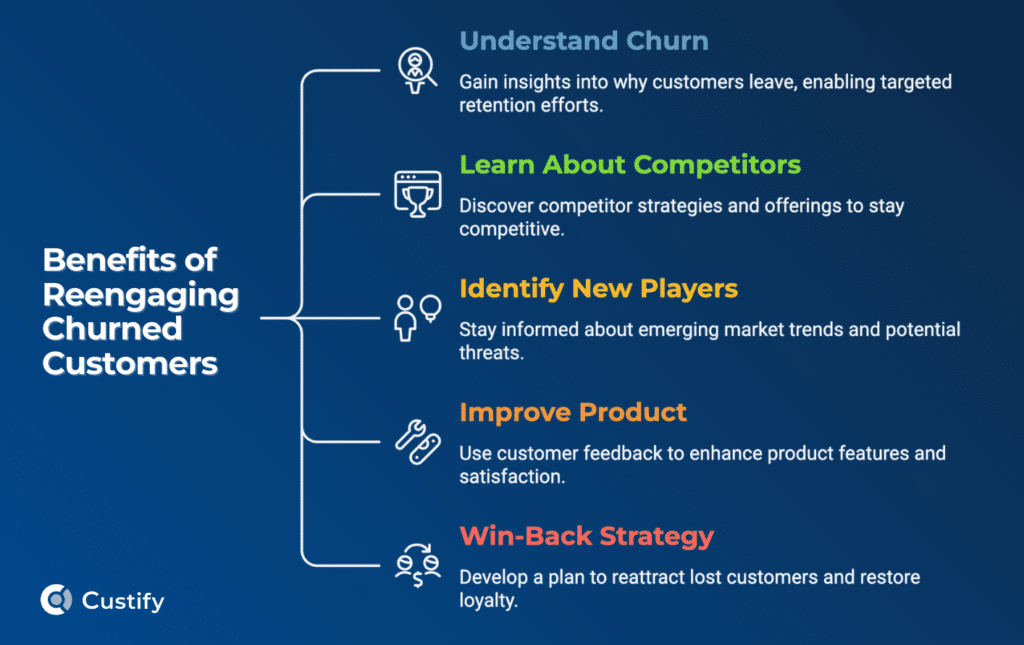
Here are just a few tremendous boons you can get by checking back in with customers who’ve maybe moved on from your solution.
Getting to the Root of Customer Churn
Once a customer is no longer in a direct relationship with you, there’s a refreshing air of honesty that settles over the conversation. This means:
- Churned clients won’t hold back and will be brutally honest about your missteps.
- Churned customers will be very precise with churn reasons, often bringing receipts.
- You might also find out churn had nothing to do with you or your solution, but was due to financial pressure or a decision from a higher up.
Competitor Insights and Market Research
Beyond the reason for churn, reengagement allows you to learn about a customer’s current situation:
- Customers will let you know what they’ve switched to or if they’re improvising with spreadsheets (for example).
- Customers will be brutally honest about whether they like the new solution or not, and will often draw comparisons between the two products.
- Insights from this part of the conversation are invaluable for almost everyone in your organisation:
- Product can get real feedback on what they’re doing right and what they could do better
- Marketing will get the truth behind your competitors’ promotional messaging
- Sales will get real, demonstrable facts about competitors that they can use as weapons in their calls
- Everyone else gets up-to-date market insights and information about the competitive landscape
Potential to Win Back Churned Customers
Lastly, you can then transition the chat towards a win-back attempt. This should always come last and with due emphasis on emotional intelligence. Don’t just attempt to sell outright; the customer will smell it a mile away and simply leave or get upset. Instead, try these tricks:
- Be very empathetic with the current situation: ask about their struggles, quietly note if your solution could help with that issue
- Note the reasons for churn and try to find ways to overcome those
- Ask when the next renewal date is and whether it would be acceptable to send a proposal via email. If the customer is already dissatisfied with their current solution, sending a PDF proposal that addresses their issues directly might convince them and their management to give you another shot.
Throughout the call, empathy and connection should be the driving factors. All other considerations are secondary, and 9 times out of 10, they will come around naturally.
A strong win-back proposal should be built around what caused the customer to leave and what has changed since then, rather than simply repeating the original sales pitch. Personalization, a clear narrative, relevant proof points and an obvious next step can make the case easier for both the former customer and other decision-makers to evaluate. Looking at a few sales deck examples can help you highlight these elements across real presentations, including the use of customer pain points, visual storytelling, social proof and clear calls to action.
How to Re-engage Churned Customers? Building a Strategy
1. Determine the Goal of Reengagement
Any effort to open up the chat window with an old client should start with a clear purpose.
In fact, it’s essential to do so as the conversation generally goes one of two ways:
- You know the client well, in which case you might end up talking about anything and everything for an hour and forgetting the actual reason you’re there, wasting business hours for both of you.
- You don’t know the client well (or at all), in which case the conversation will stall, feel disingenuous, and result in wasted time for both parties.
Setting a goal means purpose-led conversations and customers who don’t get put off by potential ulterior motives. The conversation flows smoothly, your AI meeting tool has a better time taking notes and organizing them, and everyone exits the conversation feeling refreshed.
2. Segmenting Churned Customers
Just like with regular customers, churned customers can also be put into segments for increased efficiency and prep work before actually re-engaging with them. You can segment churned customers by:
- Churn reason
- Value received
- Customer type
- Industry/niche
- Behavioral insights
- Relationship status
The kind of customer segmentation you choose will depend on your organization type, number of customers, and how many customers you actually want to reach back out to. Ultimately, the last one (relationship status) should factor into any decision you make since conversations will be more efficient with customers you know better vs those you’ve only marginally had contact with.
3. Client Research and Communication Strategy
On a related note, you’ll want to know as much as possible about a customer before reengaging. This will also inform what type of tone you should take within the conversation, saving you any awkwardness and backtracking while on the call.
Some quick research can reveal that:
- Your champion left the company, in which case reaching out will need to be done with great care (not abandoned, they can still offer great insights, you just lose the chance of a win-back).
- The company is in financial dire straits, something you need to factor into any win-back proposal.
- The company has been purchased by someone else, which can reveal plenty of things, such as new opportunities for a win-back, new potential issues you can solve, and maybe even a new champion.
All this homework will tell you when to reach out, what to say, what your tone should be, what to have prepared, and what kind of counteroffer you can have up your sleeve. Whether you go for a casual, jokey, approachable, or fully professional tone, remember you can always reference the previous relationship and details from their account history to get the conversation back on track.
4. Communication Channels
Some consideration should also be given to where you’re going to have the customer conversation. Three options stand out:
- A Recorded Meeting with AI Note-Taking. The most efficient way to go about reengaging churned customers is to set a meeting and recording with a note-taking app such as Fathom. At the end of the meeting, you’ll get all the notes neatly laid out in a Google Doc, complete with a meeting summary and action items.
- Preferred Comms Channel. You should also consider where your former customers usually liked to chat when they were still doing business with you. Some customers like Slack, others prefer WhatsApp, and others still would rather keep it professional and stick to email. Each of these is valid.
- Ideal option: best case scenario is you consider both. You can start the conversation over WhatsApp or Slack, and continue it in a video call where you record everything and take notes.
5. Rewards and Incentivizing Discussions
Difficulties getting that uptake rate to grow? Consider incentivizing discussions. Former clients might not be willing to give time out of their day to chatting with old vendors, but throw a $50 Amazon gift card in, and the conversation takes an entirely different turn.
If you’re having trouble justifying the spend to higher-ups, consider:
- Getting Sales on Board. Align with your salespeople and consider whether a conversation with customer X or Y could reasonably help them in their efforts as well. This could be an added benefit to help secure that budget.
- Looping in Marketing. See if the customer switched to a competitor you know precious little about. The market research angle alone could justify the gift card purchase.
- Gift Card vs Potential Value. In many B2B spaces, contracts bring in thousands of dollars per month, so a $50 spend might be a trifle when you consider the potential return on investment.
All these can add up and make a compelling case for incentivizing churned customer reengagement efforts.
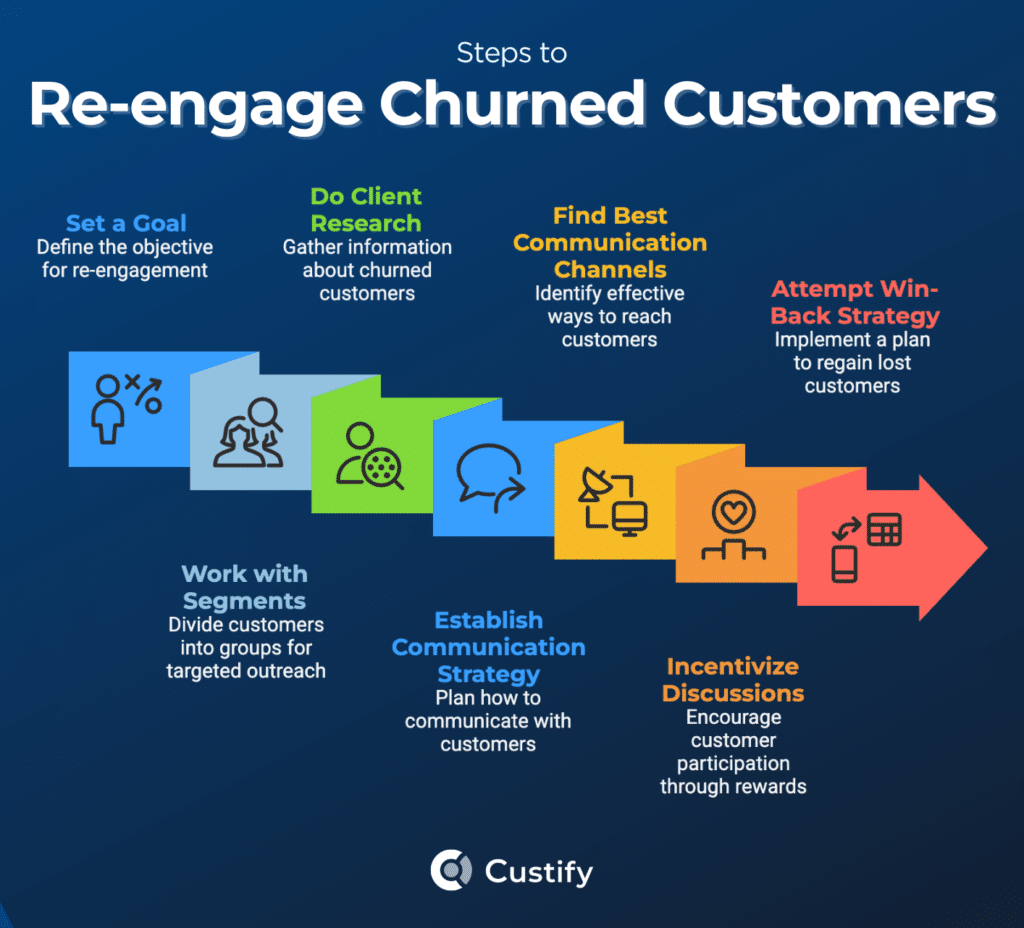
6. Win-Back Strategy
To be efficient in moving from a simple conversation to a win-back scenario, you first need a diligent documentation process. This means: well-organized notes, with all relevant account-specific information front and center. Focus on things like: customer segment, churn reasons, proposal draft, incentives, account files, and notes from previous meetings. A customer success software can help centralize these data points and build customer dashboards.
So, how do I win back churned customers?
Work on a strategy for customer reengagement, then do it. You will need first to outline the strategy. Talk to your churned customers, understand and empathize with them. If possible, try to find out and write down:
- What they don’t like about the current situation/vendor. This is your opportunity to outshine your competitors.
- What they’d like to improve. Figure out ways to bring value that actually matters to them.
- Whether the decision is up to them or their higher-ups/colleagues. Sometimes your champion’s hands will be tied: they won’t have much they can do to sway management in your favor, no matter how close you are. This lets you know how to structure and phrase your proposal to convince decision makers.
- When renewal is coming up. You should know how much time you have until your former customer has to renew with the current vendor. That’s how much time you have to work out a mutually beneficial proposal. Don’t jump the gun here; it’s more important to nail the proposal and be ready when renewal comes around.
- Ask: What’s one thing you could do that would win them back? Sometimes you’ll be surprised by their honesty. A single question could save you weeks or months of second-guessing.
- Be direct, be kind, be understanding, be honest. Above all else, make an effort to be kind, friendly, and anchored in reality, not in your projected goals.
What to Do after Re-engaging Churned Customers? Post Reengagement Plan
Once all the information is in order and the first conversation is done, then the real work begins.
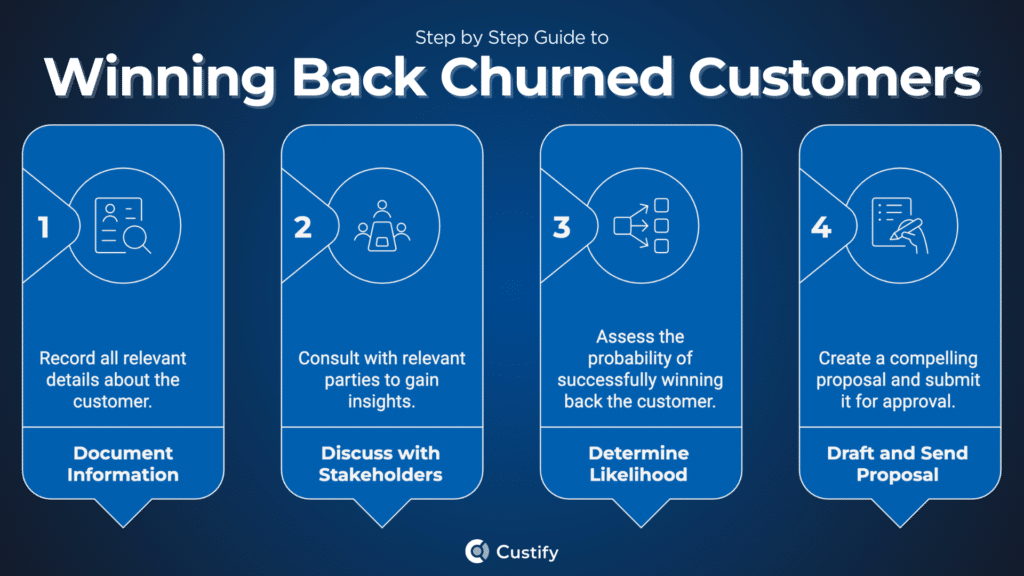
- If you intend to win back the customer. The immediate next steps are to discuss with stakeholders, determine how likely you are to win back the customer in a head-to-head fight with their current providers, and then make a proposal (which can go through multiple drafts before final approval and sending).
- If you don’t intend to win back the customer. Sometimes, a win-back is not possible right away – that’s fine. Make a note of all you’ve learned. Share those notes with Marketing, Product, Sales, and your C-Suite. Understand your competitors better and be ready for the next opportunity to outshine them. As for the churned customer? Set a call in 6 months, or close to their renewal date, maybe by that point you’re in a better position to attempt to win them back.
New information can be uncovered quite quickly through simple conversations with churned customers. It’s important to act on that information before it becomes stale: adjust your sales strategy, implement changes to your product, fine-tune your communication, and make any other incremental improvements you can.
Roundup: CSMs and Salespeople on Reengaging Churned Customers
1. Set the Right Goal and Ownership for the Effort
First, it’s important to understand if churn reactivation is a CS goal or a Sales goal. Then I would also map all the wishes and requirements from those churn accounts, and if we have a new development that fulfills a customer need from that cohort, I definitely will reach out with that.
– Sara Vera-Cruz Quintas, Head of Customer Success, VESSELINDEX
2. Find the Correct Amount of Time to Dedicate to Churned Clients vs Current Customers
[Reengaging churned customers] is good, but can be a time suck, distracting you from other activities. The suggestion is to meet with product, marketing, and leadership to see if they want to do a formal campaign to get feedback, attempt a winback, or other. Key is to determine how much time/effort you want to sink into this, and that is determined by the outcome you want to get from the motions.
My suggestion is – let this occupy no more than 5% of your time for small businesses, especially if you’ve never heard of them. Different if they are small to you, but have the potential to grow.
Make sure you focus on the other accounts you have and those you are not engaged with, and make them stick.
Or down the road, if you do get feedback from them or even if you don’t, set up a win-back campaign for you or someone on the Sales side. Key to making this successful is giving the person making the calls to win them back as much info as possible. If you were too expensive, come at them with a newer promotion.
You’d need to coordinate with Sales leadership on this, but just a suggestion.
Just make sure to focus on those that are still with you to give them what they need and be the person that keeps them coming back month after month.
– Chris Otenbaker, Director of Customer Success, PlanITROI
3. Learn What You Could’ve Done Better, and What Competitors Are Doing Worse
Talking to churned customers is very different from speaking with a brand-new prospect. There’s already history there, so the conversation is usually more direct and honest. People tend to be quite open about why things didn’t work at the time, what changed internally, and what they would have actually needed to make it successful. For me, those conversations are some of the most valuable ones you can have. They don’t just create the chance to reconnect, they give you real insight into what you could have done better, whether that’s the product itself, the timing of the deal, or simply how you approached the customer in the first place.
In one conversation with a former customer, they said they actually liked Custify and the support we provided, but management decided to go with another vendor. During the sales process, they were told the other product was superior, but they never had the chance to properly test it and were only shown videos. Once they started using it, the experience was completely different from what they had been told: things didn’t work as expected, and support responses were slow. Conversations like this are valuable because they show how different the reality of a product can be from how it’s presented during a sales process or in marketing materials.
– Vlad Strimbeanu, Account Director, Custify
4. Understand the Buying Process Better through a Different Perspective
Churned customers are one of the few sources who will tell you what the buying process looked like on the other side. They’ll tell you which promise won the deal, which objection mattered, and where your message lost credibility. That kind of feedback is more useful than another internal debate about positioning, because it comes from revenue that already left.
– Mircea Popa, Co-Founder & CEO, Medicai
5. Focus on the Valuable insights You Can Receive
I used to have a program around this, I’d personally reach out to 5-10 churned customer contacts every quarter to see how they are doing. The uptake rate was very low, less than 15% from what I remember (i.e., on average, about one person would actually engage out of those 5-10). It never led to a win-back, but it did create valuable insights for the product team in some cases as to what product a customer migrated to (they would often be very hesitant to reveal specifics, but based on the framing, we could make a very educated guess).
This was for enterprise B2B high-ticket product companies, where there usually was a fair bit of vendor politics involved. I’d imagine it would be quite a bit different in less enterprise-heavy spaces.
– Manuel Harnisch, Fractional CCO and Technical Success Leader, TopSERV Fractional
6. Look for Insights and Operational Value from Churned Clients
The mistake is thinking reengagement only matters if you win the customer back. In many cases, the real value is operational. You find the weak points in handoff, support, pricing, or communication, and those weak points usually exist in active accounts too. Fix that, and the whole portfolio gets healthier.
– Radu Scarlat, General Manager, Bento MDM
7. Prove You’ve Made Progress and Can Actually Serve Their Needs Better
Reengagement only works when the company can prove progress, not just intent. Former customers do not care about your roadmap theater. They care about whether the problem that pushed them out is now solved in production, documented clearly, and usable without extra friction.
– Alexandru Artimon, Co-founder / CTO, Atta Systems
8. Find the Ideal Timeline for Reengagement
I make offboarding a pleasant experience, and ask if I can check back in X amount of time. Since Customers sign with other vendors after churn, reaching out too quickly while they’ve just signed on with someone else results in a ‘no’ due to the contract and they’re still learning to adopt the new platform.
I find a good sweet spot has been about 6-9 months after churn for outreach. They’re midway, if not more, know what they have, and I reach out depending on their churn reason, i.e “hey we just released that feature!” or “curious if your new platform is solving your pain points” etc. It’s hit or miss, but I have seen it result in boomerang opps for sales.
– Nicole Petkovits, Revenue Operator & Storyteller
9. Remind Former Clients You’d Like a Partner in Their Success
This is a great idea and something we should make a concerted effort to do more. We’ve had a number of boomerangs – but that has largely been organic, they come back to us on their own. We could be checking in and reminding them we’re still here and still want to partner on their success… especially when we’re fairly confident that they’re getting a lesser experience with a competitor.
– Michael Maron, VP of Customer Success and Global Accounts, WordPress VIP
Conclusion: Churned Customer Conversations Can Be Gamechangers
Clients who’ve ceased doing business with you can still be valuable if you know how to approach them. We’re in a new era of SaaS. Customer churn doesn’t mean what it used to. The door to new opportunities is not closed when customers leave, it’s left ajar, ready for you to step in and reconnect on occasion.
Reengaging churned customers will lead to new insights into churn, new research and information about competitors, and new potential for winning back old contracts. I’d say that’s worth considering, at the very least.
Wondering how you can build dashboards full of all the necessary info for those reengagement calls? Reach out for a 15-minute chat, and my team can walk you through it.