2025 asked a lot of Customer Success. Results improved, but so did stress and burnout.
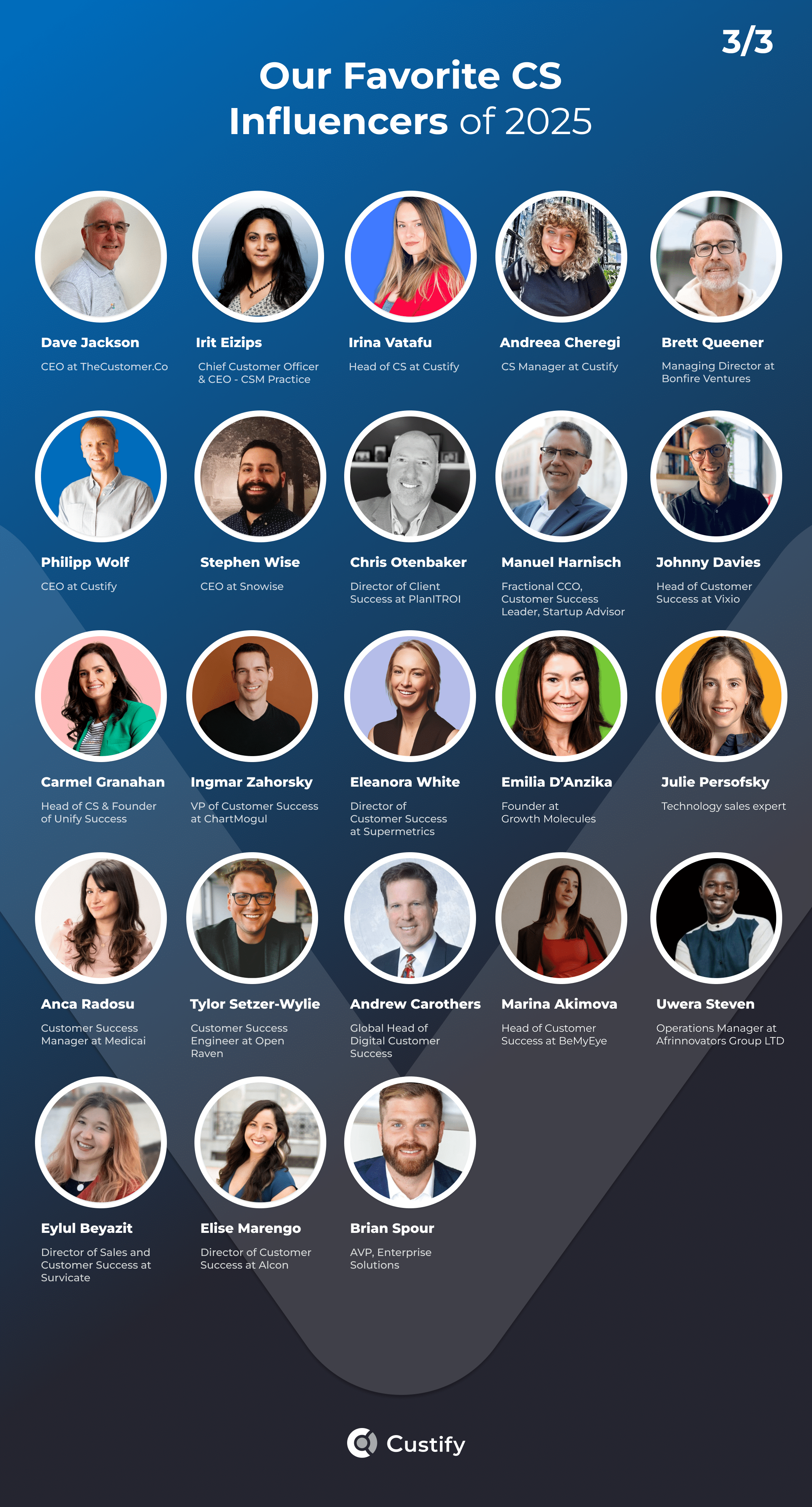
Yet we weren’t alone. Through it all, we were guided by the wonderful CS community and their inspiring and insightful posts, stories, webinars, podcasts, comments, and opinions. Below are our picks for the top voices that influenced customer success over the past year.
Alignment emerged as the year’s defining theme: aligning with customers, revenue leaders, and cross-functional teams. So let’s hear from the voices that shaped how Customer Success showed up in 2025.
The Leaders Who Shared Their Insights
Here’s a quick review of the top minds that made us think, question, and refocus in 2025:


1. Onboarding and Its Impact: Building the Foundation
Onboarding was once again a key priority for many in customer success. Our webinar on whether we should charge for this mission-critical process sparked an interesting debate with some great lessons.
A big learning for me was building the internal relationship with Sales and Marketing. You have to give them specific context. Explain what is in it for the customer and for the salesperson, such as commission. You cannot just create something and say, “Go sell that,” because they will not. That undervalues what we do.
There is a psychological principle called the endowment effect, which suggests that if something has a price attached, people are more invested in it. Make it easy for the Sales team to know what they can and cannot do, what the packages are.
In my experience, building a world-class onboarding experience starts with Marketing and Sales. The relationship piece is key.
– Clare Knight, Founder of The Onboarding Lab, during our webinar on The Cost of Free
Onboarding is a process. We’re gonna get to a point where something good is gonna happen. They’re using the product, they’re getting value out of it.
We can quantify that process. We can look at time, cost, and quality.
What are the results that come from it? How effective is that process? What is the impact on retention and growth? We can measure that, we can quantify that, and we can show that value.
We’re making an investment in that process. What’s the return on that investment?
– Ed Powers, Principal Consultant at Service Excellence Partners
2. Customer Escalations: Learning from Complex Customer Issues
If we learned anything from the previous years in CS, it’s that customer escalations will happen, and a key avenue for growth comes from how you deal with them in an empathetic and productive manner, and how you apply the lessons learned moving forward.
Ultimately, success depends on whether service strengthens the relationship and delivers measurable business value. In B2B, self-service is often the first spin of the flywheel — but it stalls quickly. Gartner reports that only 14% of service and support issues in self-service are fully resolved. Even among issues that customers considered “very simple,” the resolution rate was just 36%. The takeaway: automation starts the motion, but empathy keeps it turning.
– Michelle Wicmandy, Global Strategic Marketing and Communications Leader
Escalations are healthy. So it’s a healthy, natural, important part of what that job is, what our role is, and why there’s a leadership structure in the first place.
Swallow that pride. Best case scenario, a CSM then interrogates what’s going on very deeply because the quality of the engagement with leadership depends very, very much on the research and your understanding about what exactly the nature of the challenge and problem is.
– Matt Woodward, VP of Client Success at Link Investment Management
I think there are several key attributes that are imperative to de-escalation.
- Empathy
- Active Listening
- Ownership
- Staying calm
- Transparency
- Top tier communication skills
- Problem solving mindset
In addition, quickness is also key. Here’s what I have in my CS Playbook for best practices:
- Triage Quickly
- Engage the right internal stakeholders
- Create an action plan
- Document EVERYTHING
- Follow up consistently
- Debrief internally and externally after resolution
- Analyze trends
– Melissa Parry, Head of CX at TRUCE Software
3. Leadership with Purpose: Outcome-Driven CS
This year, we also went further in our lessons in CS leadership. We moved beyond simply looking at metrics and monitoring accounts and learned how to lead with intention and inspire the people in our team.
There are many, many things that can look like priorities. There are many expectations from the team. But the way I tried to think in order to put some clarity in my mind was to think that just like when you’re a CSM building relationships with customers, as a new manager, you need to establish trust and clarity internally before making any major changes in the team or coming with new ideas and projects.
So I started by listening. So I scheduled calls with everybody to understand: What are the current pains? What is everybody expecting from me?
I would try to find some small wins that I could deliver fast, but also establish some strategic projects that I could focus on in the upcoming weeks and months.
– Irina Vatafu, Head of Customer Success at Custify
Another big shift has been what we call the three P’s: People, Process, and Practice. As you develop people and build trust, they start to demonstrate good practice. At that point, you can relax some of the process elements because it becomes muscle memory — people do it naturally.
When you implement a new process, you have to design it, implement it, pilot it, and police it until it’s embedded into daily practice. Once it becomes part of how people work, you need less oversight.
People will only adopt a new process if they believe in it, and one way to achieve that is through co-construction. Let them contribute. Sit down, talk, listen, and share ideas. Often, they’ll come up with better solutions, which is a double win — you get better processes and greater buy-in because they helped create them.
– Steve Finch, Brand Ambassador at Thinqi, during our webinar on surviving as a first-time CSM
4. Revenue Considerations: When Sales, CS, and the CRO Work Together
A contentious topic of lively debate in CS this year was how to satisfy the divergent expectations of the CRO, the responsibilities of Sales, and the role of Customer Success. Let’s hear from some of the CS minds that tackled this topic recently:
At a basic level, this is what happens when Customer Success becomes part of the sales org. I see it time and time again and in fact, I just ask them when I have a crappy CS experience who they report to. It’s always the CRO.
When growth slows the trade-offs here become acute: if you are growing say 15% a year and declining, and new customer count is say growing 10% a year … the CRO’s only hope may be to aggressive upsell the base.
– Jason Lemkin, Founder of SaaStr
Working in CS, I’ve talked to many CSMs who were upset their pricing model changed, and all of a sudden, they’re struggling to justify the decision and keep legacy customers tied to their old, higher-tier plans, despite the new options being cheaper and making more sense for their business. That’s because many times, companies have a process in place for upsells but don’t have one for downsells, even if the alternative is full customer churn.
At the other end of the spectrum, I’ve seen companies raise their prices by 25% and lower their growth rate to under 10%. A move like this can cripple your SaaS and have an adverse effect compared to what you intended. For example, say your COGS increases by 35%, so you decide to raise your prices. The solution works for a few months, then suddenly your customer base stops growing like it used to. Meanwhile, churn hasn’t slowed down, and, in fact, has increased as customers are more hesitant when seeing the new price tag upon renewal.
– Philipp Wolf, CEO of Custify, in our article on Making Pricing Changes while Preventing Downgrades and Encouraging Upsells
Looking at your customer churn says a lot about how your user base behaves, what they expect from your product, and how you’re meeting (or ignoring) their goals and expectations. To that end, data related to churn can inform the sales prospecting and qualification process, allowing sales reps to focus their efforts on high-potential leads by deprioritizing those with increased risk of churn.
To make this distinction, all you need is to sift through CS churn data and identify the early churn indicators for your customer base.
– Irina Vatafu, Head of Customer Success at Custify, in our article on Using Churn Data to Improve Sales Prospecting and Qualification
5. Proactive Customer Success
Being proactive with customers continues to be a quintessential tactic of customer success. As Johnny Davies says below, it’s what sets it apart from account management. And according to Grant Dutton, it’s what makes CS remarkable.
[Customer success] is now a fully fledged industry with its own set of best practices and principles and everything else. I’ve been in that industry now as well. And yeah, I think that’s really what we’re seeing.
So how is that different to account management and kind of contract management? I think it’s proactive. As I say, it’s got its own industries and best practices.
We try and place the customer at the heart of everything that we do rather than the revenue or the rep. And I think customer success has a big part to play in helping businesses become more customer-centric. Folks that are able to achieve that typically have very successful businesses.
– Jonny Davies, Head of Customer Success at Vixio
[My continued CS Strategy is about] those remarkable experiences. It’s when [customers are] reaching out to tech support, they’re getting a fast response, they’re getting an accurate response when they’re reaching out to their CS rep, or their CS rep, better yet, is reaching out to them, proactively addressing needs, keeping them informed of upcoming roadmap responsibilities, anything like that. I’d say that’s the remarkable side of it.
– Grant Dutton, VP of Customer Success at Submittable
Once you’re at the far end, it’s a long climb back if you can do it at all. But if I’m aware of something, I’ll proactively reach out, introduce myself if we don’t already have a relationship, explain what I’m observing, and own it.
It’s, hey, I’m the face of the company right now. I’m sensing you guys have an issue. Let’s get in front of it. Let’s fix it.
I’ve got data which shows the reduced cases or the increased lag times. And that’s just data, but you have to use your intuition to understand and interpret that data.
Silence is not necessarily a good thing. I’d rather reach out and say, how are things going?
– Miles Goldstein, Executive Member at the International LEAP Network
6. Tools and Technology: Empowering Customer Success Teams
We’ve been saying for a while that the right CS tools can make the difference between stagnation and success. Last year was the first year that we saw widespread agreement from multiple leaders from across the CS space.
Right now, we are seeing our research highlight: there’s this growing complexity associated with our technology, especially as we continue to layer in additional capabilities, and with these AI tools that are out in the market.
So as we adapt to our evolving customer needs and we expand our service offerings, more often than not, I think, we all have experienced that we are encountering challenges with these disparate technology stacks and different teams that can really hinder our performance and our efficiency as a team. And so the core of this issue really lies in these disconnected customer experiences.
– Darlene Kelly, Director of Customer Success and Customer Growth and Renewal Research at TSIA
I think [scaling] is about having the tools to know what to prioritize and when. As we scale and get more customers before adding any headcount, we need to be very mindful of how we assign new accounts. I let the team decide who takes on which account most of the time, not just based on their book of business but on their knowledge of how much time their customers require right now. They’ll know about any new projects going on. I work with the team to understand where the new accounts should go before we add headcount. That’s the capacity planning front.
– Kasia Laugenie, Customer Success Director at Jacquard
I really like systems and tools. Deep in my heart, I’m an ops guy. A really well-designed CRM or customer success platform is a beautiful thing.
If you want your team to do something, you need to make the right thing the easy thing. Because when the thing you want them to do is hard, people will naturally follow the path of least resistance and go in other directions.
The challenge is recognizing the steps you want them to take and then asking: how do I make that the easiest thing to happen—through automation, resources, and making it harder to do the wrong thing? When you do that, you’re helping the team go in the right direction.
This isn’t easy, and I haven’t always succeeded, but that’s where good systems and good data really matter.
– Porter Williams, VP of Customer Success at BrightHire
7. Using CS Metrics to Deliver Business Outcomes
When metrics fall short, progress still shows up in CS Ops. Usage patterns, risk reduction, and renewal data told the story over the past year, helping CSMs set up a credible plan for their upcoming success goals.
When hard numbers aren’t where you want them, you want to lean into operational improvements. Stakeholder wins in this case, in the example, risk mitigation progress, whatever it is, those are proof points that still demonstrate that you’re making progress, and they can be connected to the bigger picture. And once you’ve done that, even though I talked about you can’t start telling or positioning future value before you’ve identified the current value, you can, at least in this situation. You then pivot to value ahead.
So you go from value achieve, which may not be very data rich because the data doesn’t sound good, to value ahead, but we really think we’re going to get to that point, right? And make that conversation forward-looking, right? We’ve built the foundation, and here’s what our next focus is going to be, so we can get to that point that you want to get to.
– Andrew Marks, Founder of SuccessHACKER & SuccessCOACHING, Host of the CS Leadership Roundtable
Product usage data, as much as people say that adoption metrics is surface level, it’s so important. You want to know what your customers are doing on your product, how often they’re using it, and if they’re not using it, where can they find value.
And the truth is, your product team has this. It’s living somewhere in your data warehouse.
And I think non-negotiables are obvious, like contract data. We need to know when is the renewal date. How much is the ARR? Because it’s so important for us to be able to forecast retention and expansion.
– Angeline Gavino, Founder, CEO, and CS Leadership Coach at CS RevSpeak
8. Scaling and Efficiency: Doing More with Less
Everything felt urgent in 2025. Teams defaulted to short-term goals. The natural question is: how do we break that loop? The CS leaders below showed us it takes intention, thinking time, and clear focus on work that matters for our KPIs.
It’s a vicious cycle, and it doesn’t matter what starts the cycle. You think short-term, everything becomes urgent because everything is urgent. Now, you need to break the cycle.
And like anything else in life, it calls for being intentional. So the first thing is to be aware that because everything is on fire, there is a little chance that you could be just doing everything short-term and you’re not thinking beyond the quarter.
So you really have to start with very small steps. It can be as simple as having white space in your calendar for 30 minutes every day. And you really respect that 30 minutes. So you just give yourself that half an hour every day.
– Neha Singh, Principal Customer Success Manager at Adobe, in our webinar on building a CS Playbook for tough times
There is no universal right or wrong. Some organizations decide to never charge because that is right for them, but you still have to be aware of where you spend your time. It is easy to get pulled into things that do not drive retention or expansion.
Leaders and ICs in CS should know what Sales is saying. If you are new, ask to watch a Sales demo. Then give Sales precise positioning for onboarding and services.
Have a clear, open dialogue. Once you show consequences, they adjust. Be specific with words. You can always give more, but it is hard to take away.
– Jamie Moquin, Head of Customer Success at Nectir, during our webinar on The Cost of Free
9. Customer Outcomes and Mindset
A strong customer mindset keeps teams focused on outcomes, not output. These leaders showed us it’s all about anchoring roadmaps to real pain, measuring impact early, and embedding customer signals into daily work, progress becomes faster, clearer, and repeatable.
A true customer mindset means anchoring at least 80% of the roadmap to measurable customer outcomes.
At Custify we learned this the hard way: a fintech client’s onboarding took 14 days. Instead of polishing two UI “nice-to-haves,” we shipped pre-built data-mapping templates.
Results: time-to-first-value fell to 3 days, feature adoption rose 35 %, and net revenue retention climbed 7 points in one quarter.
Every sprint now opens with three questions:
- Which concrete customer pain does this solve?
- How will we measure impact in the first 30 days?
- What internal blocker must we remove to ship fast?
If a story can’t answer all three, it gets parked, no matter how “brilliant” it sounds in a workshop.
– Philipp Wolf, CEO of Custify
Having a customer mindset means you’re constantly putting yourself in the customer’s shoes. You’re not just reacting, you’re anticipating needs, spotting opportunities, and helping them win.
– Tylor Setzer-Wylie, Customer Success Engineer, Open Raven
Having a customer mindset means embedding the customers’ perspective into processes and workflows. It starts with understanding customers’ perspective through listening to all and analyzing their signals (social, support conversations, CSM interactions, peer community engagement, purchasing and adoption behavior). The next step is designing journeys based on this knowledge, and leveraging the customers’ perspective throughout each work step. Embedding it into processes and workflows will ensure it gets considered when designing journeys, creating enablement material, developing products/services, updating support processes, etc.
– Andrew Carothers, AI & Digital Customer Experience Expert
10. Strategy and Focus: Prioritizing What Matters
Customer success strategy comes down to focus and clarity. In 2026 and onward, CS teams need complete data, clear handoffs, and simple frameworks customers recognize, while staying flexible enough to realign priorities as business goals and phases evolve.
One of your issues in the support and success area is that when a customer success person works on a case, they usually aren’t putting notes into the case management system detailing what they’ve done. So your support database is now a little bit off because it doesn’t have important data that happened outside of it. So now you’re making decisions on incomplete data.
Support is good. How does this work? If it breaks, I’ll fix it. Success is how do I use this tool to increase my profitability and my productivity? So you do a handoff about: you need to talk to our product, our business expert, our advisor over here, your customer success manager, because that’s where they specialize in.
– Mikael Blaisdell, Executive Director at The Customer Success Association, during our webinar on Capacity Planning
I think our goals are related to building a simpler framework. So a simpler customer success and measurement framework that customers can recognize themselves in. So building an external communication path, basically, on which customers can identify, okay, where am I on the journey.
I think that now what we currently have is a very solid model that we have in place. But we need to make sure that it’s very clear for customers what they’re going to get. And that’s something that we are now working on.
Sometimes that is still difficult to convey. Because we are not always talking about very tangible things.
– Jeroen Kuiper, Director of Customer Success at OpenUp
I guess [strategy] changes. You don’t have one strategy and then stick to it. It’s about identifying what is a priority for the team at that particular time and showing how that contributes to business goals. It was important for me to get visibility into our business strategy for the coming year to understand where we fit into it.
How do we help the business achieve its goals? And something really important is how you align your strategy and objectives with what the business is trying to do and the phase the business is in. Otherwise, it doesn’t matter.
– Steve Finch, Brand Ambassador at Thinqi, during our webinar on surviving as a first-time CSM
11. Leadership Vision: Shaping the Future
These leaders showed us true leadership blends trust, curiosity, and clarity. They led the charge by modeling sustainable habits, empowering smart tradeoffs, and balancing vision with execution.
I really think that it starts with transparency and building trust, right? Your team needs to feel safe knowing the why behind tough decisions.
When you have few resources, you got to prioritize, and you need to empower your CSM to say no to low-impact work. Give them the space to really make those kinds of calls and decisions.
And most importantly, you got to model the sustainable behavior yourself. If your team only sees you working late and messaging them on odd hours, firefighting, then they’re going to think that that’s how they should be doing things, that that’s the standard.
– Angeline Gavino, Founder, CEO, and CS Leadership Coach at CS RevSpeak
It’s a burgeoning industry in many ways. Of course, everything depends on the customers. But I would go back to something I’ve mentioned before: remain curious. Always be curious.
Yes, there are going to be tasks you have to do throughout the day—there will be repetitive things, and admin might not be your strong point. But as long as you remain curious when you’re having conversations and discussing things with your customer, and you’re genuinely interested in them as a person, as an organization, and in understanding the challenges they face and what their company actually does, it will keep your days interesting and make people want to talk to you.
– Ellie Yates, Head of Customer Success at Signable, in Episode 20 of Mastering CS
As a customer success leader, my advice is to focus on balancing strategic vision with operational excellence. Success doesn’t come from merely solving day-to-day challenges; it’s about ensuring your team has the tools, data, and processes to anticipate customer needs and align with their desired outcomes. One essential skill is fostering cross-functional collaboration—working closely with Sales, Product, and Support to create a unified customer journey. Remember, leadership isn’t just about directing; it’s about empowering your team to act decisively, continuously learn, and deliver measurable value to your customers.
– Irina Vatafu, Head of CS at Custify
12. CSM Commissions and Comp Plans
One thing that many were debating this year was the commission percentage. From these leaders, we learned CSM compensation works best when it reinforces near-term priorities. Splits, caps, and incentives should vary by company stage, role, and customer segment, aligning pay to the behaviors that matter the most.
I’ve found the right comp model depends a lot on the stage of the company and what behaviors you’re trying to incentivize over the next 6–12 months. A simple starting point I’ve used is an 80 percent base / 20 percent variable structure. From there, the 20 percent can be weighted based on the problem you need the team to solve.
- If churn is the biggest issue, you might put 70–80 percent of the variable toward renewal targets with accelerators.
- If expansion is the focus, you can go closer to a 50/50 split between renewal and expansion.
- If adoption is the gap, and you have the telemetry to support it, you can tie part of comp to seat usage or milestone completion.
TLDR: decide which behaviors matter most in the next phase, and build the comp model to reinforce those. Happy to chat more if helpful.
– Stephen Wise, CEO & Co-founder at Snowise
In my experience with CS and Acct Mgmt teams, a 10-30% comp eligibility is pretty standard. But I also had one that was not capped for my team. Now it does need to be managed from how much is paid out if the person/team hits 300% of the plan. And you can do that by doing monthly payments not to exceed $X or X% of what is listed in the comp plan, so the CSM doesn’t cash in and then take another job. Hope that helped a little.
– Chris Otenbaker, Director of Client Success at PlanITROI
I’ve gone mostly with an 80/20 split, but also had ranges up to 75/25 and 85/15.
The higher variable split was usually for more experienced Enterprise CSMs with more outcomes agency, the lower ones for more mid-market / auto-renewal customers.
– Manuel Harnisch, Fractional CCO, Customer Success Leader at topSERV Fractional
13. Building Customer Success: The Ideal Team Structure
Is there an ideal CS team structure? These leaders said it plainly: there’s no single blueprint that works for everyone. The right structure depends on stage, scope, and goals, and it only works when roles protect focus, reflect reality, and give CSMs room to drive outcomes.
There’s no universal way to structure a Customer Success team, it depends on the company’s size and stage, the product and pricing model, the service delivery expectations, and the growth or revenue targets. All those factors shape what ‘good’ looks like. Lots of ways to slice setup, all very dependent on multiple factors.
– Kourtney Thomas, Head of Customer Success, TakeUp
Scope of service matters as well. How you define Customer Success and what the team actually does really changes the structure. For example – is CS given revenue targets? Is it pure CS, or does it include support? The scope of the team usually tells you how you should build it.
– Katherine Tattum, Fractional CCO/COO, Insight Health Tech
Structure only works when the daily reality supports it. CSM roles break down when they absorb tasks from support, product, or sales. That creates noise and hides the real customer signals. A healthy structure protects focus. Give CSMs space to drive outcomes instead of patching gaps across the org. It leads to cleaner customer journeys and fewer internal escalations.
– Anca Radosu, Customer Success Manager at Medicai
14. Vision for the Future: Innovating Customer Success in 2026
Lastly, we end on some predictions for the year to come. From the sci-fi to the grounded, CS leaders paint a promising picture: a future that we can deliver with data, based on the hard lessons of this past year.
Just as Captain Kirk relies on Spock’s logic to navigate uncharted galaxies, Customer Success leaders can rely on Data Scientists to chart the course to customer value. Together, they ensure that every decision—from onboarding to expansion and revenue growth—is informed, strategic, and impactful.
By leveraging data science, organizations not only enhance the customer journey but also fortify their foundation for long-term growth.
– De’Edra Williams, Customer Success Leader
2025 wasn’t exhausting because of the actual work. 2025 was exhausting because the entire internet was screaming: “CS is ending.” “AI is taking our jobs.”
We weren’t lazy or resistant; we were scared. So we dove headfirst into the AI rabbit hole.
But look at us now. By the end of 2025, we know AI. We know how to use it. We know where it helps and where it absolutely does not.
There is no “best CSM” or “worst CSM.” There are only humans doing their best in an industry that moved at the speed of panic all year long.
2025, you were uncomfortable as hell. But uncomfortable = growth. And I finally have clarity for 2026. Cheers to that.
– Stijn Smet, Head of Customer Success at Whale
10 predictions for Customer Success in 2026.
Save this. Argue with it. Revisit it in a year.
1️⃣ Fewer CSMs. Higher retention.
2️⃣ Expansion will follow usage, not hype.
3️⃣ Business reviews split: usage vs value.
4️⃣ Voice of the Customer decks disappear.
5️⃣ Value articulation becomes table stakes.
6️⃣ Small, private circles replace “community”.
7️⃣ The CSM role splits: strategist or orchestrator.
8️⃣ Strategic influence becomes the top CSM skill.
9️⃣ LLM access will be basic. Purpose-built agents win.
🔟 Humans show up less. When they do, it matters more.
– Daphne Costa-Lopes, Global Director of Customer Success, Hubspot
Conclusion: Onwards and Upwards in Customer Success
There’s one prediction about 2026 in customer success that will definitely be true: it’s not going to be a boring year.
After such a rollercoaster, it’s hard to believe that nothing will break the analogue and make us rethink our strategy once or twice, or more.
As this year draws to a close, we’d like to thank everyone who lent their voice to the treasure trove of insights that was the CS space in 2025. And if you’ve participated in any of our webinars, podcasts, or roundups, or partnered with us in any way, we extend our heartfelt gratitude to you all.
Here’s to seeing everyone again in 2026 for bigger and better dreams in Customer Success!