There’s a lot of chatter about customer success in 2026.
Many are predicting the best year yet. Finally, they say, CROs will switch to a post-sales, CS focus. Comp models will be tied to retention instead of upsells. Yes, and unicorns will roam the land, and we’ll have rainbows made of cotton candy.
It doesn’t take a prophet to realize this is not what will happen in 2026. All we need to do is look at the current year. Recent surveys say 49% of CSMs are still responsible for ALL upsell, cross-sell, and renewal efforts. A simple glance over r/CustomerSuccess paints a stark picture – one of job dissatisfaction, quiet quitting, overwork, toxic environments, and misaligned goals.
But is it all doom and gloom? No. There are rays of hope.
Many CSMs found their dream jobs in 2025. And while some were already exhausted by AI bloatware, many platforms discovered ways to help CSMs with newfound efficiencies, rather than trying to replace them through agentic AI or cookie-cutter features.
Today, let’s explore the biggest stories in customer success recently and see where that leaves us for 2026.
Here’s a Summary of What to Expect in this Article:
Customer Success presently is marked by contradiction: while predictions promised a shift toward retention-focused, post-sales models, the reality remained misaligned. Nearly half of CSMs continued to own upsells, renewals, and cross-sells, contributing to burnout, dissatisfaction, and role confusion. Major industry events (including high-profile security breaches, growing overlap between CS, CX, and Service, and widespread AI experimentation) reinforced the pressure on CS teams, even as some professionals found stronger roles and organizations began rethinking how CS creates and delivers value.
Despite persistent challenges like tool fatigue, ineffective management, churn complexity, and poorly implemented AI, signs of progress emerged. Leaders increasingly emphasized long-term thinking, clearer boundaries between support and success, better pricing and onboarding practices, and AI that augments rather than replaces CSMs. Looking ahead to 2026, the outlook depends on returning to CS fundamentals: driving adoption, delivering measurable value, aligning leadership expectations, and using context-aware tools to reduce noise and restore purpose in customer success as a whole.
2025 Changes, News, & Shifts in the Customer Success Industry
1. News and Shifts
1. Google says hackers stole data from 200 companies following Gainsight breach | TechCrunch
One of the biggest shockers this year was the recent breach of Gainsight security. where hackers stole company data relating to 200 businesses. The security breach happened as a result of an earlier breach of Salesforce data through Salesloft, the makers of Drift.
A spokesperson of the hacker group ShinyHunters told TechCrunch that:
Gainsight was a customer of Salesloft Drift, they were affected and therefore compromised entirely by us.
Such a security breach sends strong signals among the CS community. Many of the clients we’ve worked with have highly sensitive data. That’s doubly so for a company like Gainsight, which caters to enterprise customers. CS teams will, as a result, be more aware of vendor risk and show higher buyer scrutiny when choosing new software solutions.
2. Custify Introduces New AI Agents to Transform Customer Success Work | PRWeb
This year, we officially launched CustifyAI, and we couldn’t be prouder. Our new suite of AI features integrates into Custify seamlessly, offering context-aware features that help B2B SaaS teams cut down on repetitive work, view and act on churn risk, and build customer success in a more efficient and proactive way.
CS leaders keep hearing that AI will fix everything, yet most tools live outside their workflow or feel like experiments. We built CustifyAI to be boring in the best way. It quietly does the work you don’t have time for and surfaces what really needs your attention.
– Philipp Wolf, CEO of Custify
3. The Convergence Of Customer Success, Experience, And Service | Forbes
According to this in-depth analysis and comparison of different surveys, the lines between CS, CX, and Service are increasingly blurry. With everything now being managed either by the CRO, CCO, or both, the focus on revenue-driving activities, from retention to expansion, is increasing, as is the search for AI and automation tools that can augment CSM work rather than replace it.
Most customers (82%) will want to interact with humans more as technology improves in the future according to a global survey by PwC. That makes the art of balancing the human touch with digital and AI engagement critical to maximize customer lifetime value and differentiate the experience.
4. 9 Customer Success Managers Share How They Broke Into the Field | BuiltIn
This comprehensive roundup gives us a clear picture of the breadth and depth of customer success experiences in the field. From consulting to real estate, cellular biology, statistics, finance, advertising, and more, the folks from BuiltIn showcase just how diverse today’s CSMs can be.
So much has been said this year about adopting AI solutions in Customer Success. But what about adopting customer success in AI organizations? Vanessa Gaithi is OpenAI’s first Customer Success hire, and she offers a very insightful peek into what CSM means for a company like OpenAI.
6. How to Be a Customer Success Leader? Top CS Professionals Answer | Custify
Rounding up our list of news, we can’t forget about this list we put together of opinions on what it takes to lead in CS. We talked to professionals from around the CS space and got a range of qualities that are vital: curiosity, strategic thinking, planning, people skills, the ability to listen, and to know when to give advice.
2. Opinions
1. Refocus CS Work and Reduce Focus on Support Work
One of your issues in the support and success area is that when a customer success person works on a case, they usually aren’t putting notes into the case management system detailing what they’ve done. So your support database is now a little bit off because it doesn’t have important data that happened outside of it. So now you’re making decisions on incomplete data.
Support is good. How does this work? If it breaks, I’ll fix it. Success is how do I use this tool to increase my profitability and my productivity? So you do a handoff about: you need to talk to our product, our business expert, our advisor over here, your customer success manager, because that’s where they specialize in.
– Mikael Blaisdell, Executive Director at The Customer Success Association, during our webinar on Capacity Planning
2. Balance Short-Term Demands with Long-Term Goals
It’s a vicious cycle, and it doesn’t matter what starts the cycle. You think short-term, everything becomes urgent because everything is urgent. Now, you need to break the cycle.
And like anything else in life, it calls for being intentional. So the first thing is to be aware that because everything is on fire, there is a little chance that you could be just doing everything short-term and you’re not thinking beyond the quarter.
So you really have to start with very small steps. It can be as simple as having white space in your calendar for 30 minutes every day. And you really respect that 30 minutes. So you just give yourself that half an hour every day.
– Neha Singh, Principal Customer Success Manager at Adobe, in our webinar on building a CS Playbook for tough times
3. Rethink What You Charge for in Customer Success
A big learning for me was building the internal relationship with Sales and Marketing. You have to give them specific context. Explain what is in it for the customer and for the salesperson, such as commission. You cannot just create something and say, “Go sell that,” because they will not. That undervalues what we do.
There is a psychological principle called the endowment effect, which suggests that if something has a price attached, people are more invested in it. Make it easy for the Sales team to know what they can and cannot do, what the packages are.
In my experience, building a world-class onboarding experience starts with Marketing and Sales. The relationship piece is key.
– Clare Knight, Founder of The Onboarding Lab, during our webinar on The Cost of Free
4. Plan and Design Extensive and Future-Proof Internal Processes
Another big shift has been what we call the three P’s: People, Process, and Practice. As you develop people and build trust, they start to demonstrate good practice. At that point, you can relax some of the process elements because it becomes muscle memory — people do it naturally.
When you implement a new process, you have to design it, implement it, pilot it, and police it until it’s embedded into daily practice. Once it becomes part of how people work, you need less oversight.
People will only adopt a new process if they believe in it, and one way to achieve that is through co-construction. Let them contribute. Sit down, talk, listen, and share ideas. Often, they’ll come up with better solutions, which is a double win — you get better processes and greater buy-in because they helped create them.
– Steve Finch, Brand Ambassador at Thinqi, during our webinar on surviving as a first-time CSM
2025’s Most Notable Challenges in Customer Success
1. AI That’s Actually Useful and Not Cookie-Cutter Bloatware
Over the past year, there’s been significant backlash to companies and leadership that push AI adoption above everything else. There’s significant distrust fomented when there’s a big disconnect between what the company does, its products and services, and the sometimes very costly effort to add AI.
Thing is, AI has literally nothing to do with any of our product lines. We work on things that are more consultative in nature.
– Reddit User of r/CustomerSuccess
There’s a lot of truth to that. As we researched what was going on in the customer success space for our CustifyAI launch, we realized a lot of companies were focusing on features that ChatGPT could already do, or were attempting to replace CSMs with AI agents. Neither approach has proven very successful or popular.
Please stop pivoting the entire company to support it like you know what’s going to happen. Executives pushing AI at every single meeting, both for internal use and external use. Firing my team members and justifying it with AI but showing no actual gains from it […]. I didn’t sign up to customer success for this.
– Reddit User of r/CustomerSuccess
Unlike many in the industry, we decided our AI features would augment CSM work instead of replacing it. We made it entirely optional. We allow our clients to use their existing AI credits. And we made all our AI features context-aware, novel, and directly connected to things you can do in our platform.
2. Changes in Employment – CSMs Moving on to Bigger and Better
While last year we saw plenty of job dissatisfaction and burnout in the CS space, this year we’re seeing a lot of CSMs landing in more advantageous and coveted positions.
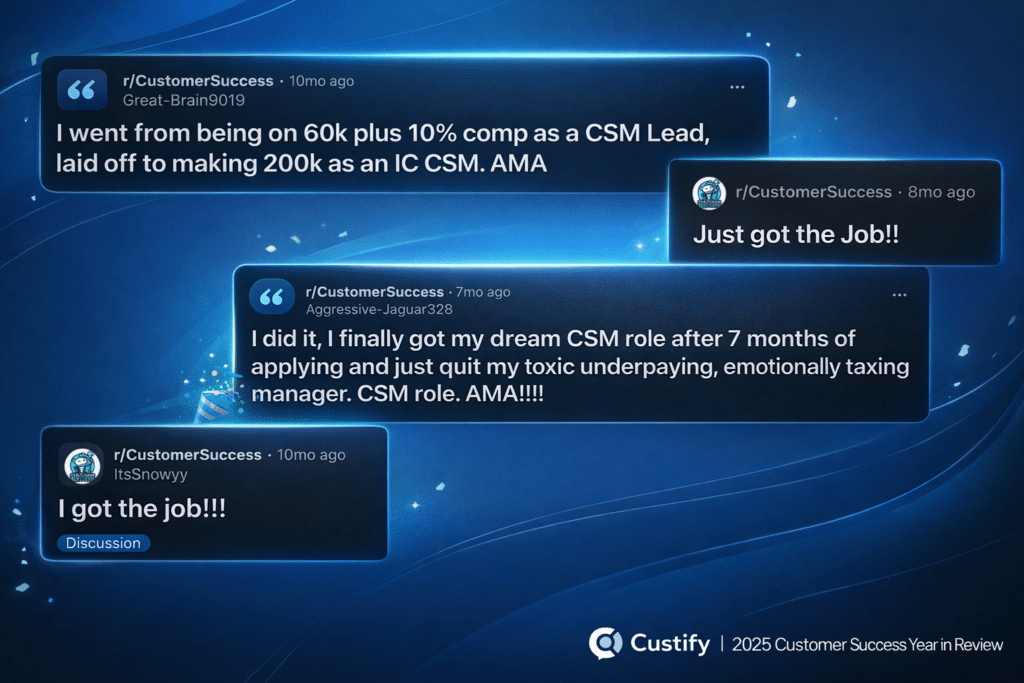
While many found new and exciting opportunities over the past year, the struggle was very real. Most highlight months-long processes that included hundreds of applications, very few actual interviews, and many take-home assignments.
3. Management Issues Continue to Lead to Customer Churn
Surprising no one, management and communication issues continued to be a top concern for CSMs in 2025. Specifically, customer success is currently facing some recurring issues between CSMs and higher-ups, particularly in areas like:
- Churn risk, prevention, and miscommunication.
- Churn interpretation and explanations, particularly when it’s out of the team’s control.
- Explaining the value of customer success and potential blockers.
- Customer success taking the blame despite reaching retention goals.
4. Dissatisfaction and Burnout among CSMs Continue
Despite some CSMs landing in very fruitful positions, dissatisfaction and burnout seem to be continuing. While not as prevalent as last year, there is a shift that’s happening: many CSMs are feeling like their job is “soul sucking”, “unbearable”, and “a dumping ground for all the company’s issues.”
For many, the enjoyment of providing a white-glove service for their customers has slightly faded, maybe along with that specific role of CSMs. While many still operate in that manner, a lot are seeing more of a shift towards either expansion-focused, salesy goals, or support-first, firefighting roles.
Does Anyone Else Find This Career Boring Now?
byu/HeyimShae inCustomerSuccess
5. Churn Prevention Continues to Be a Complex Process
Regardless of all these issues plaguing CS, churn prevention and retention continued to be top-of-mind for many. Specifically, there’s been a lot of talk around clients with highly complex use cases and high ARR ($1M+):
- How to secure onboarding when the client’s team doesn’t want or have time to cooperate.
- Finding uncommon ways to move past adoption blockers (such as sending lunch money to incentivize onboarding).
- How to document work on problematic clients so the blame doesn’t fall on the customer success team.
- How to avoid cases where the CS team is blind to potential churn risk and signals.
6. Tool Fatigue and Platform Sprawl
While CSMs have continued to be focused on churn reduction tactics, it’s been difficult to focus on a single tool or customer success software that can unify data sources into an accessible UI.
Platform sprawl and tool fatigue have set in: there are too many dashboards, too many spreadsheets, and too much disorganized data. Furthermore, the constant arrival and adoption of new AI tools have only worsened the issue.
The problem isn’t just the number of tools, it’s the lack of visibility across them. Information lives everywhere and nowhere at the same time. Customer context sits in the CRM, technical blockers are buried in Jira, onboarding tasks are hidden in project boards, and support conversations live in a ticketing system. None of these tools connect, and as a CSM, you’re left stitching everything together manually.
– Reddit User of r/CustomerSuccess
2025 Customer Success Must-Reads: The Best Articles, eBooks, and Studies
1. Articles
1. Time for a Reboot in How We Measure Customer Success | CMSWIRE
In this fascinating look at how customer service should be a company-wide mentality rather than a department, Michelle Wicmandy explores how we should measure the performance of CS and integrate those metrics into the wider organization.
Ultimately, success depends on whether service strengthens the relationship and delivers measurable business value. In B2B, self-service is often the first spin of the flywheel — but it stalls quickly. Gartner reports that only 14% of service and support issues in self-service are fully resolved. Even among issues that customers considered “very simple,” the resolution rate was just 36%. The takeaway: automation starts the motion, but empathy keeps it turning.
– Michelle Wicmandy, Global Strategic Marketing and Communications Leader
In this new landscape, a simple rethink of a team’s focus is necessary. Old, reactive metrics only track productivity, not the impact on customers. Instead, the article argues, we need to look at retention rate, lifetime value, revenue retention, customer health, and lastly, expansion.
2. Is Your Customer Success Team Helping or Harming Your Word-of-Mouth? | SaaStr
Jason Lemkin, Founder of SaaStr, explores how it feels to be upsold by a CSM that reports to the CRO, and how obvious it is when the goal isn’t “customer success” but to make a sale. Jason gives the example of a CSM setting a roadmap review call that, surprise surprise, turned out to be “Yet Another Upsell.”
At a basic level, this is what happens when Customer Success becomes part of the sales org. I see it time and time again and in fact, I just ask them when I have a crappy CS experience who they report to. It’s always the CRO.
– Jason Lemkin, Founder of SaaStr
3. Customer Success Plays A Crucial Role In Revenue Process Transformation | Forrester
In a frank discussion of customer success’s role in revenue operations, Laura Ramos argues that clear alignment around retention goals can move customers from the “retention groups” to the “buying groups” once expansion opportunities come up. CS is in a unique position here to help provide a better understanding of customers, leading to more meaningful results.
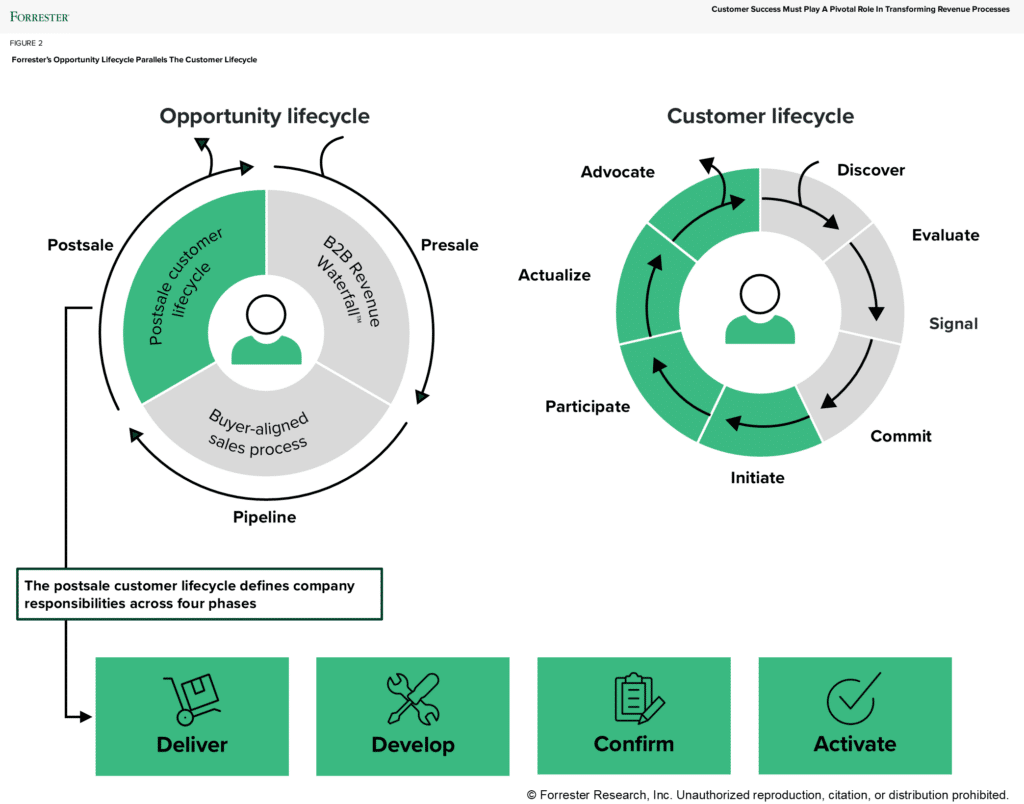
This adds further nuance to a key topic throughout the past year in customer success: how much should CSMs be in charge of expansion. A potential answer is: they’re already in charge through their retention efforts. If a company does all the necessary steps for onboarding, adoption, and retention, then expansion comes more easily and naturally.
4. Using Churn Data to Improve Sales Prospecting and Qualification | Custify
Sticking to the theme of how CS and Sales align, earlier this year, Irina Vatafu explored how churn data can inform and improve lead prospecting and qualification. The basic process comes down to:
- Gathering data from customer success regarding accounts that have churned
- Creating a churn scoring system that can inform lead segmentation
- Proceed to sort leads by churn score, potential value added, and other key datapoints (product fit, company risk, startup potential, etc).
- Prioritize the best leads according to your customer success criteria.
- Tailor outreach strategies for each lead segment.
5. How to Make Pricing Changes while Preventing Downgrades and Encouraging Upsells | Custify
Speaking of highly-specific strategies, our CEO Philipp Wolf explored a complex topic this year: how do you make price changes without losing your customers?
Working in CS, I’ve talked to many CSMs who were upset their pricing model changed, and all of a sudden, they’re struggling to justify the decision and keep legacy customers tied to their old, higher-tier plans, despite the new options being cheaper and making more sense for their business. That’s because many times, companies have a process in place for upsells but don’t have one for downsells, even if the alternative is full customer churn.
At the other end of the spectrum, I’ve seen companies raise their prices by 25% and lower their growth rate to under 10%. A move like this can cripple your SaaS and have an adverse effect compared to what you intended. For example, say your COGS increases by 35%, so you decide to raise your prices. The solution works for a few months, then suddenly your customer base stops growing like it used to. Meanwhile, churn hasn’t slowed down, and, in fact, has increased as customers are more hesitant when seeing the new price tag upon renewal.
– Philipp Wolf, CEO of Custify
The proposed solution? It’s multifaceted: careful consideration of the price change before implementation, cross-departmental alignment, full draft of price change strategy, addressing common issues, evaluating risks, gauging customer sentiment, and, if possible, soft launching and A/B testing the new price.
2. Books, eBooks, and Reports
1. State of SaaS 2025 | BetterCloud
Interesting Stats from this Report:
- 95% of companies have already invested in AI use cases.
- Organizations use an average of 106 SaaS apps.
- 34% of SaaS organizations automate onboarding.
2. State of Subscription Apps 2025 | RevenueCat
Interesting Stats from this Report:
- Yearly SaaS subscriptions significantly outperform monthly and weekly plans, with an average of 50-60% retention, versus 20-40 for monthly and 10% for weekly plans.
- “Not enough usage” is the top reason for churn across all subscription apps, with 32% to 47% cancelling because of it (depending on app categories).
- Over 30% churn for first-month users, suggesting many opt for free trials then cancel, or they cancel after a “forgotten renewal.”
3. CX Trends 2025 | Zendesk
Interesting Stats from this Report:
- Shadow AI usage surged 250% year-over-year.
- Consumer favorability regarding AI rose to 67%, a 10% increase compared to last year.
- 59% of CX professionals want to work more with AI.
4. State of the AI Connected Customer | Salesforce
Interesting Stats from this Report:
- Only 42% of customers trust that businesses will employ ethical use of AI.
- 71% of customers are more protective of their personal information than last year.
- 42% of customers would trust AI more if AI use was transparent.
5. The Future of Customer Onboarding 2025 | RocketLane
Interesting Stats from this Report:
- 49.6% of onboarding professionals cite misaligned expectations as the biggest bottleneck to onboarding today.
- 74.1% say that highly variable customer needs are the biggest challenge to maintaining consistency in onboarding.
- 90% of companies wanted to use AI and automation in 2025.
6. The Future of Sales in 2025 | Gartner
Interesting Stats from this Report:
- 44% of millennials prefer skipping sales rep interactions when making a B2B purchase.
- 33% of all buyers want to skip sales interactions altogether.
- Uncertain B2B buyers are 30% less likely to purchase and 42% less likely to get a high-quality deal.
7. Customer Success Trends ‘25 | Daphne Costa Lopes & This Is Growth
Interesting Stats from this Report:
- 91.8% of CS teams are directly responsible for customer retention metrics.
- 66.7% of CS leaders cited delivering value to customers as a key challenge.
- 52% of SMBs cited usage and adoption as their leading challenge.
8. 2025 State of Workforce Mental Health | Lyra Health
Interesting Stats from this Report:
- 73% of employees say work-related mental health issues impact their performance.
- 85% of employees say mental health benefits are key when looking for job opportunities.
- When offering comprehensive benefits, 96% of companies saw increased productivity, 88% saw positive ROI, and 88% had higher engagement.
9. State of the Customer Experience Report 2025 | CSG
Interesting Stats from this Report:
- 49% of US customers say customer service has worsened in 2024.
- 77% of US consumers don’t trust businesses to use AI responsibly.
- 60% of CX professionals said finding a link between CX and business metrics was a top challenge of their VoC programs.
10. Future of Jobs Report | World Economic Forum
Interesting Stats from this Report:
- Global net employment is expected to increase by 7% over the next 5 years, equivalent to an additional 78 million jobs.
- 67% of North American workers are projected to require reskilling or upskilling by 2030, a higher rate than the global average.
- 85% of employers globally plan to adapt by adding upskilling strategies, while 73% plan to increase automation.
3. Webinars and Podcasts
1. The Survival Guide for First-time CS Leads | Webinar
There are many, many things that can look like priorities. There are many expectations from the team. But the way I tried to think in order to put some clarity in my mind was to think that just like when you’re a CSM building relationships with customers, as a new manager, you need to establish trust and clarity internally before making any major changes in the team or coming with new ideas and projects.
So I started by listening. So I scheduled calls with everybody to understand: What are the current pains? What is everybody expecting from me?
I would try to find some small wins that I could deliver fast, but also establish some strategic projects that I could focus on in the upcoming weeks and months.
– Irina Vatafu, Head of Customer Success at Custify
2. Capacity Planning for CS Teams: Building Scalable Models That Work | Webinar
When you come into a startup as a new brand-new customer success group, you may only have a handful of customers. You don’t have a set procedure that says at this phase of the customer journey, you do these specific actions.
As time goes on and you get more customers, you do discover the workload’s getting pretty heavy. And that’s when you have to say, okay, we can’t really provide the same level of service to everybody. So we have to pick the ones that make the most sense and focus on them.
I tend to prefer the Horton Business School term of portfolios. So that you know how much that portfolio of customers is worth to you. And therefore, how much money you can spend on managing it and what services you have to provide.
– Mikael Blaisdell, Executive Director at The Customer Success Association
3. Driving Expansion and Revenue Growth | SuccessCoaching
When hard numbers aren’t where you want them, you want to lean into operational improvements. Stakeholder wins in this case, in the example, risk mitigation progress, whatever it is, those are proof points that still demonstrate that you’re making progress, and they can be connected to the bigger picture. And once you’ve done that, even though I talked about you can’t start telling or positioning future value before you’ve identified the current value, you can, at least in this situation. You then pivot to value ahead.
So you go from value achieve, which may not be very data rich because the data doesn’t sound good, to value ahead, but we really think we’re going to get to that point, right? And make that conversation forward-looking, right? We’ve built the foundation, and here’s what our next focus is going to be, so we can get to that point that you want to get to.
– Andrew Marks, Founder of SuccessHACKER & SuccessCOACHING, Host of the CS Leadership Roundtable
4. CS Playbook for tough times: What to do when the odds are against you | Webinar
I really think that it starts with transparency and building trust, right? Your team needs to feel safe knowing the why behind tough decisions.
When you have few resources, you got to prioritize, and you need to empower your CSM to say no to low-impact work. Give them the space to really make those kinds of calls and decisions.
And most importantly, you got to model the sustainable behavior yourself. If your team only sees you working late and messaging them on odd hours, firefighting, then they’re going to think that that’s how they should be doing things, that that’s the standard.
– Angeline Gavino, Founder, CEO, and CS Leadership Coach at CS RevSpeak
5. From Dashboards to Action: AI Agents and the Future of Customer Success | TSIA
Right now, we are seeing our research highlight: there’s this growing complexity associated with our technology, especially as we continue to layer in additional capabilities, and with these AI tools that are out in the market.
So as we adapt to our evolving customer needs and we expand our service offerings, more often than not, I think, we all have experienced that we are encountering challenges with these disparate technology stacks and different teams that can really hinder our performance and our efficiency as a team. And so the core of this issue really lies in these disconnected customer experiences.
– Darlene Kelly, Director of Customer Success and Customer Growth and Renewal Research at TSIA
6. The Cost of Free: Rethinking what we charge for in CS | Webinar
There is no universal right or wrong. Some organizations decide to never charge because that is right for them, but you still have to be aware of where you spend your time. It is easy to get pulled into things that do not drive retention or expansion.
Leaders and ICs in CS should know what Sales is saying. If you are new, ask to watch a Sales demo. Then give Sales precise positioning for onboarding and services.
Have a clear, open dialogue. Once you show consequences, they adjust. Be specific with words. You can always give more, but it is hard to take away.
– Jamie Moquin, Head of Customer Success at Nectir
7. Escalated: How CS leaders tackle real customer crises | Webinar
Escalations are healthy. So it’s a healthy, natural, important part of what that job is, what our role is, and why there’s a leadership structure in the first place.
Swallow that pride. Best case scenario, a CSM then interrogates what’s going on very deeply because the quality of the engagement with leadership depends very, very much on the research and your understanding about what exactly the nature of the challenge and problem is.
– Matt Woodward, VP of Client Success at Link Investment Management
2025 Top Influencers in the Customer Success Space
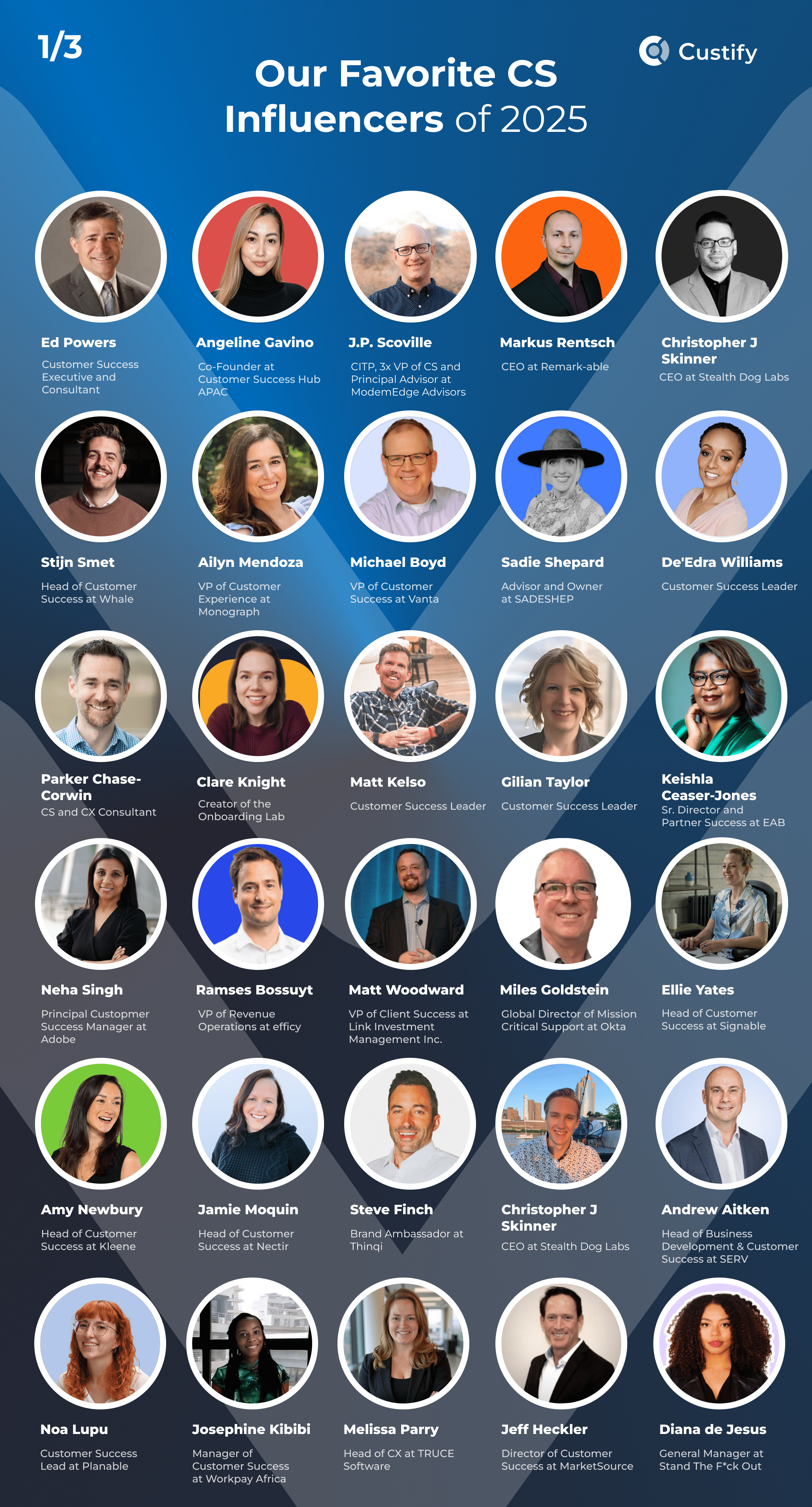
Full list of our top customer success influencers in 2026 here.
2025 Custify Year In Review: Best New Features & Achievements
New Features
In 2025, we broke ground on some exciting, in-depth updates to the Custify customer success platform. We focused on improving what our customers already loved and adding functionality that can enhance and personalize their experience.
1. CustifyAI Official Launch
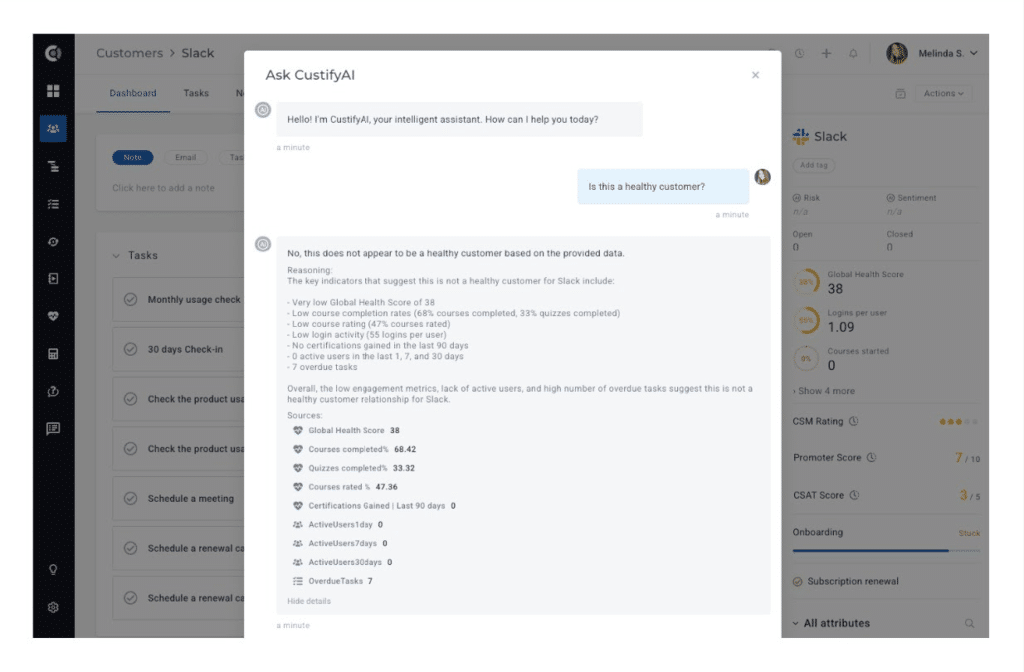
First off, 2025 saw the full launch of our CustifyAI feature. While last year we simply tested what we could do with AI, we’re now at full, context-aware implementation that allows our customers to:
- Ask CustifyAI directly about accounts. Example: “Does this customer seem at risk based on recent conversations?”
- Filter accounts based on AI. Example: “Show me customers who haven’t logged in for 30 days.”
- Conversation analysis, sentiment and risk scores. Example use case: build customer segments such as “Detractors with high ARR” or “Negative sentiment + low product usage.”
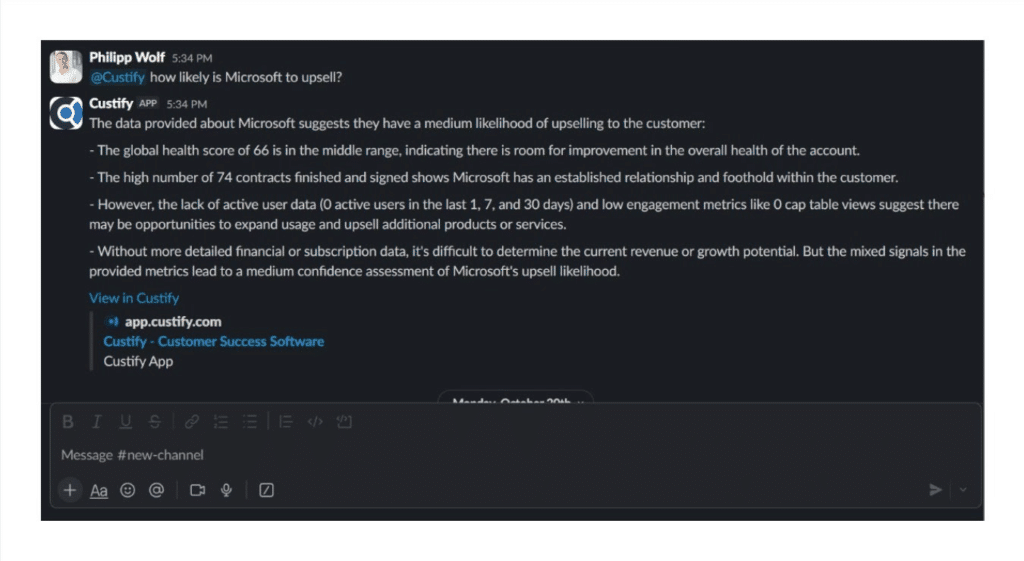
- Talk to CustifyAI directly on Slack. Example: “Give me a quick summary of this customer, key risks, and any open issues that might impact renewal.”
- Generate AI customer summaries. You can also use pre-built templates to determine the focus and headings of each summary.
- Add automated AI steps to playbooks. Example step: “Generate CustifyAI Summary using the Revenue Snapshot template.”
- Generate automation playbooks. Example: “Create a customer re-engagement playbook that triggers based on inactivity and sends 5 emails.”
And these are just a few examples of what CustifyAI can do.
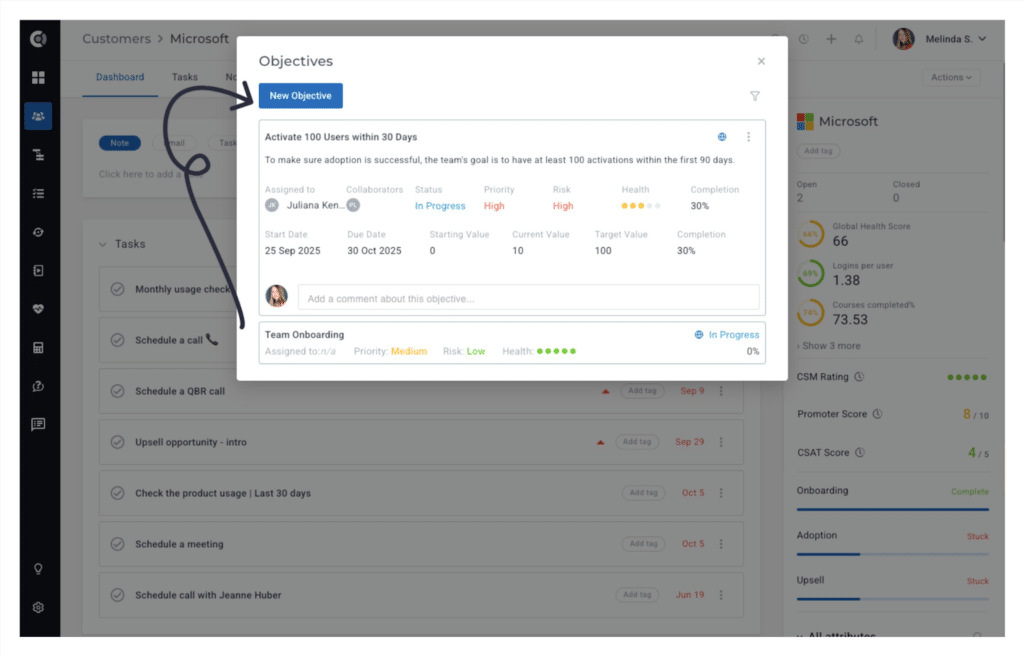
2. Customer Objectives
With Customer Objectives, you can track your customers’ strategic goals directly in Custify. You can view your progress, see health scores, and track adoption, ROI, onboarding, or expansion goals against your milestones.
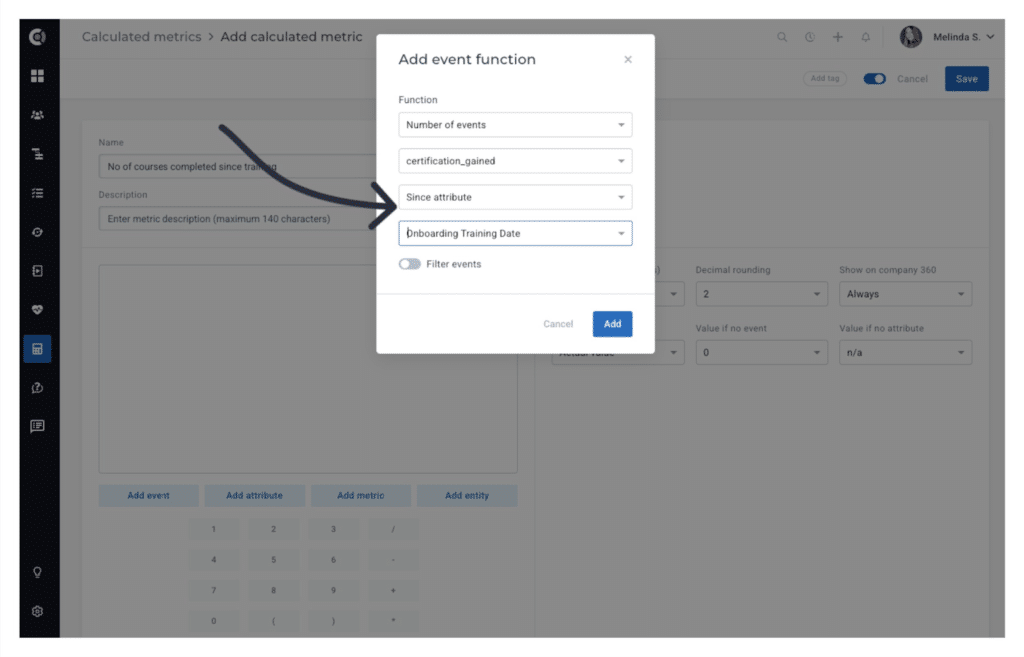
3. Calculated Metrics
We also launched the ability to create calculated metrics. For example, you can now track customer activity from a specific date onwards. Calculated metrics also allow you to factor in customer objectives into your customer health scores, further enhancing our already powerful health scoring engine.
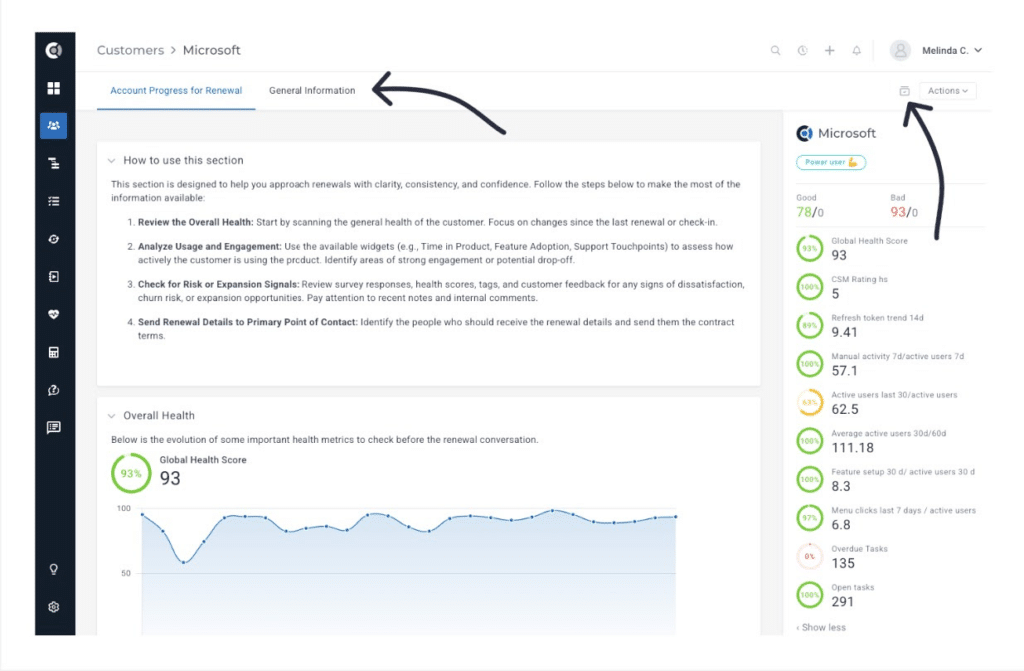
4. Dynamic Customer 360 Views
You can now customize your Customer 360 views and tailor them around specific workflows. Change tabs, layout, add or remove content blocks – everything is at your disposal in the new Dynamic 360 Views.
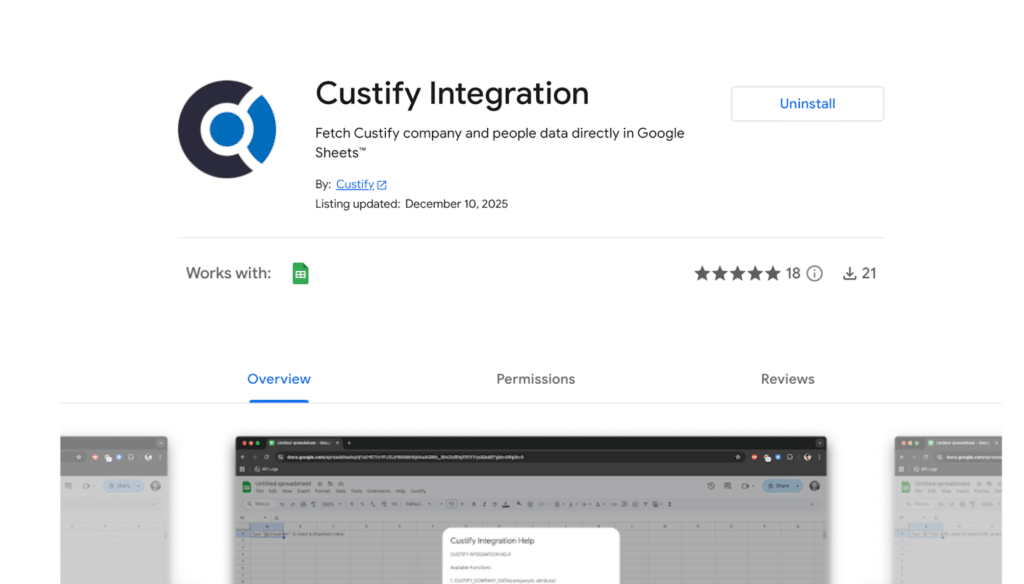
5. Custify Integration for Google Sheets
Another much-requested feature comes from our new Custify Integration for Google Sheets. With this simple, formula-based extension for Chromium-based browsers, you can access company and people data, cache items to improve performance, and create dynamic reports with custom cell references. Say goodbye to manual CSV exports – you can now export reports directly to Google Sheets and have everything ready for your next QBR in minutes.
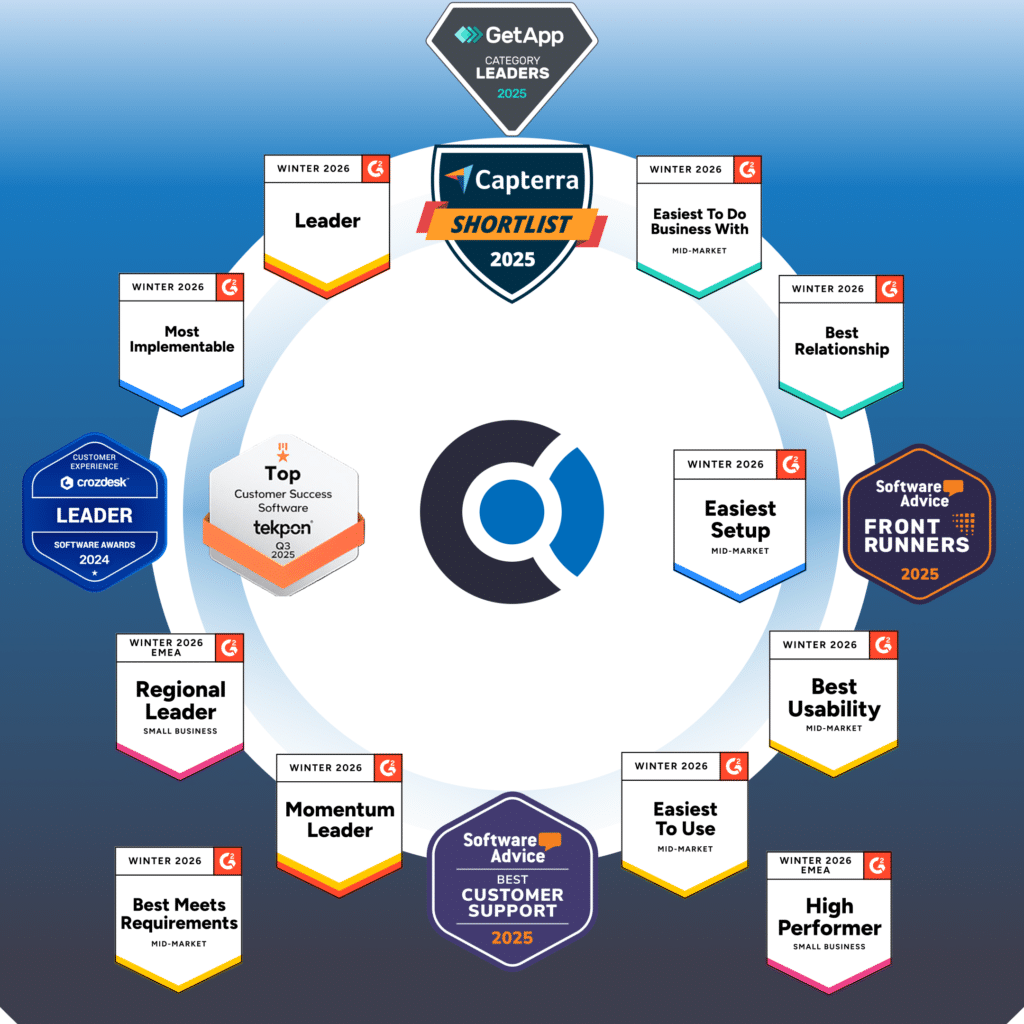
Awards & Achievements
Predictions and Expectations for 2026 in Customer Success
- More Accent on Implementable, Context-Aware AI CS Solutions. AI that lives in your CSP, integrates with everything from your dashboards to your tasks and automation, and conversational AI that is actually aware of what’s happening with your accounts and doesn’t hallucinate answers that sound nice without any action items.
- Renewed Focus on True Product Adoption, Particularly for SMBs. With 52% of SMBs still facing significant adoption and usage challenges, it’s clear that most new CS teams will have major challenges as they start to work more strategically.
- A Time of Trials for Customer Success Leadership. Customer success leaders seem to be stuck at a crossroads between leading their teams with intention and purpose and providing explanations to leadership as to why some customers churn and why customer success adds value. But there’s a clear path ahead: lead with empathy, stick to the numbers, document everything, and bring receipts.
- Back to the Basics of Customer Success. Delivering value seems to be one of the only facets of customer success that continues to consistently rank high among CSMs’ challenges. In a return to form, this renewed focus could help workflows shift closer to the original purpose of CS: driving retention and helping customers.
Why Did 2025 Feel Harder for CSMs than 2024?
On the whole, I think it’s fair to say 2025 has felt worse than 2024, especially for CSMs. There are a few key reasons why: The core of the issue came down to burnout and stress, slow progress, misalignment and miscommunication, and haphazard AI adoption.
Altogether, these elements have contributed to a general feeling of uneasiness and confusion that permeated all levels of customer success in 2025. There have been positives, however:
- Many CSMs have landed their dream jobs
- There’s been a renewed focus on delivering value and helping customers
- We’re seeing new AI solutions that actually make life easier
That being said, we’re looking ahead at 2026 with hope. With a bit of effort, a bit of alignment, and some help from purpose-built tools, we can continue to weather the storm of uncertainty facing customer success and help each other through it. That’s going to be our focus at Custify going into next year. If you’d like to join us on our quest, schedule a call, and let’s see how we can help!