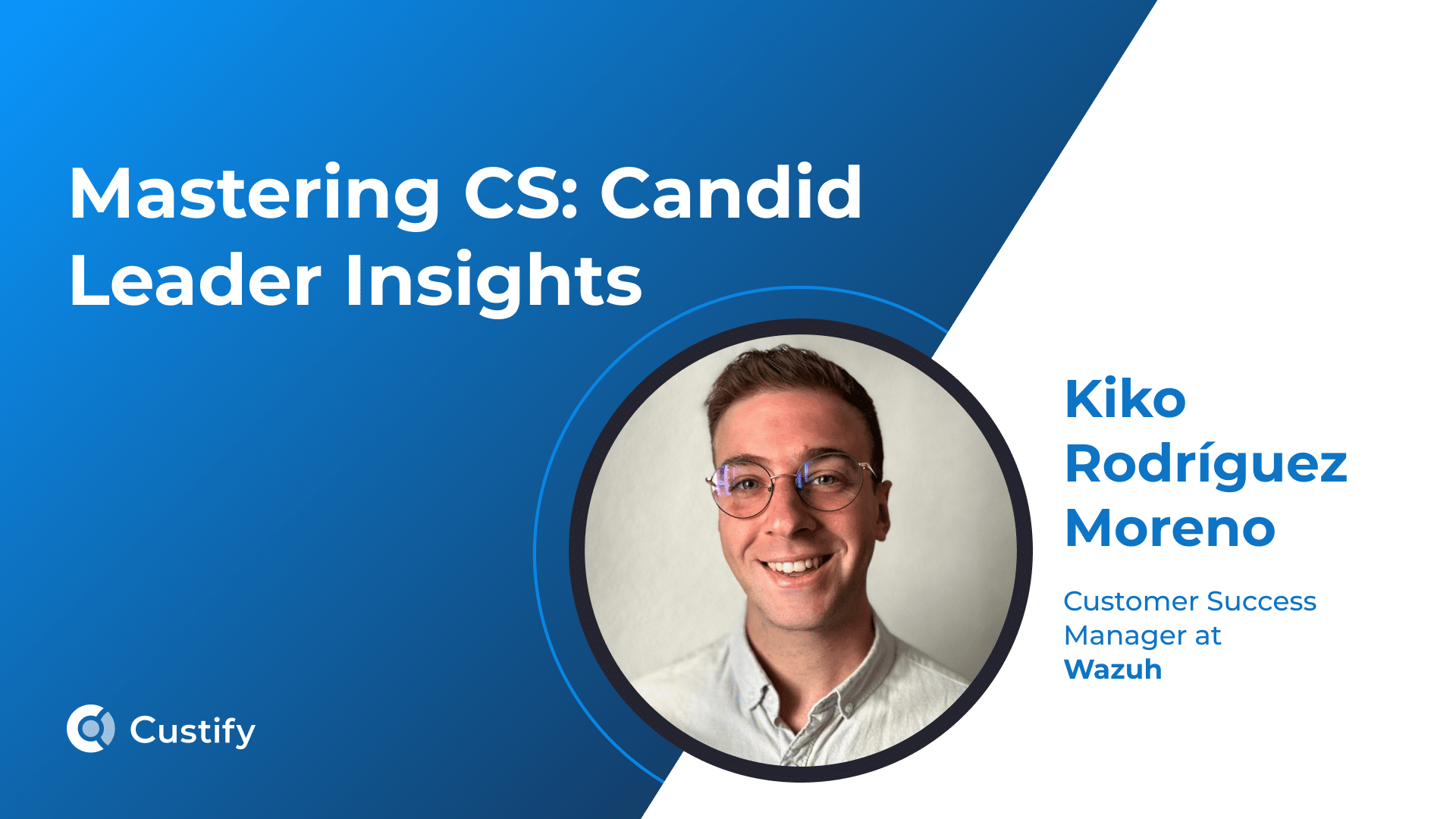
In this episode of Mastering CS Candid Leader Insights, Irina Cismas sits down with Andrea Zen, Customer Success leader at Fairly Made, the technology platform helping fashion brands improve supply chain traceability, sustainability reporting, and regulatory readiness.
Andrea shares how his background in fashion, buying, and marketplace transformation shaped a deeply customer-centric approach to CS, then explains what it takes to support clients in one of the most complex operating environments: fashion data, supplier networks, and fast-evolving ESG regulations.
He breaks down how Fairly Made serves luxury, premium, and mass-market brands, why messy product data sits at the center of customer success, and how CS becomes part educator, part change manager, and part strategic guide in a regulated category.
What You’ll Learn
- How Andrea transitioned from fashion buying and merchandising into customer success
- Why customer centricity starts across the entire business, not only inside CS
- What makes customer success in fashion traceability more complex than standard SaaS
- How Fairly Made supports luxury, premium, and mass-market customers with very different needs
- Why messy product data creates one of the biggest operational barriers in fashion tech
- How Andrea uses ARR, churn, renewals, and NRR to understand customer maturity and growth
- Why portfolio management requires balancing revenue, support effort, and client margin
- How low-touch experiences can still feel high-value when designed intentionally
- Where teams lose critical customer data between Sales and CS, and how to fix it
- Why CS at Fairly Made depends on regulation knowledge, change management, and internal advocacy
- How Andrea helps his team balance customer advocacy with healthy boundaries
- What non-traditional CS leaders need to learn early: SaaS language, business context, and when not to say yes
Key Insights & Takeaways
Customer centricity starts long before CS. Andrea’s background in fashion and merchandising shaped a core belief: every team affects the customer experience. Customer success formalizes that responsibility, but it does not own it alone.
Fashion traceability turns CS into an operational guide. Fairly Made’s customers are not only adopting software. They are navigating messy product data, supplier complexity, and new sustainability requirements, often while balancing already overloaded roles in production, quality, and development.
Customer maturity matters as much as retention. Andrea looks at renewals, ARR growth, and churn, but he also reads customer frustration differently. New challenges often signal progress, because the customer has moved beyond last year’s problem and is ready for the next stage.
Portfolio strategy needs margin logic. Revenue alone does not define account value. Andrea evaluates revenue, support effort, and margin together, then designs customer journeys based on both ARR and maturity.
Low-touch does not mean low-value. Smaller accounts do not always need more human involvement. In many cases, they need better autonomy through documentation, structured guidance, and scalable support that still feels high quality.
The Sales-to-CS handoff is a major data risk point. Teams lose critical context when deal information is not transferred clearly. Andrea focuses on CRM playbooks, simple handover structure, and better feedback loops between Sales and CS.
Podcast transcript
Intro
Irina (0:06 – 0:28)
Welcome to Mastering CS: Candid Leader Insights, the podcast where we dive into the world of customer success with industry leaders. I’m your host, Irina Cismas, and today I’m joined by Andrea Zen, the Customer Success at Fairly Made, a technology platform supporting supply chain traceability in fashion.
Andrea, I’m really happy to have you here. Thanks for joining!
Andrea (0:29 – 0:30)
Thank you for having me!
From fashion and merchandising to customer success
Irina (0:31 – 0:47)
You didn’t start in SaaS. You started in fashion, buying, merchandising, marketplace transformation. Looking back, what parts of that world shaped how you think about customers today?
Andrea (0:48 – 2:10)
I love this question. My previous experiences made me realize how important it is to be client-centric. It doesn’t depend on where you work in the company.
You can be in the tech team, marketing, or accounting.
What’s important is to always think about your clients. The consequences of your actions shape how clients see your business. For example, when I was at 24S.com, an e-commerce pure player created by LVMH, we had a strong client-first philosophy. That shaped how I approach my daily work today.
At Fairly Made, we want to create a customer-centric standard. Beyond the technology and the value we deliver, we want clients to remember Fairly Made, raise awareness within the industry, and recognize the service we provide.
Irina (2:12 – 2:19)
I’m curious, what made you move from the luxury marketplace world into customer success and tech?
Andrea (2:21 – 3:32)
I don’t think it’s that far from what I was doing before. I was already having business discussions with clients. At 24S.com, I was in the purchasing team, so I was technically the client, but the discussions were quite similar.
We were building an e-commerce website, which is quite technical in a way, and I really enjoyed that. I also enjoyed working with tech teams to recreate a human luxury experience through a website. That also came through the product selection we were setting.
When I left 24S.com after three years, I wanted to have different discussions with the same type of people. I was lucky to find Fairly Made, where we work with luxury, fashion, and mass-market clients. It’s the same audience, but the level of discussion is different and more aligned with the value I was looking for.
Fairly Made in 2026: who they serve and why the work is complex
Irina (3:33 – 3:42)
Today, as head of CS at Fairly Made, what does your world look like? What kind of customers do you serve, and what makes them complex?
Andrea (3:43 – 5:51)
We have very different segments in our portfolio, which makes our work exciting. We started with luxury clients because Fairly Made was part of an LVMH startup incubator. That’s how we built the business, but now we also have premium and mass-market clients.
These segments come with very different challenges. What makes the fashion industry complex is that it’s highly creative. Teams are constantly creating products, defining brand DNA, and launching new collections every three to four months.
The result is that the data becomes creative as well. By that, I mean it can be messy. It’s often difficult for people in the industry to know exactly what to expect when they upload data into Fairly Made.
When we talk about ESG challenges, they are often seen as something very positive—green tech, eco-design, and so on. But behind that, there is a major data challenge. That’s one of the core complexities of the industry.
Another complexity is the people we work with. Most of them are not CSR specialists. They work in production, development, or quality, and already manage large responsibilities around cost, delivery, and performance. Now they also need to take on CSR topics.
That’s where Fairly Made comes in—to make their daily work easier and help them manage these new challenges. We are building important standards and helping them handle a growing to-do list. The same applies to suppliers as well.
What success means: retention, growth, and customer maturity
Irina (5:53 – 6:08)
What does success mean in your context? Adoption, compliance, impact, renewals, maybe totally something else. What’s important?
What’s the North Star metric that you guys are monitoring in customer success?
Andrea (6:09 – 8:09)
We are monitoring the basic KPIs in customer success, which would be renewals. Another way to say this is that we’re trying to retain clients as much as possible, which means we are really looking at churn rates. We are also looking at growing ARR, because it means our clients are expanding their projects with Fairly Made.
They are purchasing new modules and increasing the volume of products they want to trace and analyze with Fairly Made. Net recurring revenue is also one of the new KPIs that we are implementing this year.
We are trying to make our team more mature around these KPIs. We are looking at the basic ones, but if you tell the story, a successful customer journey would be someone who subscribes to Fairly Made with a few targets. We are partly a regulatory tool, so they subscribe for an initial regulatory step.
Then, year over year, you see them growing in maturity and understanding that one problem is solved. They move on to the next one, and then the next. This progression can be reflected in the metrics I mentioned.
But when you actually speak with them, what sometimes happens is that a client becomes annoyed by something they weren’t concerned about the year before. For example, my team sometimes says, “We worked so hard with this client this year, we solved this problem, but now they are annoyed about something new.”
I see that as a positive sign. It means we helped them grow in maturity, uncovered new challenges, and now we can help them solve those as well. Each year is different.
Managing the CS portfolio through revenue, effort, and margin
Irina (8:11 – 8:34)
You’ve worked in marketplace economics where margins, performance, and portfolio optimizations are everything. How does that influence how you manage a CS portfolio today? Also correlating with how you help your customers grow and how growing exposes new challenges that you guys are overcoming together.
Andrea (8:34 – 11:23)
I think one of the most interesting parts of working at LVMH is that it’s very numerical. Everything is a number—margin, growth, turnover, etc. At first, when you are young, it feels overwhelming. It’s just a new language.
When I changed roles and arrived at Fairly Made, I was new to customer success, so I had to ramp up. Today, we try to be very specific when looking at the portfolio. We know the revenue each client generates, the time we spend on that client, the time the team spends overall, and then we look at the margin for each client.
It doesn’t mean we stop supporting clients based on that. It means we try new scenarios. For example, for clients in the lower ARR range, we ask: what do they actually need? Do they need that much support? Or do they need more autonomy, more documentation, or a help center?
When you dig into it, it can feel like a cold way of looking at things, but it actually leads to better conclusions. You can help the business evolve while still supporting the client—just in a different way.
We now have a clearer vision of clients, margins, and time spent, and we are building customer journeys based on both client maturity and ARR.
What I often say in meetings is that we can reproduce the same human experience with lower-touch approaches, using technology or other formats. We can still create the feeling that Fairly Made supports the client, helps them grow, and is there when needed—even if it’s not always through people.
My previous experience really helped me with this. Working with numbers is challenging because it requires precision and leaves room for error, but when you improve that precision, you can design better experiences for both clients and teams.
Data integrity in CS: internal handoffs and industry-wide messiness
Irina (11:24 – 12:01)
I want to talk about data because you mentioned that data is important. And to be honest, I wouldn’t have expected this because for me, fashion means creativity, fashion doesn’t work hand in hand with data. But I know that you’ve led data conformity and back office transformation projects before.
So I want to ask you how important data integrity is in customer success, and where do you see teams getting it wrong? Why is it so hard, at least in your industry, in your vertical? What’s the hard part?
Andrea (12:04 – 16:34)
I think there are two different things here. First, what you were mentioning is how customer success teams handle data—data continuity within the pipeline.
This is basic for many SaaS companies. Salespeople sign a contract after having many discussions with the client, where a lot of information is shared. Then they hand over the client to the existing business team.
This is where, in my opinion, a lot of data gets lost. We are trying to create playbooks in our CRM with key questions, but without making them too heavy, because then people stop using them. The goal is to make sure that even if sales, account managers, and CSMs don’t meet in person, everyone has the same level of information.
So we use simple questionnaires. But what is often missing—and I see this across many companies—is a feedback loop between Sales, CSMs, and account managers. Not just about specific contracts, but more generally. For example, this contract was a good fit because of X, or this one wasn’t a good fit because of the product or the client profile.
This helps align teams on what the ICP actually is.
That’s the first part of how important data is for our teams. The conclusion is that the more you know, the less you rely on feeling. I see this a lot in my team, and even in myself when I manage a key account. Sometimes we say, “I feel they need this.”
That feeling is useful, but it can also be a bias. So we coach ourselves to ask: what is this feeling based on? Do we have data? CRM information? Any concrete signals?
As a manager, it’s interesting to see people grow and start bringing clear, factual explanations of why we should upsell—or why we shouldn’t. It becomes less about “I have a good or bad feeling” and more about evidence.
The second part is specific to the fashion and luxury industry. For years, people were creating products without questioning how data reflected the actual product. But if you look closely, a product is a collection of data points moving through different systems.
Now, teams in fashion and luxury need to collect and structure this data for solutions like Fairly Made, including data from suppliers and across the supply chain. When they start doing that, they realize there are many inconsistencies and gaps.
Some clients even tell us that working with Fairly Made helped them reorganize internal teams because workflows were not aligned.
This is also part of our role in customer success. It’s not only about helping clients use the platform—it’s about pushing them toward change. We talk a lot about change management: how to implement change, how to identify who is ready for it, and how to support that transition.
We are a mission-driven company, and we invest heavily in that objective.
Customer success in a regulated, mission-driven category
Irina (16:35 – 16:58)
Speaking about how this role might be different, FairlyMade operates in sustainability and traceability, which is highly regulated and politically sensitive. How does that change the role of the customer success compared to a standard SaaS environment, if it does?
Andrea (16:58 – 18:45)
I think I see what you have in mind. The thing is that we have traceability and impact measurement solutions on the market today. We are very young companies, and it’s a new market.
So yes, it’s highly regulated. What is expected from our clients is quite structured. The first thing is that we need to stay very close to the reality of those regulations.
For example, we have someone at Fairly Made involved in working groups with the French government and the European Commission, constantly updating the company on what will be expected from our clients in terms of regulation. At the same time, in customer success, we need strong knowledge of these regulations and the technical aspects of the field, and we need to advocate for them.
Sometimes, people feel it’s too much—and I understand that. They already have full-time roles, teams to manage, and targets related to quality, pricing, and more. Then we come in and say, now there are new objectives and new regulations.
So we need to help them keep up and understand the vision behind what we are doing. It’s not just about reducing churn—it’s about helping them see why this work makes sense, both for them and for the industry, and how it compares to other solutions on the market.
So yes, you really need to believe in what you do when you work in CS at Fairly Made.
Scaling challenge: competition, positioning, and AI-driven doubt
Irina (18:46 – 18:52)
So what’s been one of the toughest scaling challenges you’ve faced in CS so far?
Andrea (18:52 – 21:18)
I think it’s the… I don’t want to say it’s only competition, but what I mean is that the market is very new. When a market is new, you have many players entering it and trying to take share. Sometimes that creates misleading discussions with clients.
The company was built based on regulation and a scientific approach. The first people we hired at Fairly Made were engineers—textile engineers, real experts in the field, and not easy to find. Then we expanded the team with other experts.
We are very serious about what we do. It’s not perfect, but it’s based on scientific research that we interpret and integrate into the product. Sometimes, new players enter the market at a lower price, adding AI to their marketing and sales pitch. That creates doubt for our clients.
They might think they can get the same quality for half the price because another solution mentions AI. We are not the number one on the market, but we are one of the best.
The hardest discussions with clients are around this. How do you explain that you can’t get the same quality with half the price and fewer people involved? It can be frustrating for the team. They say, yes, we are more expensive, but that’s because we invest more expertise and more people into each account.
You need to help them take a step back. When you are buying something and you see half the price and AI, it’s attractive. So you need to stay calm and focus on what you do best compared to competitors.
The goal is to help clients make the right decision in a rational way, without emotion. You present the facts and let them decide. Generally, it works.
Irina (21:19 – 21:30)
If customer success were a fashion collection, what season would your team be in right now? Launch, run away, restructuring, reinvention, and why?
Andrea (21:31 – 23:09)
How would I see my team? I think, if I’m being honest, we are still in the development phase of creating garments. Three years ago, we were two people, with more engineers working face-to-face with clients, but only two people in what we called customer success.
The year after, the conception of customer success within the company changed, and we started hiring. Last year, the model changed again.
So every year, we are changing. And I think it’s because customer success is a theory, and you need to adapt that theory to the reality of the business. As Fairly Made is changing so fast, we are changing every year.
We are releasing new features, big features in the product, and because of that, the team evolves as well. As long as the company changes, the team will keep changing.
So it’s a continuous work in progress, which is exciting, but you need to be careful with the team involved. You need to explain why things are changing, why roles are changing. Someone who was in customer success might now be closer to account management, or more focused on implementation.
You need to explain the “why,” share the vision, and show how it supports the business.
Andrea’s advice: stay curious, learn the language, and build boundaries
Irina (23:10 – 23:20)
Andrea, last question. For someone stepping into CS from a non-traditional background like yours, what’s one mindset they should develop early on?
Andrea (23:21 – 27:10)
I think when I arrived at Fairly Made, if I’m being honest, I had no clue what I was talking about. I came from purchasing and merchandising, so I had client relationship skills and B2B experience, but customer success itself—I had only taken a four-week online course before the hiring process, and I was like, okay, let’s go.
What helped was staying curious about what people were talking about and trying to translate it. People were talking about ARR, churn, renewals. It didn’t mean much to me at first, but I could relate it to what I already knew. ARR is revenue, renewals mean the client stays, churn means the client leaves.
So I stayed grounded in the reality of the business. The SaaS model requires you to know this language and share these KPIs, even with investors. You need to learn it, but also stay practical.
Another important thing is learning how to say yes and no at the same time. You don’t want to say no to a client, but always saying yes is risky.
You need to take a step back when a client has a request that is out of contract or process. This happens often at Fairly Made because we are a young company, and clients are still shaping what the product should be.
So we coach the team to pause and clarify: what is the exact request, and what options do we have? There is also an internal escalation process—who to contact, who makes the decision.
Then, instead of saying no directly, you explain what is possible. You present options and let the client decide. You don’t push a solution—you guide them.
If you immediately say yes without thinking it through, it may not work as expected, and that creates frustration later.
So the approach is: this specific request is not possible, but here are the options. Which one works best for you?
Saying yes all the time is not a good idea. At the same time, in a startup or scale-up like Fairly Made, some requests are valuable signals. If one client asks for something, others in the same segment might need it too.
So you also need to advocate internally. You can say: this is one client, but I see a pattern in this segment, and this feature could help us grow.
It’s a balance—advocating for the customer while maintaining healthy boundaries.
Irina (27:11 – 27:32)
Andrea, thank you for the conversation. It was great exploring how you guys approach customer success in a space where data operations and long-term impact all intersect. And to everyone, thanks for tuning in.
Until next time, stay curious, keep learning, and mastering customer success.