AI knowledge bases for SaaS now handle many first-line support queries, but a confident response isn’t necessarily an accurate one.
Citations give customers a way to verify an AI-generated answer against its source, although research shows that citations can increase trust even when users don’t check them.
A customer logs a billing inquiry into your support widget at 11 p.m. The AI gives a link to a help page, sounds certain, and answers in two seconds. The customer skims it, nods, and closes the tab.
If you remove that link, nothing else changes. The answer and its confident tone stay the same, but now there’s no way to check it.
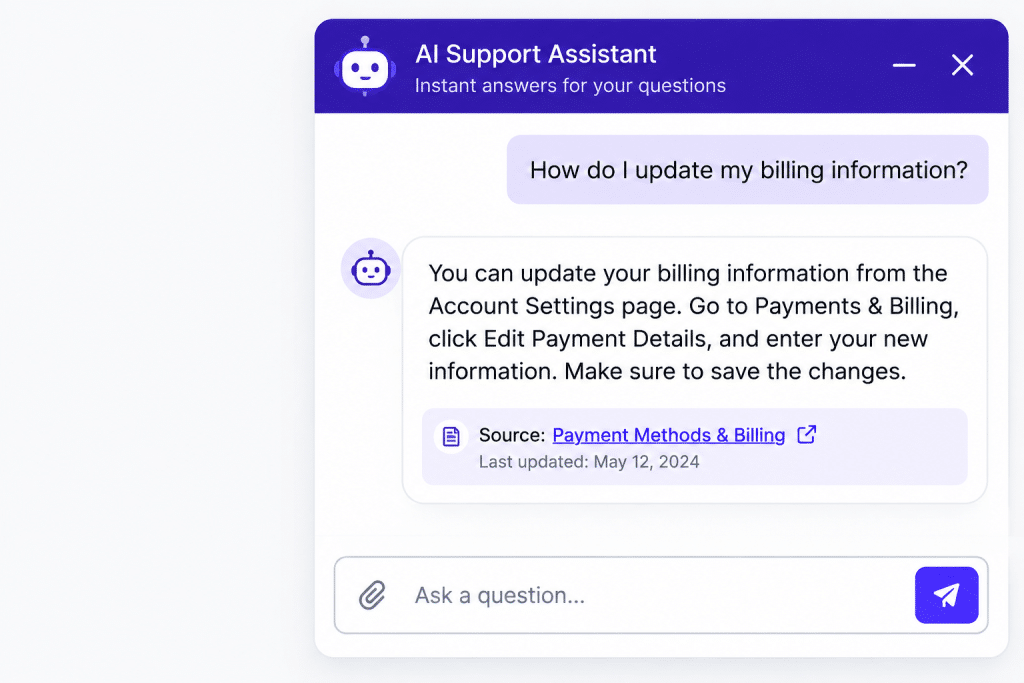
SaaS teams have rushed to put AI in front of customers, largely because it’s cheap and it works around the clock. But speed without a source is a gamble. A language model can generate a well-formatted, elegant response that is incorrect, and it uses exactly the same tone it uses when it’s correct.
Citations are supposed to close that gap. They turn “the AI said so” into “here’s the page it came from, go look.” But a citation only helps if the page behind it actually supports the answer.
How Citations Work in an AI Knowledge Base
Before you try to fix your citations, it helps to know what’s happening behind that small “[1]” next to an AI’s answer.
Retrieval, generation, and source attribution
Most AI knowledge bases for SaaS run on a method called retrieval-augmented generation, or RAG. The system doesn’t know your product the way a support agent does. It works in steps instead:
- It searches your documentation for passages that match a question.
- It hands the best matches to the language model, along with the question.
- The model writes an answer using those passages as raw material.
- The interface links back to the passages presented as sources.
Three separate jobs happen there, and any one of them can fail on its own:
- Retrieval has to find the right passage.
- Generation has to summarize it without twisting it.
- Attribution has to point to a source that actually supports the answer, not just something loosely related to it.
Why a citation does not automatically prove an answer
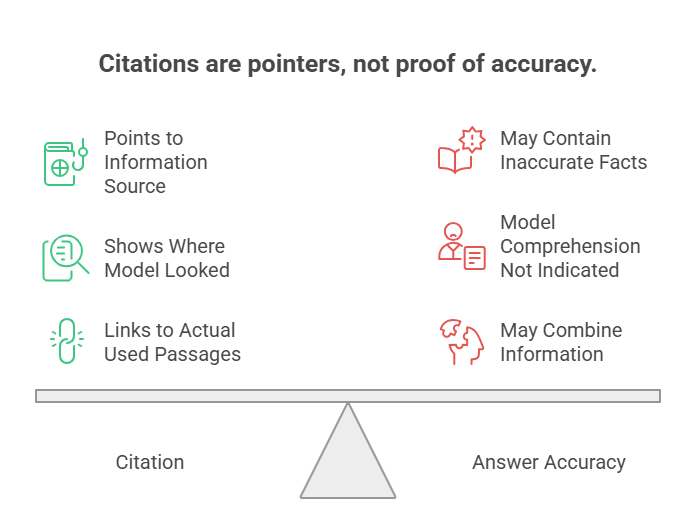
A citation identifies a source presented as supporting the answer. The link alone does not establish how the answer was generated, or whether the model understood what it read. A system may retrieve the correct article and still get details wrong in several ways:
- It can state inaccurate facts.
- It can combine information from two distinct sections.
- It can answer a question the source never addressed.
The link isn’t proof; it’s a pointer. Teams that treat citations as automatic evidence of correctness often end up shipping incorrect answers with comforting links attached.
Why Verifiability Matters in AI Customer Support
The risk of confident but incorrect answers
A support agent who isn’t sure usually says so. “I think,” or “let me double-check that.” AI systems rarely hedge that way.
A wrong answer reads exactly like a right one, clean and certain either way. That flatness is the real problem. Nothing in the tone warns a customer to be careful, so a made-up refund window carries the same weight as a real one.
Why citations can increase trust even when users do not verify them
This part surprises many people, and it’s backed by research rather than conjecture. A 2025 study published in the Proceedings of the AAAI Conference on Artificial Intelligence examined how citations affect confidence in chatbot responses. Researchers measured participants’ trust in answers that had zero, one, or five citations, some relevant and some added at random.
Two findings stood out:
- Trust rose when citations were present, even when those citations were random and unrelated to the answer.
- Participants who clicked through and checked the citations reported lower trust.
The study doesn’t show that checking was the only reason trust dropped. But the pattern is clear: the presence of a citation shaped trust before anyone verified it.
A separate study points the same way. In a nationally representative UK study by Ipsos on AI answers that cite news brands, trust in the answer closely tracked trust in the cited source. Together, these findings show that citations can influence trust before customers verify the information themselves. For SaaS companies, that creates a clear risk: adding citations without maintaining accurate documentation can make an incorrect answer look more credible.
The same dynamic plays out beyond your own support widget. Public AI assistants also cite sources when people ask about your product or category, and your documentation may or may not be among them. Similarweb’s AI Brand Visibility helps marketers see which topics and prompts surface their brand across AI platforms and how that compares with competitors. It doesn’t verify answers from your own knowledge base, but it can show where your content is being used as a source externally and where stronger coverage might help.

What a Useful Citation Gives a Customer
A citation earns its place in the interface by doing three specific things.
1. A path to the supporting passage
A good citation doesn’t dump someone onto a 4,000-word help article and let them go hunting. It links straight to the section, ideally with an anchor that jumps to the paragraph the answer relies on.
If a customer has to search a page just to find the sentence backing up an answer, the citation isn’t doing its job.
2. A way to check version and recency
A citation showing up doesn’t mean it’s current. Pricing changes. Features get retired. Pages get rewritten.
A citation with a visible “last updated” date and a product version gives customers a way to judge for themselves whether the source still matches the product they’re using today.
3. Access to deeper product documentation
For customers who want more than a short answer, a citation also works as a door into the rest of your knowledge base.
A well-linked citation invites someone to keep reading instead of stopping at an AI’s summary. This matters most for advanced users chasing an edge case the AI wasn’t built to fully solve.
If you haven’t built out that broader self-service layer yet, our guide to what a knowledge base is and how to choose the right tool is worth reading first.
How to Structure Documentation for Reliable AI Citations
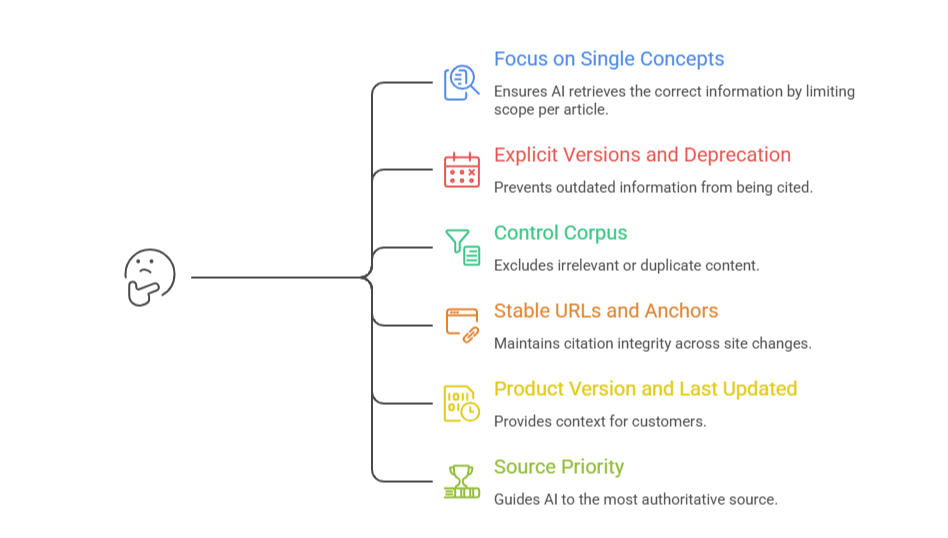
Good citations don’t come from a smarter model. They come from two things:
- Documentation written to be found and cited cleanly.
- Retrieval rules that decide what’s allowed to be cited at all.
Keep each source focused on one product concept
If one help article covers billing, refunds, and account cancellation in the same long scroll, retrieval has to guess which chunk answers a question, and it often grabs the wrong one.
Stick to one concept per article, or at least per clearly headed section. That gives retrieval a clean single piece to pull and cite.
Make versions and deprecations explicit, then enforce them
Retrieval systems have no built-in sense that a feature stopped existing last quarter. A version tag or a deprecation banner helps human readers, but on its own it doesn’t stop anything. The label only keeps old instructions out of customer answers if the retrieval system reads it and filters on it.
That takes a few layers working together:
- Separate metadata for product version, subscription plan, and access permissions, stored as fields the system can query, not just text on the page.
- Retrieval rules that enforce them. A customer on the Starter plan shouldn’t be served Enterprise-only instructions, and deprecated content should be excluded, not merely labeled. Most retrieval platforms support this kind of filtering, including applying permissions at query time.
- Refresh and removal of indexed content, so an updated or retired page doesn’t linger in the index as an older copy.
- A fallback when no current, permitted source supports the answer: ask a clarifying question or hand off to a human instead of answering from whatever is closest.
Control what enters the retrieval corpus
Not everything sitting in your content system belongs in the pool AI can pull from.
Watch for:
- Old drafts that were never meant to go public
- Internal-only pages that ended up in the public docs folder by accident
- Duplicate versions of the same article, worded slightly differently
- Pages archived in name only, but still technically live and indexed
Deciding what goes into that corpus is an editorial call. It shouldn’t be left to the retrieval system to sort out on its own.
Here’s a quick reference for what to check before a document goes into that corpus:
| Documentation element | Why it matters for AI citation | What good looks like |
|---|---|---|
| Stable URLs and anchors | Broken or shifting links turn a citation into a dead end | URLs and section anchors survive site restructures |
| Product version | Customers on different versions see different features | Stored as metadata and stated near the top of the article |
| Plan and access permissions | Customers shouldn't be served instructions for features they can't use or content they can't see | Plan and permission fields that retrieval filters on at query time |
| Last updated date | Lets customers judge recency for themselves | Visible, accurate, and updated on every real edit |
| Deprecated status | Prevents old instructions from being cited as current | Flagged in metadata and excluded by retrieval rules, not just bannered |
| Duplicate documents | Multiple near-identical articles confuse retrieval | One canonical version, others merged or redirected |
| Archived pages | Old pages left live can still get indexed and cited | Removed from the index or redirected before they're retrievable |
| Source priority | Retrieval needs to know which doc wins when two conflict | Clear hierarchy: official docs outrank community posts |
| No-source fallback | Without one, the system answers from the nearest match | Clarifying question or human handoff when no valid source exists |
For the broader principles behind organizing a customer-facing knowledge base, like navigation, search, and article design, this knowledge base UX guide goes deeper than we can here.
When an AI Citation Looks Trustworthy but Isn’t
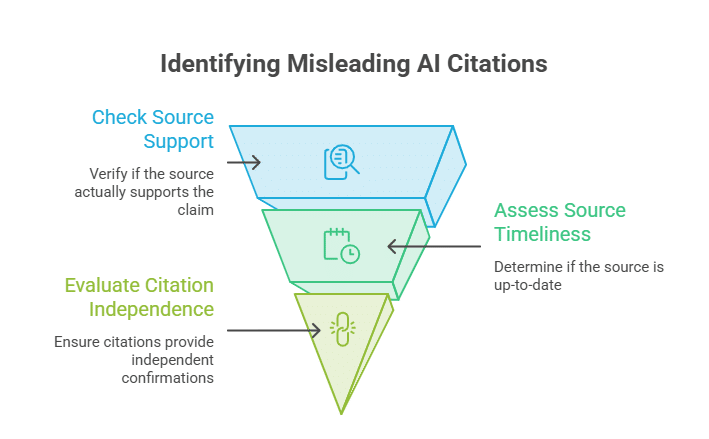
This is where most teams get caught off guard. A citation can look completely legitimate and still mislead someone.
The source does not support a claim
Retrieval can pull a passage that’s topically close to a question without it backing up what the model wrote. The link goes somewhere real. It just isn’t proof of the specific claim next to it.
Air Canada learned this in a 2024 tribunal case:
- A passenger asked the airline’s chatbot about bereavement fares.
- The bot told him he could apply for the discount retroactively after booking.
- It even linked to Air Canada’s bereavement travel page, but that page said the opposite: the reduced fare couldn’t be claimed after travel.
- The tribunal found Air Canada liable for negligent misrepresentation and ordered it to pay damages.
The citation was real, on-topic, and one click away. The answer was still wrong, and a customer relying on it had no reason to think otherwise. This is the most common way a “cited” answer turns out wrong.
The source is outdated
A citation can point to a real, on-topic article that used to be accurate.
If your pricing changed last quarter and nobody updated the article, the citation is technically honest and completely useless at the same time.
Multiple citations create false confidence
It’s tempting to assume five sources beat one. They don’t, not automatically.
Five links can just mean five documents got retrieved, not five independent confirmations of the same fact. If nobody checked them, more citations only add more decoration.
Call it “trust theater”: citations make an answer look rigorous, but nobody has checked whether they support the claim. Naming the pattern makes it easier for your team to catch before it reaches a customer.
How to Measure Citation Quality
Metrics from AI support logs show what the system did, but they do not show how customers felt afterward. A short post-interaction confidence check can add that missing perspective.
For example, teams can ask customers whether they felt confident in the answer they received. Tools such as Confiscore can support this type of confidence measurement through customer and employee feedback. This feedback can then be compared with claim-level support for the same topics.
This creates a clearer picture of citation quality:
- Answer-level citation presence: Did the AI answer include a citation?
- Claim-level support coverage: What percentage of factual claims were supported by the cited sources?
- Citation correctness: Did the cited passage actually support the claim?
- Stale-source exposure: How often did answers cite outdated or deprecated content?
- Source-open rate: How often did customers open the cited source?
- Recontact rate: How often did customers return with the same issue within seven days?
- Customer confidence: How confident did customers feel about the answer they received?
- Escalation rate: How often did cases require human support?
A high citation rate alone does not mean answers are well supported. Claim-level support and customer confidence provide a broader view of whether customers can rely on AI-generated answers.
Illustrative example: A customer asks whether a subscription downgrade qualifies for a refund. The AI says the customer receives a pro-rata refund within 14 days and cites a billing page. The cited passage only states that unused subscription value is issued as account credit. The reviewer marks the citation as present but identifies unsupported details in the answer. The corrected response explains the account-credit policy and directs the customer to support if the specific case requires review.
Support and documentation teams can review this evidence regularly. Customer success teams can follow up when repeated citation failures affect onboarding or adoption. If no current, permitted source supports an answer, escalation to a human can be the correct outcome rather than a measurement failure.
What Happens When the Source Documentation Changes
Documentation doesn’t sit still, and citations can’t be treated as if they do either. When a source article changes, a few things need to happen right away:
- Reindexing should run soon after publishing, not wait for a weekly batch job, or the AI keeps citing an old version of a page that no longer says what it used to.
- Outdated retrieval results need to be flagged and removed actively instead of left to age out. A stale chunk sitting in the index keeps getting pulled until someone removes it.
- Source replacement needs tracking, so when an article is modified or merged, every citation pointing to it is updated rather than left pointing at a dead link.
- Regression checks on your most frequently asked support queries catch cases where a previously accurate answer was subtly altered by a documentation update. Rerun your top 20 questions after any major doc change and confirm the citations still hold.
Skip this, and a knowledge base drifts from accurate to outdated slowly, until a customer notices before your team does.
Build Better AI Knowledge Bases for SaaS
AI knowledge bases for SaaS earn customer trust only when they can show their work, and showing their work only matters if the documentation underneath deserves that confidence.
A few things worth carrying forward:
- Structure sources around single concepts so retrieval has a clean unit to cite.
- Store version, plan, and permission data as metadata, and make retrieval enforce it rather than relying on labels.
- Treat your retrieval corpus as something you actively curate, not something that just accumulates over time.
- Measure claim-level support and recontact rate, not just ticket deflection, so you know whether trust is being earned or just performed.
If your team is wondering how AI support fits into a broader customer education strategy, our customer education content is a good next read.
And if repeated support problems are showing up in your ticket data, Custify‘s Zendesk Support integration lets you bring open and solved tickets into customer health scores, segments, and playbooks. That way, CS can spot accounts where support issues are starting to affect adoption before they turn into churn.