A playbook is your business’s operational blueprint for customer success (CS). It defines how to onboard customers, manage renewals, resolve support issues, run quarterly reviews, even guide account health. Done well, every team member knows the next step without constant guidance.
But here’s the challenge: what works for ten customers often breaks at 100, 1,000, even 10,000 if you haven’t designed for scale. Small ad-hoc fixes that work in the early days can create chaos as volume grows. So, how do you deal with it?
Don’t worry; This article builds on the Customer Success Playbook for Beginner CSMs, defining a playbook and its core elements for small books of business. But here, we focus on the next step: how to design a playbook that continues to grow as your customer base expands.
How To Create a Scalable Playbook for Customer Success
A scalable playbook starts with a customer hub. This hub is a centralized place where your processes, templates, data, and best practices live.
When your team can access the same information and follow the same workflows, consistency becomes automatic, even as your customer base grows. The goal is simple: Build systems that don’t break when volume increases.
As a customer success leader, here’s how to establish a playbook that scales:
1. Understand its core components
A scalable playbook has four essential elements: Processes, templates, guidelines, metrics. Keep each section insightful, actionable, helpful, and relevant to real CS work.
Ryan Hammill, Executive Director of the Ancient Language Institute, highlights why adaptable playbooks matter when serving learners at different stages and skill levels:
“A scalable playbook in education can’t be a fixed script. It has to be structured, but flexible enough to adjust as students advance, stall, or take unexpected turns. When every step can bend without breaking, you can support far more learners without losing the personal guidance that keeps them moving forward.”
To get started, here are the key components of a customer success playbook:
- Processes: These step-by-step workflows define who does what, when, and how. For example: “When a new customer signs, the onboarding email is sent within two hours, then the kickoff call is scheduled.” Tie this to triggers in Custify: e.g., “Input: customer reaches health score X → Output: task created, welcome email sent.”
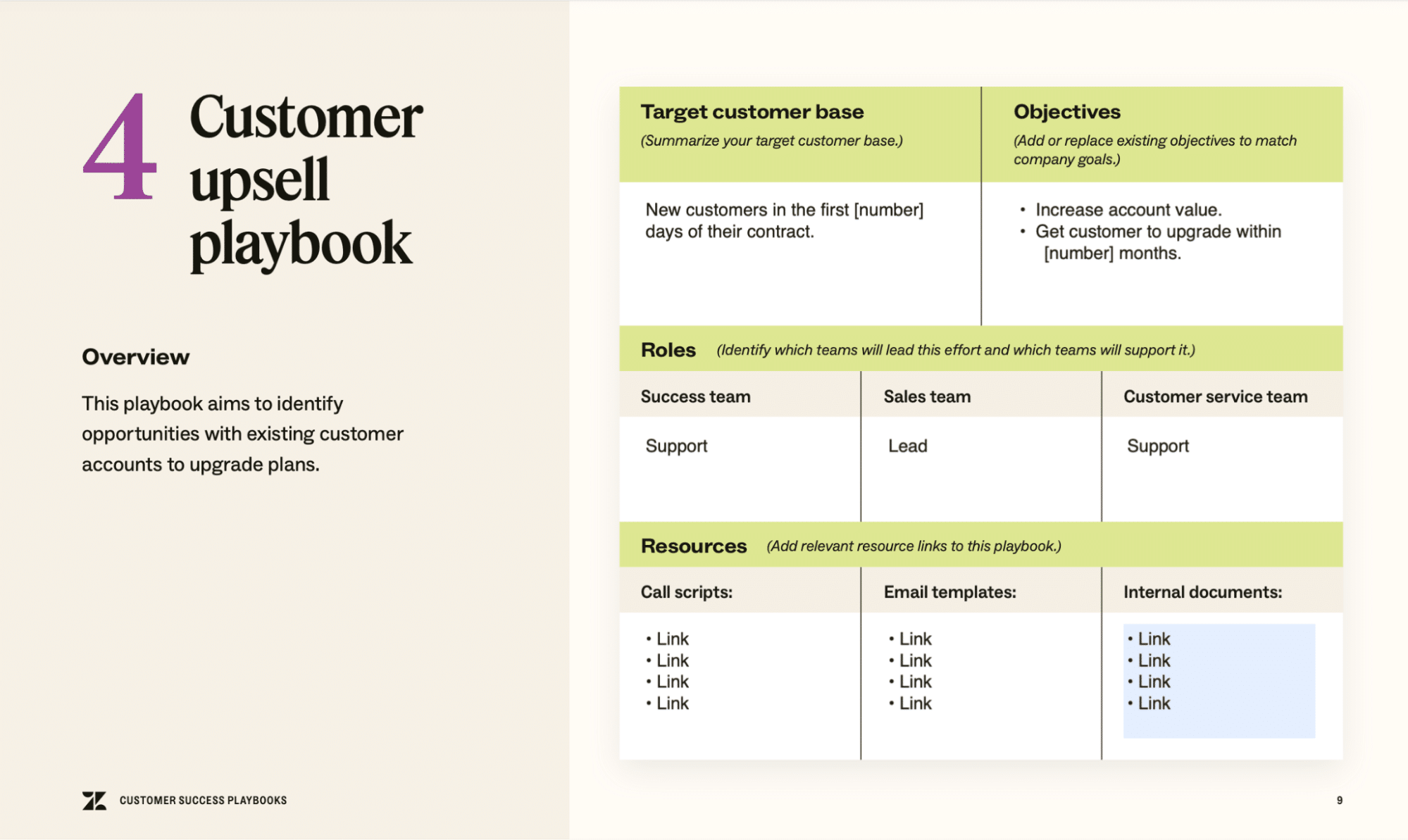
- Templates: These include standardized emails, agendas, slide decks, success plans. They save time and maintain messaging consistency while supporting high-touch or tech-touch variations. See Zendesk’s playbook template for customer upselling below:
- Guidelines: Instructions for handling exceptions and edge cases, such as churn risk and escalations. Document how to respond when things deviate from the expected path.
- Metrics: Measure both outcomes and process health. Outcomes include NRR, churn, time-to-value, and feature adoption. Meanwhile, process metrics track task completion rates, SLA adherence, even milestone achievement.
The key takeaway: Every component of a playbook should be practical, repeatable, and measurable.
2. Design a flexible framework
Scalable playbooks strike a balance between clarity and flexibility. CS teams need one core flow for the customer journey, plus overlays for segmentation, risk level, or product line. Here’s a glimpse of GitLab’s Handbook with its customer success playbooks:
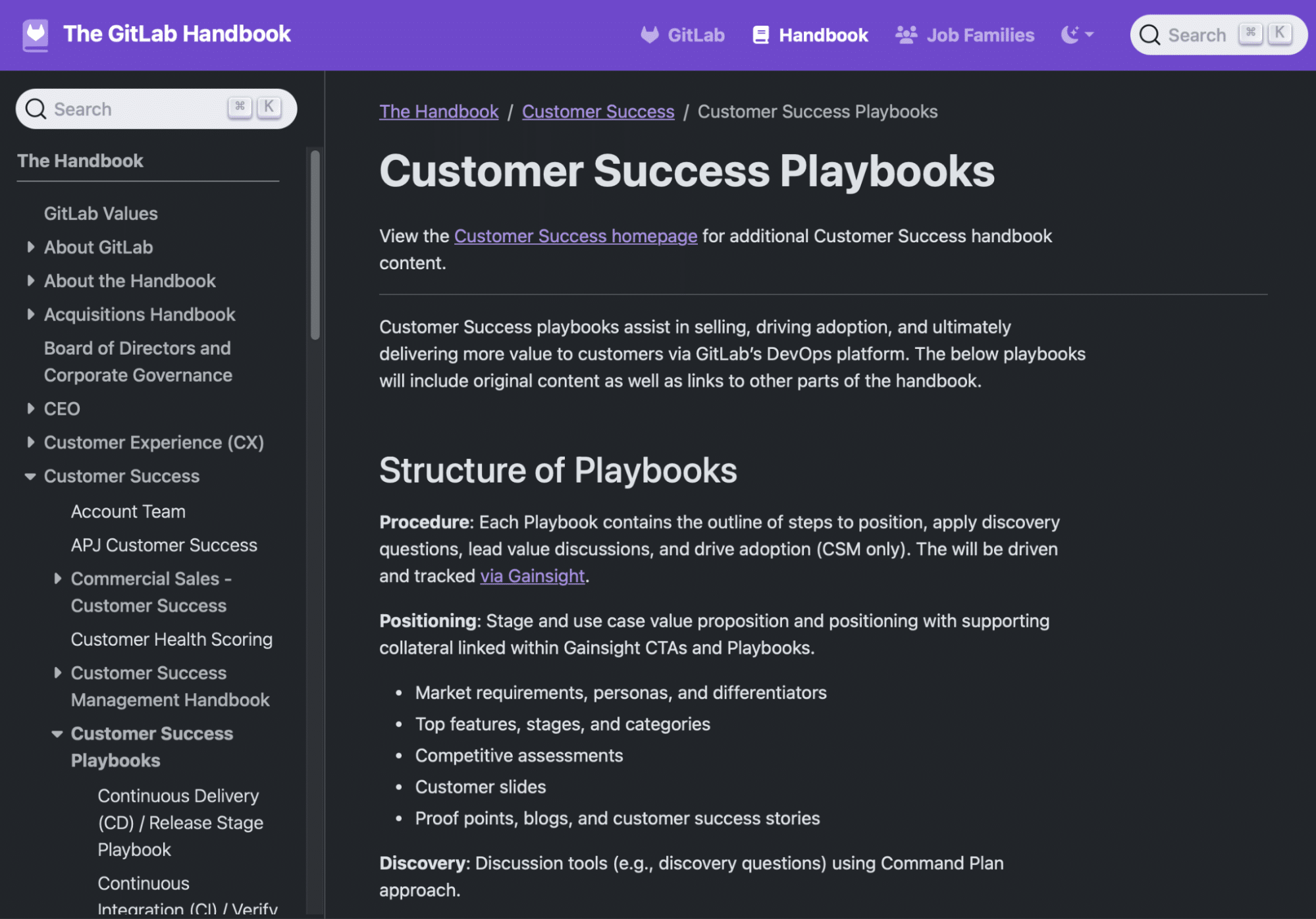
- Modular base playbook: Break workflows into reusable modules, such as kickoff calls, technical setup, admin training, and executive alignment.
- Segment overlays: Apply adjustments for high-touch, low-touch, and/or tech-touch accounts. Overlays add specificity without rewriting the entire playbook.
- Inputs and outputs: Define triggers and results for each step. Example: “Input: customer health score drops below threshold → Output: alert triggered, follow-up task created.” This ensures automation can plug in cleanly.
- Version control and ownership: Track changes, assign step owners, document updates. Treat the playbook like code: Record why step 4 changed in Q3 to avoid repeating mistakes.
- Exception management: Decide which steps you can skip under specific conditions. More importantly, document them to reduce ad-hoc improvisation.
Tom Rockwell, CEO of Concrete Tools Direct, emphasizes the need for a flexible framework in your CS playbook. He has his fair share of doing so when expanding his customer base in such a niche-specific industry: selling concrete tools.
“The playbooks that survive scaling get built like Lego sets, not monuments. Each process should be modular, allowing teams to rearrange, duplicate, or retire steps as needed. Designing for change rather than permanence makes scaling an evolution, not a revolution.”
3. Use tech to automate processes
Automation isn’t about replacing people but amplifying their impact. Companies that scale successfully use technology to handle repetitive tasks. This frees up teams to focus on high-value customer interactions.
Digital tools or platforms, such as contract management software, also play a supporting role by keeping agreement details centralized and up to date. However, make sure that your automation flows trigger accurately and that your customer data remains consistent across systems.
Automation is crucial for scale, especially beyond the first 100 accounts. Rather than listing tools, focus on the job each solution performs. Take a sneak peek at Custify’s platform below, automatically generating tasks and keeping records of them:
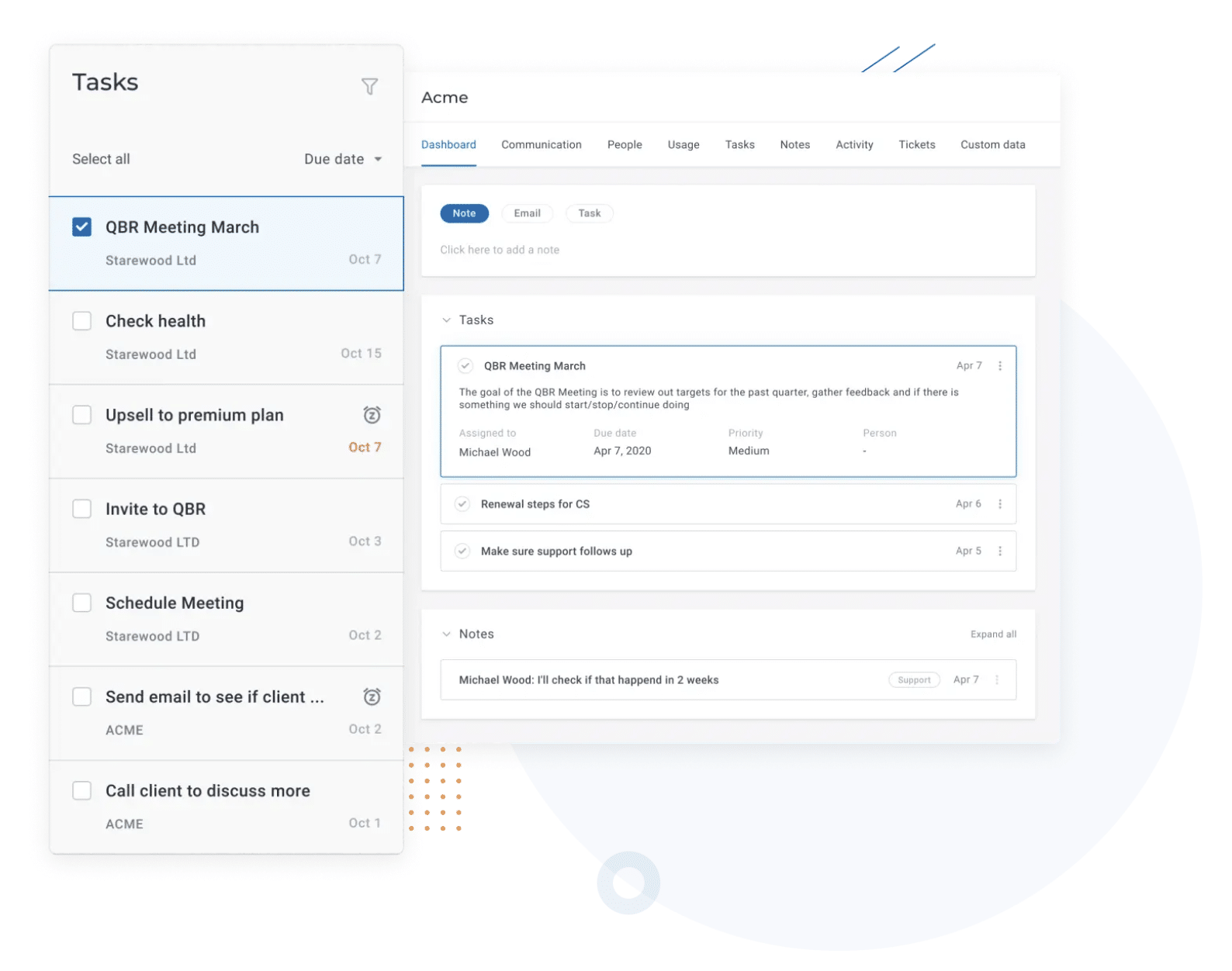
- CS platform records triggers, health scores, task assignments, and playbooks.
- CRM serves as a source of truth for account ownership, contracts, and lifecycle stages.
- Automation connectors integrate product events, billing, and CRM actions.
- Product analytics tracks feature usage that triggers workflows.
- Documentation tools store playbook logic, version history, and access rules.
- Ticketing systems handle edge cases and escalations efficiently.
What to automate first
Before diving into specific tasks, start by configuring your customer success software or platform to capture the right signals: Health changes, product usage shifts, even lifecycle milestones. This foundation makes your automation reliable by ensuring every workflow supports scalable execution.
That said, prioritize high-impact yet repetitive tasks:
- Notifications and reminders
- Standard renewal sequences for low-touch accounts
- Health score–based alerts
- Success plan task creation
4. Ensure continuous improvement
Did you know? A well-designed customer success program can deliver more than 90% ROI over three years, just enough to grab any executive’s attention. But according to Forrester, CX leaders need a clear framework to build a strong business case for customer success management. Continuous improvement is key!
What do the facts and figures imply? Customer success should have proper playbooks in place.
However, playbooks aren’t static. They must evolve alongside your customers and your products, not to mention the realities of your team. What worked six months ago may no longer hold up. Why? Your customer base grows. Your workflows shift. Or new segments emerge.
Continuous improvement ensures your playbook stays relevant and effective. It helps align with the outcomes your business needs to deliver. Here’s what you need to do:
- Track outcomes vs. process health. Consider NRR, churn, time-to-value, versus task completion rate and SLA adherence.
- Run small tests. Experiment with onboarding agendas, check-in frequency, or email sequences. Keep what works, discard what doesn’t.
- Create customer feedback loops. Collect input at milestones or after support interactions.
- Set monthly review cycles. CS Ops should lead reviews, documenting updates, version history, even decisions.
- Establish a playbook as code. Record rationale for changes to prevent repeating past mistakes.
Adrian Iorga, Founder and President of Stairhopper Movers, emphasizes the importance of updating playbooks for continuous improvement. He notes they should evolve with customer needs, market shifts, and industry trends, a practice they follow when enhancing their moving services.
“A customer success playbook isn’t set-and-forget. It should adapt as your customers, products or services, and workflows change. Regular updates keep your team effective and your outcomes aligned with business goals. Stay flexible, or risk falling behind.”
5. Train and upskill your team
A playbook is a living document. However, teams bring it to life, and continuous learning loops create scalable success. When every team member understands both the ‘how’ and the ‘why,’ they become architects of improvement.
Training is critical to maintain consistency at scale. Cross-skilling, re-skilling, and upskilling strategies can help your CSMs level up in their field of endeavors. At 10 accounts, improvisation is not ideal, but fine; at 1,000, it’s how clients are lost, and teams burn out. As a CS leader, here’s what you need to do:
- Explain why steps matter, not just what to do.
- Use multiple formats: short videos, live walkthroughs, and checklists.
- Teach flexibility and escalation rules, guiding CSMs when to adapt or escalate.
- Encourage team feedback and integrate improvements into the playbook.
Patterns from Teams That Scale Through Documentation
It’s easy to see businesses investing in the CS platform today. In fact, its worldwide market is projected to grow from $1.52 billion in 2023 to $5.89 billion at a 21.8% compound annual growth rate (CAGR).

In 2026, it’s crucial to kick off the year with customer success predictions and opportunities. However, some things remain the same: Team patterns that scale through documentation. Rather than overused brand examples, focus on CS-specific scaling patterns, such as the following:
- Single source of truth: This should serve as the central playbook for all CSMs.
- Mandatory playbook onboarding: Every new CSM must learn core workflows and metrics.
- Clear ownership and version control: Assign process owners and track changes.
- Modular design: Break down processes into reusable modules for high- and low-touch accounts.
- Data-driven refinement: This requires continuous feedback loops, metrics, monthly review cycles, and more.
These patterns enable CS teams to scale accounts without sacrificing quality and increasing churn.
Final Note: Crafting Playbooks for Sustainable Growth
Scaling from ten to 10,000 customers isn’t about working harder. It’s about working smarter. Here’s what you need to do:
- Build modular processes for flexibility.
- Standardize templates and guidelines for efficiency.
- Automate repetitive tasks and keep humans for high-value work.
- Track outcomes and refine continuously.
- Train CSMs on both the ‘how’ and the ‘why’ to ensure thoughtful adaptation.
Start with one critical process, iterate, then add modules over time. By designing for change from the start, your playbook can evolve alongside your customers. Doing so enables true scale without collapsing under growth pressure!
Ready to set up your customer success playbook? Consider leveraging Custify’s software to manage customer data, boost engagement, and achieve growth. To learn how it works, get a free demo today!