In this session, Irina Cismas, Head of Marketing at Custify, was joined by Gillian Stringer, Senior Client Partner at N.Rich, and Hana Gruzman, CS Operations and Enablement Lead at Agora, to explore how customer success teams can spot churn before it shows up in the data.
The conversation covered both sides of the early-warning problem: the relationship signals that dashboards cannot capture, and the operational structure needed to catch them at scale. Together, they unpacked what it actually takes to move from gut instinct to a shared, repeatable system for identifying risk, without pretending that data alone is ever enough.
Summary points
- Early churn signals appear in relationships before they appear in data: slower replies, shifting energy, and a champion who stops pushing things forward are often the first signs something is wrong.
- Health scores need a human layer to be meaningful: usage data tells you a customer is using the system, not that they value it or plan to stay. A qualitative pulse, updated regularly by the CSM, captures what the score cannot.
- Payment behavior is one of the strongest churn predictors: overdue invoices are not always intentional, but they are always worth investigating. Building a connection with finance gives CS teams an early signal most are missing.
- Stakeholder depth matters more in enterprise accounts: a single champion is a concentration risk. The more people who understand and can speak to the product’s value, the more stable the relationship.
- A useful pulse score requires standardization: a decision tree with yes/no questions, clear definitions for each level, and a bias toward flagging risk rather than assuming safety helps keep the signal consistent across a team.
- AI is already practical for CSMs without a full tech stack: call transcripts, follow-up emails, weekly summaries, and trend analysis across accounts are all things AI tools can handle today, saving hours and surfacing patterns that manual review misses.
- Building CS structure starts with the customer journey, not the tooling: identify the stage that consistently breaks down, focus there first, and build outward. Excel with dropdowns and defined options is a legitimate starting point.
- Wins deserve as much attention as risks: proactive outreach when a feature request ships, when a client hits a milestone, or when usage improves is both a retention tool and a morale one.
Podcast transcript
Intro
Irina (0:07 – 6:18)
Hello everyone, welcome. I’m Irina Cismas, I’m the chief of marketing at Custify and I’ll be your host for the next hour.
And I think I’m going to start with an admin thing. I think I accidentally invited all of you on stage. But taking into account that we are a big crowd today, I’m going to start with a disclaimer.
If anyone feels like or realizes that it’s on stage, please remove yourself and let the stage today just for the three of us. With this intro that it shouldn’t be, I want to introduce the topic of today. Because I think most CS professionals have felt at some point that something is off.
You know that moment when you get off a call and you know instinctively that something went wrong? In my case, something for sure went wrong today. But it wasn’t instinctively, it was by fact.
Maybe in some case you cannot point to a number. You have the health score, you have the usage, everything is normal. But something has changed.
Maybe the energy is different, the replies are slower. The person who used to push things forward from their end has gone quiet. What do you do when you have the feeling that the dashboard is telling you something but your gut has the opposite?
Today I have on stage with me Gillian Stringer, Senior Client Partner at N.Rich, and Hana Gruzman, CS Operations and Enablement Lead at Agora. Gillian, Hana, thanks for joining me.
Today we have an interesting topic to unpack. And I know that both of you will present or will end up on the same result but from two different perspectives. So in the next hour we will talk about two things that belong together even though most teams treat them as separate.
On one side we have the structure. We have the health score, we have the data, we have the reporting. That tells us what is happening across your accounts.
And on the other side we have the relationship signals, the shifts in tone and everything. Gillian is going to help us understand how to read the relationship. And Hana is going to show us how to build the structure around it.
And Custify sits at the intersections of those two as being one place where your data and your team’s knowledge of an account live together. So nothing falls through the gap between what the score shows and what the CSM knows. A couple of quick things before we started.
The session is being recorded so you will get the replay. And if you have questions for Gillian and Hana, drop them in the chat. We will take them some as we go if they complement the discussion.
Or we will allocate at the end five, ten minutes for a proper Q&A session. Now, before we dive in, I want to get a quick pulse from everyone here. I know that I kicked you out of the stage, but I still want to interact with you.
So I’m going to publish a poll. And I want to know how does your team currently catch early churn signals? Allow me a moment to basically publish the poll.
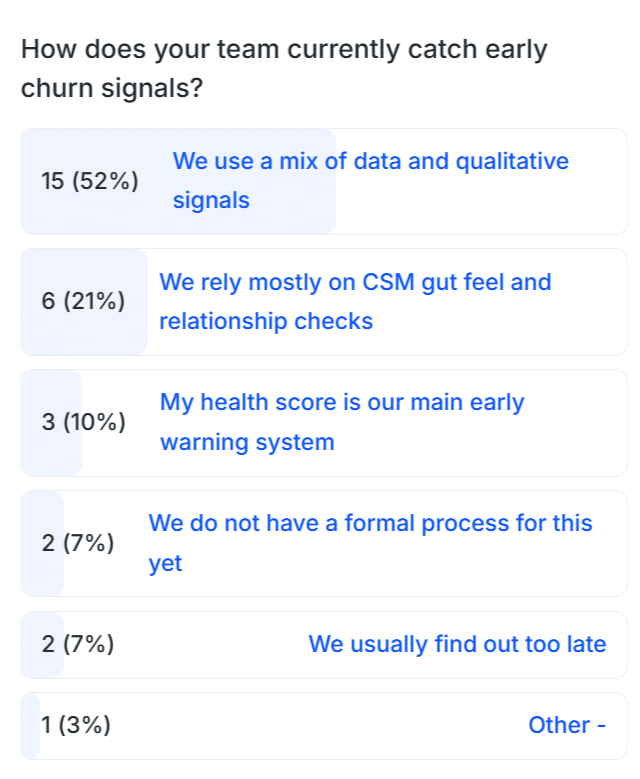
Start expressing your options. I’m curious how you do this. And while you guys are voting, I suggest to basically start this conversation with the human side of things.
Because most of the people, if not all of them, with the exception, are working in customer success. So let’s start with the human side of things. Gillian, we talked about this topic in a podcast episode that we recorded a few weeks back.
And in that conversation, you told me about a customer kickoff call when something felt misaligned. And you had a choice. Address it right then or tell yourself you’ll deal with it later.
Let’s share that story with our audience today and tell us what was actually happening in that account before the conversation happened.
Misaligned expectations
Gillian (6:19 – 9:28)
Yes, yes, it’s my pleasure. First of all, hello, everybody. Thank you so much for joining.
I’m really excited for this conversation. Irina, you asked such a wonderful question. I really vividly remember this case.
So as Irina mentioned, I’m a senior client partner at N.Rich, which is an account-based marketing platform. And we essentially help organizations to marketing teams specifically to influence pipeline and influence revenue as well through account-based marketing, which is not lead generation. So I joined the kickoff.
And the first thing that my new customer is talking about is generating leads. And I know full well that they are not going to generate any leads through N.Rich in the way that they’re thinking about it. Like they’re not going to get inbound form fills.
And I really was faced with a choice. It was like you nod and smile and go along with it, knowing that they’ve just signed a 12-month contract. They’re not going anywhere today or tomorrow.
So there isn’t really a pressing need to say anything if you’re thinking about it in a particular type of way. But on the other hand, I knew this is going to be a problem.
There’s no way to get around it. So I had to confront it head on. And I said to her, listen, I’m going to level with you.
I know that you’ve just signed the contract and we’re onboarding and I’m confident that we can help you. But this is not a lead generation platform. So you’re not going to get any leads.
I could tell you what we can do instead, but you’re not going to get any leads. And obviously she was disgruntled and she felt like she’d been misled in the sales process. But I knew, I worked very closely with our sales team.
Nobody told her she was going to get leads. I know that no one told her that. But sometimes when you want something really badly, you convince yourself that is what people are saying, even if they’re not.
So I had to confront that. And it was like this is my first conversation with someone and it’s a difficult conversation, which sucks. Like it’s very hard to build a relationship from there.
And I really feel like it could go one of two ways. You either have people who really value the honesty and the integrity that it takes to be straightforward with them or you just sour the relationship. And every conversation following that is just painful.
So, you know, looking at a health score at that point in time, it’s a brand new customer. There’s no there’s nothing to suggest that anything would be amiss with a brand new customer.
They should be clear on our value prop and ready to use the platform and get onboarded. But right then and there, I had to signal like this is not looking too good. We had several conversations.
I would say we went through a resale, if I’m being honest, because she really didn’t understand what she had purchased. So we had to go through the whole process again. I involved the AE to support me with that.
And over time, I’d say it took about three, four months to get to a place where I’d say that account had a green health score, so to speak. But it was difficult. It was a slog.
And I could have just ignored that and just went about things as normal. And then they just churned by at the end of 12 months. But I decided to face it head on.
And I think that’s what we really need to do.
Irina (9:31 – 9:35)
Did she renew in the end?
Gillian (9:36 – 10:05)
She didn’t. But she wanted leads because someone above her wanted leads.
And while she was turned and understood why leads aren’t going to work. That didn’t translate going higher up to C-suite. And that’s kind of an organizational positioning.
But she got it. And I feel confident that if she moved on to another organization, I think that we could hear from her again. And our sales team could go after her again, for sure.
Why invest in a difficult relationship even when it might not renew
Irina (10:05 – 10:32)
You know what I’m curious? Why did you decide to invest into that relationship from the very beginning? What was the trigger?
Why did you still decide to do it?
Gillian (10:33 – 12:08)
It’s a good question. Obviously, at the time, I didn’t know they were going to turn anyway. Maybe if I had a crystal ball, I would have made a slightly different decision.
But in that moment, I think especially in my role and people listening may be able to resonate. I’m working with marketing teams that spend a lot of time having to prove their value and demonstrate the value of what they’re doing. What’s the ROI?
They’re being asked this very early on and they’re impacting the revenue of the business. So when I’m sitting with my clients, I’m honestly thinking about what can I do so that you can be the hero in your organization? Like, what can I do that you can take back to your manager and your manager’s manager and say, like, I did this and I did that?
You don’t have to say my name. I don’t need the credit internally, but I want you to win. Like, I genuinely want you to win.
And I know that you won’t win if you’re confused about what you’ve bought, because if you’re telling people that you’ve bought a lead gen platform and three months down the line you have no leads, that’s failure. Right. We can’t wait until after we don’t get what they’re expecting and then say, oh, well, actually, that wasn’t what you were supposed to get from the outset.
So I really just wanted to get ahead of it. I wanted her to win internally. I saw like how determined and passionate she was just in role.
Right. And I was like, yeah, I’m not going to be that person that just watches you crash and burn. So I’d say like just from like integrity, like from my own personal.
Peace of mind so I can sleep at night, I have to tell you what it is and be straightforward with you. Otherwise, yeah, when things go wrong, I could like I have to I have to blame myself. I don’t want to blame myself.
When the health score is not the predictor
Irina (12:09 – 12:34)
Hana, you came at this from a completely different direction. You built the health score at Agora. Usage data, product signals, score from one to one hundred lead structure measurable.
But at some point you looked back at the accounts that actually churned and noticed something. The health score was not the predictor. What was it?
Hana (12:36 – 17:12)
Yes. Thank you for having me.
And hi to everyone. My name is Hana. I work at Agora.
We have a SaaS platform to manage real estate investments. We also have additional products, but the main one is the SaaS one. And as you said, we built a health score, which is, I would say, a small part.
It is an important part, but it is a small part into predicting churn. I would agree here with Gillian saying that definitely the human element is the most important one. So with the health score, we also have something called a pulse, which is basically each person just saying what they think.
There’s only five levels, like severe risk, high risk, some risk, fairly satisfied or very satisfied if they love us. And each CSM updates the pulse based on what they feel, because in the end, you know, health score just like measures usage. We have clients and I’m sure everyone here has clients that use the system and they don’t like us.
They just use it because they don’t have any other choice or they don’t want to move to a competitor right now or they’re going to churn eventually. But usage alone like doesn’t it just tells you that they need a system. It’s not necessarily your system.
They could need other systems as well. And so I would definitely say the health score is important inside the health score. What I would also focus on is specifically Agora.
We have like a lot of financial features. So our health score, everything has weights in it, like everything that you do have weights because there are things that are important and there’s things that are more important. If everything’s important, then everything’s the same and nothing’s important.
So also inside the health score, like we have weights for features that are more sticky, meaning that, you know, clients start using them. For example, payments, people who have already gone through the trouble of, you know, updating their bank account, doing all these bank integrations. They’re less likely to leave because they’re already kind of invested in the system.
So payments has a bigger weight inside the health score than other features. So also, like I would think, what is really the thing that would keep clients here from all of my features and build the health score that way? And then also add the human element, of course, the pulse.
I would say also, as you said, the client. So in your case, the client bought a system that maybe wasn’t the right fit for them. But sometimes we as CSMs know that the client is not a right fit for us.
So I can even tell an example in real estate investing, there are some people that are frauds. And they come to you. And on the first call, they’re like, yes, I’m raising a hundred million dollar fund.
I’m going to buy this huge house in Miami. And the way that they talk. And I’m like “Are you going to buy this house in Miami?”
I kind of doubt it. So even like the human element and kind of recognizing the clients that they’re maybe not 100 percent what they say they are like that. I put that in the pulse.
I met him and I was like, yeah, that’s not going to happen. I literally put some risk. I’m not sure how his business model works.
I’m not sure how he’s going to be able to keep paying Agora. And he didn’t raise any funds and he eventually turned. So the human instinct element, even AI.
Like if you gave this client to AI, he’ll be like, good luck on your raise. I hope it goes well. You know, but as people can kind of smell out, things are a bit fishy.
So I would definitely say the human element of just like the sentiment of the client to the client themselves. Are they a good fit for your company? And then something that maybe people don’t talk about is money.
You know, overdue invoices. That’s also goes into I would say that is actually the biggest predictor. If clients are paying their invoices like this, you need to have some sort of connection with finance.
If people are just starting out, literally just go to your finance person and be like, hey, has this client paid? And if you’re a bigger company, obviously build some sort of integration or HubSpot or use the same source as finance. And that way you can know, we have clients that haven’t paid 90 plus days.
We reach out to them. Turn like if they don’t pay you, they don’t want your system and they’re going to leave. So that’s actually my opinion.
The biggest indicator is anything that has to do with payment issues. And also just frustrations with a product. So you can actually look at how many product requests they have.
So at Agora we have people bringing in product requests so we can see how many product requests they have. Have they been met? Have they been postponed?
Is the client frustrated from promises that were never made true? And the last one I would say is when your point of contact turns over and you have a new point of contact, they kind of need to reprove yourself to that immediately. Like it’s just harder than just keeping a point of contact that loves you.
You have someone new, you need to retrain them. They would probably reevaluate you as well. So all of those, I would say, like technically wise would go into my prediction.
Consolidating signals and the role of AI
Irina (17:15 – 17:41)
You answered several other questions, but I’m glad that you did. And I’m glad that you provided a 360 view on what’s happening in this moment.
Where do you consolidate everything? Where do you connect all those data points? How does your team leverage it?
Where do they sit?
Hana (17:42 – 18:46)
Yeah, that’s a great question. I think now, so currently we have it like just on our CRM, which is HubSpot. We have our own view.
But I do think now with AI, there’s definitely room to make everything more efficient. And we’re also looking into our own customer success CRM, which we currently don’t have, but we have HubSpot. And I would say like this is the time to be more efficient, use AI tools, write all these things to Claude and say write playbooks to Claude as skills.
And then you can ask Claude, hey, this and this account has done this and this. They haven’t paid in 90 days. They have four feature requests open.
On the call yesterday, they were a bit strange. What do you think, like is the pulse based on standards that Agora has seen over the past five years? So I would really leverage AI here.
And we are only now, after six years of the company being active, looking into CRM software. So specifically for customer success. So for some companies, it’s too early.
If you don’t really have any need for it, I would say not look for it right now. But when you have already 15, 20 CSMs, then you need something more standardized and to leverage AI.
What to read in a live customer conversation
Irina (18:47 – 19:45)
Now, Gillian, back to you.
Hana described the pulse and not only described the combination between the how they manage the qualitative with the quantitative part and the combination. You somehow been doing this instinctively without having an infrastructure around it through the nature of the role that you have. What are the actual signals that you are reading in a live customer conversation that tells you something is off before anything shows up in numbers?
What are the things that you pay attention when you are having a conversation with a customer?
Gillian (19:47 – 24:24)
Live customer call. I’m going to start at the beginning. Tardiness.
If they are constantly late to your calls, I think that is indicative of in some instances, they don’t want to come to the call. Or even if you join the call and you have to email them to say, hey, I’m on the call, like ready when you are. And they come and they’re maybe a little bit flustered or maybe not that apologetic because obviously things happen.
And sometimes the workday is hectic. I am sometimes back to back. I don’t even realize like I’m running over and that that can happen genuinely.
But I think if it’s a recurring theme on all of your meetings where they’re coming with a little bit of a like a huffy puffy energy like, oh, sorry, I was late. Then I think it’s like indicative of like, I don’t really want to be here, but maybe I’m a bit too nice to just not show up.
And I’m sure I’ve definitely experienced. I don’t know about you guys, but I’ve definitely experienced customers who just don’t show up. And that is definitely a flag.
Right. Because they feel like they’re not going to get any value out of the call. Then I would say for me in my role and especially the nature of my role, a lack of candidness about what is happening internally.
I really need to understand the go to market motion within the businesses that I’m working with. So I need to understand the marketing team. I need to understand the sales team.
I need to understand where do your where does your C-suite sit? Do marketing and sales gel? Do you guys get along?
Are you working together or are you very isolated? And I have to ask quite like a lot of questions. And sometimes if the responses are quite clipped, they’re being quite straightforward.
Yes. No. Maybe, you know, there’s not that willingness to share, not for the sake of sharing, but so that I can support you.
Then immediately I can tell you don’t trust me. You don’t trust that you’re going to share this information with me. And it’s going to have any meaningful impact on our working relationship and on your utilization of N.Rich as a tool.
So that’s another one that I would say. So the tardiness and like the lack of trust, lack of willingness to kind of open up, I’d say with my customers that are like I have a good relationship with and they would have like a healthy, good health score. There is they’re telling me everything, like they tell me so much.
They say so much with me. They’re very candid, like they would tell me about an acquisition before it’s even public knowledge. Right.
Because they see me as a trusted partner. So I think anything that suggests that you’re not a trusted partner is something to watch out for, even a lack of willingness to share future plans. Right.
So if you’re asking about like the goals for this quarter or how much revenue they made last year and they’re just being weird about it, I think that does ultimately come down to trust. And then I would also say if this is a funny one, but I think it’s quite an important one. It depends on the nature of the product.
But if you find yourself being passed around within an organization. So let’s say for me, I would typically be working with head of marketing, VP marketing. And then they pass me to like a marketing associate or marketing executive and they have no involvement.
It’s not like they pass me over to that person for added responsibility, but they’re still checking in. They have no involvement. It’s like just pass the parcel until the 12 months is up and then they churn.
So if you’re being passed around quite a bit, your champion keeps changing, but that’s not because people are leaving. I would say that that’s a problem. And also, if you’re asking for intros to other teams with good reason.
And there’s a little bit of pushback. There’s not that willingness.
If you’re suggesting that they invite their boss to the QBR and they’re very hesitant. Again, it comes down to that trust piece. Like are they clear on the value you deliver?
Another one, I’ll end with this. Ask your champions, how would you articulate in one sentence what we’re doing? If someone asked you internally, like if you got a new CRO today and they said what’s N.Rich, what would you say?
And be quiet. Don’t fill in the blanks. Just be quiet.
Let them answer the question. If they’re umming and ahhing, you’re in trouble because they need to be able to explain it quickly. What is that tool?
You’re spending however much thousands. What is the tool? What do you use it for?
For me, my customers need to be able to talk about N.Rich like they work for N.Rich. That’s when I have a champion.
That’s when I have like a healthy customer. If they can’t talk about it confidently and eloquently and succinctly, then yeah, I’m in trouble.
Stakeholder depth, champion dependency, and renewal risk
Irina (24:25 – 25:04)
I want to ask you because you touch a point, navigating multiple stakeholders into one organization. Did you saw a connection between the number of touch points and the renewal rate? And what I mean is the more touch points that you have in one company, much more secure when it comes to the renewal.
Did you see this? Did you see this connection? And a higher risk when you are talking only with one person?
Gillian (25:07 – 26:07)
It depends on the nature of the organization. If it’s an enterprise business, then yes, you need multiple stakeholders. But if it’s like a scale up or a startup, sometimes just having the one person isn’t inherently problematic because marketing is one person.
So they’re running everything. And then you’re almost like their colleague, in my experience, because you end up working very closely with them. But yeah, for the bigger enterprise accounts, definitely you need multiple people.
And all of those people won’t be like users of the platform. I’d say for like my biggest accounts, I have relationships with finance. I have relationships with the tech guys, like anybody who might be able to help procurement.
They know me. We speak and we have a good relationship because, you know, with these enterprise businesses, like even renewal is a whole process. And I think all it takes is like one person to be like, what’s N.Rich?
And it’s a problem because then we might have to resell and they might not buy into what we’re selling. So with the enterprise businesses, for sure, you need multiple stakeholders.
How to prioritize attention across a large book of business
Irina (26:09 – 26:47)
Now, I want to ask you, how do you segment? Because when you are managing a portfolio of customers, when you only talk with 10, 15, it’s okay. But if you have 80, if you have 100, you cannot have a deep conversation with everyone on every week.
So how do you decide which accounts need your human read right now? And what does this assessment actually look like in practice? How is it?
Gillian (26:49 – 29:13)
I have to be honest, I’ve never had 80 to 100 accounts. If you have, hats off to you. I don’t know how you do it.
I’ve had at most maybe I think 35, 40. And that’s when I was at ReachDesk, the gifting platform, which is a quite a high touch platform where you do need quite a bit of support. What I try to do now, I would at the beginning of my career, I wasn’t doing this.
But what I do try to do now is go and talk to the account that you don’t want to talk to. Go and talk to the customer who you are actively avoiding in your mind, the person who you feel like, every time I speak to this person, it feels like I’m pulling teeth, like the person that you don’t have the rapport with. I think naturally, you know, we gravitate to people that we like.
And sometimes, like, we don’t want to do the hard things, right. So you may find yourself like, there’s customers who I have a weekly touchpoint with, we don’t need a weekly touchpoint, they know what they’re doing, they know how to use the platform. But now we have a relationship.
So we’re just catching up, we’re just chatting. And I know it adds to the health of the account and the sentiment and the relationship. But I know that that’s not the immediate need.
And that’s not who I need to be following up with. So I would say, like, obviously, we can think about ARR and these things. But, you know, the account that you’re avoiding, that probably needs your attention.
The account that like, had 101 feature requests, and you never go back to them, because you know, your product team is not going to do any of the things that they’re asking about, you need to level with them, and you need to have like the difficult conversations with them. It’s so painful, like it literally makes me want to like rip my hair out sometimes, but it’s necessary and it pays off. And as a CSM, I always say like, you will have churn, it’s inevitable, you can’t retain all of your accounts, but you need to be able to predict that churn and communicate that churn to the people that you’re working with to like leadership and potentially loop them into support you.
So the worst thing that can happen is for you to say, oh, this account churned, and your manager says, oh, I thought they were fine. That’s a problem, and that suggests that you don’t have a handle on your book of business. So go and speak to them, even if it feels hard, and level with them, you know, about where they’re at, determine if you can support them.
If you can’t, call a spade a spade, you know, do what you need to do to communicate like, listen, this account is going to churn, and know that you’ve got a hold on it, versus like, the last time I spoke to them, it was kind of awkward, I don’t really know what they’re doing. I haven’t spoken to them for ages. That makes you look so bad, and just makes you look like you’re not paying attention.
So yeah, the annoying ones, go speak to the annoying customers.
Irina (29:15 – 29:21)
Hana, I want to pass the same question also to you. How do you segment your customer portfolio?
Hana (29:24 – 31:36)
That’s a great question, and we do actually have CSMs that can handle 80 to 90 to sometimes even, we’ve gotten to 100 accounts, which is definitely very difficult. But when you have a lot of accounts, you definitely need to use, like, that’s something that you really do need the health score, because obviously it’s a client that is using it, but maybe the pulse is bad. Usually, again, it relies on something, let’s say a product request.
So obviously, we talk to the clients that are unhappy, those are the ones that get attention. The clients that are just finished onboarding, we have a phase called early adoption, which is where we train them a lot to kind of get them to be independent, and to use the system as much as possible. And then we kind of send them off to be an ongoing, and then we help them whenever they have questions, or they need something, or we want to do a renewal.
So I would definitely say focus it for a specific training period. We have a cutoff, it’s a training period. Obviously, if they need help afterwards, we also meet with them.
So we only do weeklies with strategic clients. So our main focus is the onboarding period, the ones that are in risk because they’re unhappy. And then when something positive happens, which I know a lot of us are not used to, but something positive happens, like for example, their request actually is in the system, which a lot of our system is made up of client requests.
That’s a great touch point, you know, people like forget about also reaching out for the positive things. So if I have a client, you know, I have 90 clients, and I have this one client that really wanted something in a report, and it was very specific, but it actually got done. They’re like, hey, you remember, we talked about like six months ago, you wanted this specific feature in the reporting, it’s out now, let me show you how to use it.
Like, that’s a great touch point. I think people don’t focus on the positive enough, like they focus on the negative accounts, which is, you’re correct, Gillian, it’s something we sometimes don’t want to do, but we have to. But we can also focus on the positive ones.
Or if we can see, you know, we can see their usage. So for us specifically, let’s say we have capital raising for a new project, when a client finishes raising all their capital, it’s a great thing to celebrate. So I can say, hey, I just saw that you guys raised $20 million.
That’s amazing. Great job. So I would say to focus, obviously, on the ones that are having a hard time, the ones that need training, and any sort of positive note you would have with your client, that’s also a great touch point.
Calibrating the pulse so it stays signal and not noise
Irina (31:38 – 32:12)
I want to stay with you, Hana. And on the pulse side of things, in some cases, the gut feel can also be wrong. A customer has a slow quarter, a distracted champion, a busy internal deadline, things happen.
A CSM flags it as risk, and it turns out to be nothing. How do you calibrate the pulse so it is a useful signal and not just noise?
Hana (32:14 – 33:52)
That’s a great question. And I think like everything, you know, everything has its periods and has ups and downs. We’ve had accounts that went from like severe risk, we were 100% sure that they were going to churn to being amazing, love us, doing case studies.
So that’s why risk is like, it’s a live metric, you know, we update it on every touch point they have with the client, and at least once every few weeks, it needs to be updated. And so we have also like month over month, you know, we can see like how many clients were at risk in January, then February, then March. So I think it’s perfectly normal and the way that it should be that clients pulse changes.
Like you said, sometimes like they’re really preoccupied and they don’t have the time to use Agora right now. But then the quarter ends and they really want to get going. So I would say that’s why you need like multiple things.
So you update the pulse for the time period right now. And it’s okay that they can go from severe risk to satisfied, which is hopefully what happens and not the other way around from satisfied to risk, which also happens. And also, of course, use the data, the health score.
And we also have something new that we’ve done recently is also you asked, like, how do you how do you see each one differently? So we also have like a new score that I said weights is very important. It’s kind of more like a churn score that takes also the pulse, takes the health score, takes the invoices and takes basically any have they received any value from the system at all.
So any like features that we know are valuable doesn’t matter if they used it in the last 30 days or overall since inception. So all of that is also a score that has weights that we’re starting to use now.
Irina (33:52 – 34:08)
How often do you revisit those health scores? The definition? Are they a living thing or basically you said once and they die there?
How do you and what triggers the iterations on them?
Hana (34:09 – 35:42)
That’s a great question. So we did the health score in the beginning. Obviously, you tested like you see an account has a certain health score.
You go to CSM and you ask them, does this make sense? Does the score line up with what you would expect? And we actually didn’t touch the health score for a few years.
And then we had three really big features come out, features that we felt were significant enough that they needed to be inputted to the health score. As I said, payments is one. Right.
Like if someone uses my system to make payments, they’re probably more likely to stay. So already like dependent on it to make financial actions for them. And so when we had an aggregation of things that were worth really measuring, then we opened up the health score again and we we added those.
And then you have to play around with the weights and make sure that still makes sense. And so I would say whenever you feel that you have something new in the system that you really want to measure, it’s completely OK to open the health score and to change things. You know, we’re not robots yet.
We need to acclimate to real life. And that’s what we did. But but, yeah, we got to a place where, you know, like the CEO was looking at health scores and was looking at the pulses.
Like it became like a true metric to measure how well the company is doing, not even just customer success. So that’s why you need to first test it. Like you need to build it based strategically.
You need to test it and you need to be open to opening it. And if you open it and you change things and you kind of like relaunched health score 2.0, you just need to make sure that everyone’s aligned and knows that this is a more true reflection now because it includes, you know, these new features that have come out.
Irina (35:43 – 36:08)
When you are doing this calibration or reiterations, do you involve only the CS team or is it something that you do internally as a team as internally as a team? I mean, do you bring on board also the product team and maybe other peers to basically have alignment at the company level rather than on a CS level?
Hana (36:10 – 37:09)
Yes, it’s definitely very important to work with all the other teams. Like in the end, you’re the you’re the connection to the clients and everybody wants to get to the clients. It just has to be through you.
So we definitely work with the product team. So, you know, the product team was like, we want to we want to measure these and these features. It has to be in the health score.
It’s very important. And then, you know, we reviewed it. And that’s how we inputted the three big features that have come out.
As I said, finance regarding invoices like that’s, you know, the CS doesn’t stand alone. They’re part of a bigger company. And these clients are basically in charge, like feeding the whole company.
You know, if there’s no clients, there’s no money, there’s no company. So we definitely have to cooperate with everyone. So we mainly cooperate with the product team internally with the CS team.
And then if needed, you know, outside teams to help us as well, like the finance that have cooperated with us. And now, like the invoices are also being counted in the not in the health score of usage and the bigger health score that also includes the pulse usage and billing.
Irina (37:11 – 37:39)
I know that you are managing 30 people and they’re across. I would say to if I remember it there, you are globally distributed. So it’s not only in one in one place.
And I have to ask you, how do you keep the consistency across the at least across the pulse? Because how do you make sure that everyone uses the same thing? And the red means the same for all of for all of your team members.
Hana (37:40 – 39:14)
That’s a great question. And it is actually quite difficult because people, you know, interpret situations in different ways. So I would say the first thing is to use your team leads in your team.
Like, you know, if you have 30 people, you obviously have some sort of hierarchy and you need your leadership to be with you and to to understand why you’re doing the things you’re doing in order to help their team. So we have a team lead in Tel Aviv and we have a team lead in New York. And they’re also themselves as people.
They’re very different, but we need them to operate in the same way. So through the team leads, you know, we have some sort of standardization. Obviously, the people themselves, we tell them, like, what is the what is fairly satisfied?
What is some risk? And we also have like a decision tree that I’ve made. Like, are they are they paying their invoices?
Yes. No. And then it takes it to another question.
Are they generally happy with the product? Are they using it? Are they answering your emails?
So basically, like questions that you can ask them that have very clear answers, like the answer is either yes or no, that anyone can measure. And that will kind of lead you to a decision of what their risk should be. But as I said, again, the human element is the most important.
Like, I may think that someone’s not at risk and someone else will think that they’re at risk. So we always say if you think there is a chance that they’re at risk, it’s better to market. As Gillian said, like we need to predict, are these people going to turn?
It’s better to market rather than say, oh, maybe I don’t know. So we always say, like, go safe if you think there’s some sort of risk market. If it turns out to be nothing and they love us, then you can update the status to be fairly satisfied.
That’s why it all needs to be, you know, like live and you need to be very open to like changes that really happen.
Irina (39:15 – 39:33)
Since you mentioned this, I have somebody from the audience ask regarding the payment part, because you said that this is important. And she’s asking, isn’t it already too late when we see that they already decided to not pay? In that scenario, it seems that the decision is already made.
Hana (39:35 – 40:49)
So it may seem like that, but no. And again, depending on your types of clients, specifically, you know, if you work with other software companies or in our case, we work with real estate investment companies, sometimes they don’t do it on purpose. You know, they’re billing their department that’s in charge of payments, maybe not know what Agora is.
Maybe they didn’t pay on time. Like we kind of have to give them the benefit of the doubt. A lot of times you send the invoice to the wrong person, to the wrong contact.
Like, you know, if I get an invoice for something, I’m like, what? I don’t know what this is. So even it was like a lot of cases was like that.
It was just sent to the wrong person. And then, you know, nobody bothered to like to send it to someone else. And then the invoice just went unpaid.
Of course, we move people to subscription where it auto pays, but not everybody wants to do that. So I would say it’s not too late. You could definitely look into it, but it is an indicator.
So that’s why we’re quite involved in payments because we know we have a relationship with the client. Then we ask them, hey, I noticed our payments team has let us know that you have an open invoice. Is that something you can take care of?
And usually they’ll be like, oh, my God, you’re right. I’m sorry, I didn’t notice or something like that. Or it’ll actually be an issue.
But it’s not always too late. You definitely need to look into it.
Irina (40:52 – 41:04)
Gillian, there’s another question and I want to pass it to you. How do you convince a customer to come back after churn? It feels like more on the human side of the relationship.
Gillian (41:05 – 42:54)
It’s a tough one. It’s a really tough one. But I have had a lot of cases where we’ve been able to turn it around.
It depends on why. You have to get into the why and the real why, not the why that they tell you to get off the call. I think we need to understand churn is awkward for everybody.
I know my customers psych themselves up to come to a call and be like, oh, we won’t be continuing. Or send an email to say we won’t be continuing. So I think it’s really important to level with people.
And a lot of the time this could be unique to N.Rich, which, as I said, is influencing pipeline and it’s influencing revenue. So a lot of the time churn is tied to what is happening internally. Right?
So I’m working with a business. They didn’t hit their revenue goal for 2025 and they come in January 26 and they say we’re not continuing. They’ve had some difficult conversations.
And N.Rich is not a cheap tool. We’re talking about headcount for one or two people. So you have to get into the why.
I think once you understand the why, then you are in a better position to understand is it even feasible for them to continue. Right? So if the why is around I know this works, but I’m struggling to prove how it works internally, that’s where I think you always have a fighting chance.
And you can support them and really become like their little like silent voice in their ear for their meetings. And if you can find a way to make your champion the hero internally, then you’re good. But if your champion’s job is already at risk or they’re making cuts, they’ve been acquired, things like that, that becomes very messy.
And sometimes I think if you’re working in a good team with good leadership, you should be able to identify like this is not going to happen. Let’s let it go and not waste too much time and effort on it.
Irina (42:55 – 43:32)
Because you mentioned the why. This actually triggered the asking the five why questions. And it’s not the framework, but how do you frame the questions and how do you find how do you make them speak?
Because usually it’s about the question, how you ask it, how you basically ask the same thing in a different way to get the answer. What is your recipe for this? Because I think you need to have a recipe.
I think in some cases there’s art in asking the right questions.
Gillian (43:33 – 46:26)
100 percent. I think first and foremost, you need to study the person that you’re speaking to. My natural temperament is I’m quite casual.
I always say to people I don’t have a work voice. I don’t have a work tone. How I speak, you know, on calls is how I speak at dinner.
Like obviously the subject matter might be different, but I really try to show up as my authentic self. Some people really value that and some people resonate with that and feel safe in that, especially if they’re working in like high stress, highly like corporate stiff environments. And they don’t really have a chance to just be what I would say normal, for lack of a better word.
So you have to study the person that you’re working with and kind of place them on a spectrum of sorts that you define. So I have my customers who I feel like they’re super casual, they’re chill, you know, they just want to level. They just want to talk plainly.
And I meet them where they’re at. I also have customers where I have to kind of put on my corporate hat and be very stiff and be very serious because they enjoy that. And I need to pander to that.
If I am too casual with them, they won’t take me seriously. So you need to study the person that you’re talking to and don’t be afraid to pull certain levers. So my CRO, he’s great.
He’s male. Some of my customers really respond very positively when I bring him to a call. They feel very special and important.
They’re talking to the CRO, same with my CEO. You know, there’s people who like they really value and respect hierarchy and they want to feel like, you know, I’m with the high flyers. I’m being put in touch with the CEO because I’m like a top customer.
I think earlier on in my career, I’d kind of push against that and be like, why do you want to speak to the CRO or the CEO? You can talk to me. I can tell you all the things, you know, but after a while I was like, you know what, that’s not useful.
Like any lever that I can pull within my reach, I will. But it all starts with studying the person and knowing the person. I want to say intimately, not in a weird way, but you need to know their quirks.
Like what do they do on a call when they’re like distracted? Even if they seem distracted on a call, this is something I’ve done a few times that works well. You’re on a call with someone.
I’m guilty of it. I might, you know, in a little bit of downtime, I might just send an email or something or just check on something, you know, they’re distracted. And you can just say like, oh, have you got a lot going on at the moment?
Like, is it tough internally right now? Level with them. Like that works for most people and get to the point with them where they’re telling you like what’s happening at your company.
Like what’s your relationship like with your boss? How often do you meet your boss? What do you guys talk about when you go to your meetings with your boss?
What do you have to communicate with them? Do you have like a weekly sync that you do? Are there like bullet points you have to answer?
I’m in your corner is what I’m always trying to push. And I’m here to help you within your organization. So those are, I’d say, the levers I pull and then also involving like other people where it’s necessary if I think it’s going to help.
Practical advice for CSMs with no platform and no dashboard
Irina (46:26 – 47:13)
Now, I want to bring the audience in for a second. So I’m asking you to drop your answers in the chat because I want to know what’s the hardest part for you right now. Is it reading the room?
Is it catching those early signals before the data catches? Is it building the process around it? Let us let us know.
And I’ll ask Hana and Gillian to basically give you a few advices. And while you guys are thinking, what’s the hardest part? I want to ask you, Gillian, for a CSM who has no dashboard, no health score, no app support.
What is the one thing they can start doing this week to get ahead of churn?
Gillian (47:15 – 50:56)
That is such a good question for someone for context, guys, like I’ve only ever worked for startups and scale ups. Right. So I’ve never really been in an environment where you have all the bells and the whistles and the platforms and everything and like everything at your disposal.
And I think it does change things quite a bit. What’s the one thing that you can do to get ahead of churn today? Leverage AI.
If you’re not using AI, I refuse to believe no one’s using AI. Like there are people who aren’t using it, but please leverage AI. If you have a note taker in your meetings, which I think is fairly like low level, even startup scale ups, everybody has some kind of subscription.
Right. So if you have a note taker in your meetings, a lot of them have AI add ons. You can use Claude, you can use ChatGPT, your transcript.
What are the actions? What are the next steps from this call? Write me a follow up email.
That alone, if you are on a high volume of calls, is going to save you hours a week. It’s going to bring things to the top of your mind, which you probably like forgot because we’re on so many calls and we’re having so many different conversations. Like there’s nothing worse than going to a call two weeks later.
Oh, what’s the progress on the feature request I shared with you? What feature request? We’ve all been there, but it’s really bad and it comes across really badly.
So using AI as a first step to like automate as much as possible. I use AI for my follow up emails. I use AI for my weekly like summary that I do with my manager or CRO every Friday.
Just a pulse. Like what happened with all of my clients this week that I spoke to, whether it was on a call or via email? What’s outstanding?
What’s completed? What are my wins? I love what you’re saying earlier, Hanah.
The wins. I think CSM is like we’re in high stakes environment. So sometimes we gravitate towards everything is crashing and burning, everybody’s churning.
And that’s never the case. Right. There’s always something positive going on with at least one account.
So talk about those wins. Shout about those wins. It’s important even just for your own well-being.
And then on top of that, I would say look at the trends, even if it’s anecdotally. Right. So if you’re having conversations with your customers and you can use AI for this as well, ask it to analyze your calls.
What keeps coming up? What are the blockers? What is everybody confused about?
Which article in your support base doesn’t make sense to anybody? Which feature is always tripping people up in the same way? And build like I call it saved responses or copy resource around that.
And pick one thing to tackle, especially if you’re working in an environment where it’s not super resource heavy. You cannot solve every problem at once. So if your QBRs suck and you can’t get anyone to come to your QBRs, dedicate time to working on your QBRs a week, two weeks, whatever it is.
You know, finish that and then move on to the next thing. Don’t try to tackle everything. And then the last thing I would say is please, please, please do not fill up your whole calendar with calls.
You need to block out, I would say, at least a day. I do Fridays. I don’t take calls on Fridays for project work, for deep work, to raise the feature request, to respond to the emails, to do the follow ups.
If you’re just back to back all day, every day, you’re never going to have any time. You’re always going to feel like you’re chasing your tail. So please protect your time.
If you share a calendar link like through Calendly or HubSpot, block out the time in your calendar so that it doesn’t appear. Don’t have your clients booking time in your calendar willy nilly because they don’t know what’s happening. So just try to protect your time as much as possible.
Otherwise, yeah, it’s always going to be like, I don’t know what day it is. I don’t know where I am, but I’ve got a call in two minutes every single day, which is not healthy.
Irina (50:59 – 51:22)
Anita mentioned building processes and when it comes to processes and operational, Hana, this is on you. And I want to, for Anita, but not only, for a CS lead who is starting to build structure around this, where do they start? What do you put in place first?
What is your what is your advice?
Hana (51:24 – 55:28)
And yeah, so that’s exactly what I did. I started as a CSM. There were only 40, 44 of us and now there’s over 30 people on the team.
So I really like started out in the beginning. We didn’t really have many processes. I would say a few things.
First of all, what we’ve seen happen. So in the in the beginning, we were only CS. We did everything.
Implementation, support, CSM. We did everything. And then we started kind of breaking out into teams.
And we saw that the more we took something and really focused on it, for example, onboarding, which was quite a lot of data, had to do with a lot of data and a lot of things, Excel work that we needed to do. So we broke it. We broke it off from success and we really focused on it.
And we made an onboarding team that works much better. So the first thing I would do is kind of look at the full process of your customer journey, whatever it may be, and see if is there a part that is always doesn’t work well. Are people complaining about onboarding?
Is onboarding taking a long time? Are people not understanding how to even use the feed, the product and having the product itself? Obviously, we can’t influence.
But if you see that, like, nobody knows how to understand to use a certain feature. So you can start building trainings on that feature. So kind of break.
The first thing I would do is just take the customer journey and break it apart into different parts and see what I can focus on and what I can improve with, like, you know, breaking up teams or building processes for specific stages. The process is like for a specific stage. It’s not in general.
That would be the first thing. The second thing I would kind of see what I measured on. Right.
So in the beginning, we didn’t have upsells. We weren’t upselling anything. So we didn’t have any process for upsells because it wasn’t something we were measured on.
So first of like even understand what your leadership is looking from you. Is it the client will be happy? Is it that they use the system a lot?
Is it upselling? So I would kind of focus on what am I actually being measured at? What do I need to do to get 100?
If it’s the client being happy, then maybe you need to push for more features being made by clients. Like, you know, some companies don’t really don’t really push client requests. But if they say we want our clients to be as happy as possible and really love us.
So we say, OK, in order for that to happen, we need to push more client requests. So I would also look at that, like what I’m actually being measured on. And that’s something that I can prove.
And as Gillian said, it’s time to actually do things. If you’re back to back on meetings, you can’t do anything. So even if you don’t have a dashboard, you don’t have everyone has Excel.
Excel is free. It’s nice. Everyone knows how to use it.
Even that is something basic is something that can be built off of like a lot of things that I started doing. It’s kind of like built in Excel. And then it like really manifested into being a huge process for the department.
So even all your clients in an Excel, how much they’re paying you, how well they’re doing. And also put it don’t like you can have open text for remarks. But I would kind of just kind of like try to give options like five options, fairly satisfied, not satisfied.
Even three love us, hate us in the middle. So you can choose from because once you have things that are like you have a few options that we can also analyze. So what percentage of my clients love us?
And so it’s like do actual dropdowns that you can choose so you can analyze it later. So just, you know, just do columns, do the polls regarding health score. So we use this system called Mixpanel that actually like sees what our clients do.
Before we had that, I was a total stalker. Totally fine. I literally logged in to see what they were doing.
We upload any documents recently. If you send any emails like, you know, we know your software really well. Like there’s just go in and stop them and see what they’re doing.
So I actually looked, are people using it? And that way I saw like I saw a client that hadn’t uploaded documents to the system in like three years. I was like, OK, I don’t need Mixpanel to tell me there’s an issue here.
They’re not using a document feature. So don’t be afraid to like just go in and literally check what they’re doing. Do the work.
Do the Excel. That’s how I started. And, you know, I went from a CSM.
Then I became a team lead and now I’m in charge of the operation. So the people who actually do these things like physically have something to show for it. Look at my Excel are the ones that are going to get to these positions.
And as Gillian said, we have AI now. It’s much, much easier. You just need to start.
Irina (55:30 – 1:00:21)
I see a few more questions on the chat. But I also have to be mindful with everyone’s time. So Gillian and Hana, do you agree that between the three of us, we’ll review what was written into the chat and we’ll come back with the replies.
And I promise you guys that we’ll try to cover the both worlds, the analytical, the structure and the operational, plus the human side of things and the relationship. This way, everybody has the chance to basically get their reply. And I don’t want to rush it into, OK, we only have two more minutes.
And I also have something that I want to mention to you. It’s one of the first time things that I’m doing on my webinar. I’m basically coming up with something to offer more than from the Custify side of things, because we discussed today about the gap between what the data shows us, what is actually happening in your accounts.
But the honest answer is that most of the teams do not have visibility, do not have full visibility into the gap. And not because the signals are not there, not because of the data, but because they have to connect multiple sources, multiple data points. You mentioned, Hana, that you look at product signals, you look at finance, you look at support, you look at communication.
We also have to read between what it was told. There are many things that you have to connect. And one of the things that our team does with a lot of SaaS companies, we work on a full customer help assessment.
And we connect all your data sources, the ones that you have in this moment. And by using the AI on everything, email, support tickets, product reviews, sentiments, taking them all into account. And then we sit down together and walk you through what we found out, what it means and what to do about the project.
And this help assessment, I posted the link, and I am going to share, because I discussed with our CEO and with our sales team, and I got the approval to offer it for free for everyone who attended the webinar.
That’s it. So that’s the code. Use it.
And I’ll make sure that we will do together, for free, a health score analysis. And we are going to collect and put together all the data points and tell you what we are seeing in this moment. Gillian, Hana, thank you both!
What I appreciated about this conversation is that neither of you stayed in the theory. So you came up with real examples. Gillian, you gave us the signals.
You actually read in a room. Hana, you showed us what happens when you try to build a system around those signals at scale. And I’m sure that the people who watched us live now and the ones that we’re going to watch it on demand, we want to connect and we’re going to be or they want to reach out to you to find out more.
So if you do not mind, share with them your LinkedIn profiles. Leave them here And I assume there’s no issue in basically getting in touch and asking, hey, I have this situation.
How do I figure it? What do I do? I hope that’s okay with everyone.
As long as the three of us will go and review the chat. And we’re going to send replies to everyone. This was indeed an awesome conversation.
You are going to get the recording.
And thank you for spending the hour with us.
Hana (1:00:22 – 1:00:23)
Thank you.
Irina (1:00:24 – 1:00:27)
Thank you, everybody!