Customer success becomes a SaaS growth engine when onboarding, health scoring, expansion signals, feedback loops, and automation turn customer data into revenue action.
SaaS growth does not stop at acquisition. It slows down after acquisition when customers fail to onboard, stop using the product, miss value, or leave before expansion ever becomes possible.
That is why customer success strategy now sits closer to revenue than support. A good CS team does more than answer questions. It helps customers reach value, spots churn risk early, finds expansion signals, and gives sales, marketing, and product teams the customer context they cannot get from pipeline reports alone.
SaaS companies do not scale revenue by signing customers and hoping they stay. They scale revenue by building a post-sale system that helps customers succeed before risk becomes visible in the forecast.
What is a customer success growth engine?
A customer success growth engine is a post-sale operating system that uses onboarding, product adoption, health scores, expansion signals, customer feedback, and automation to protect and grow recurring revenue.
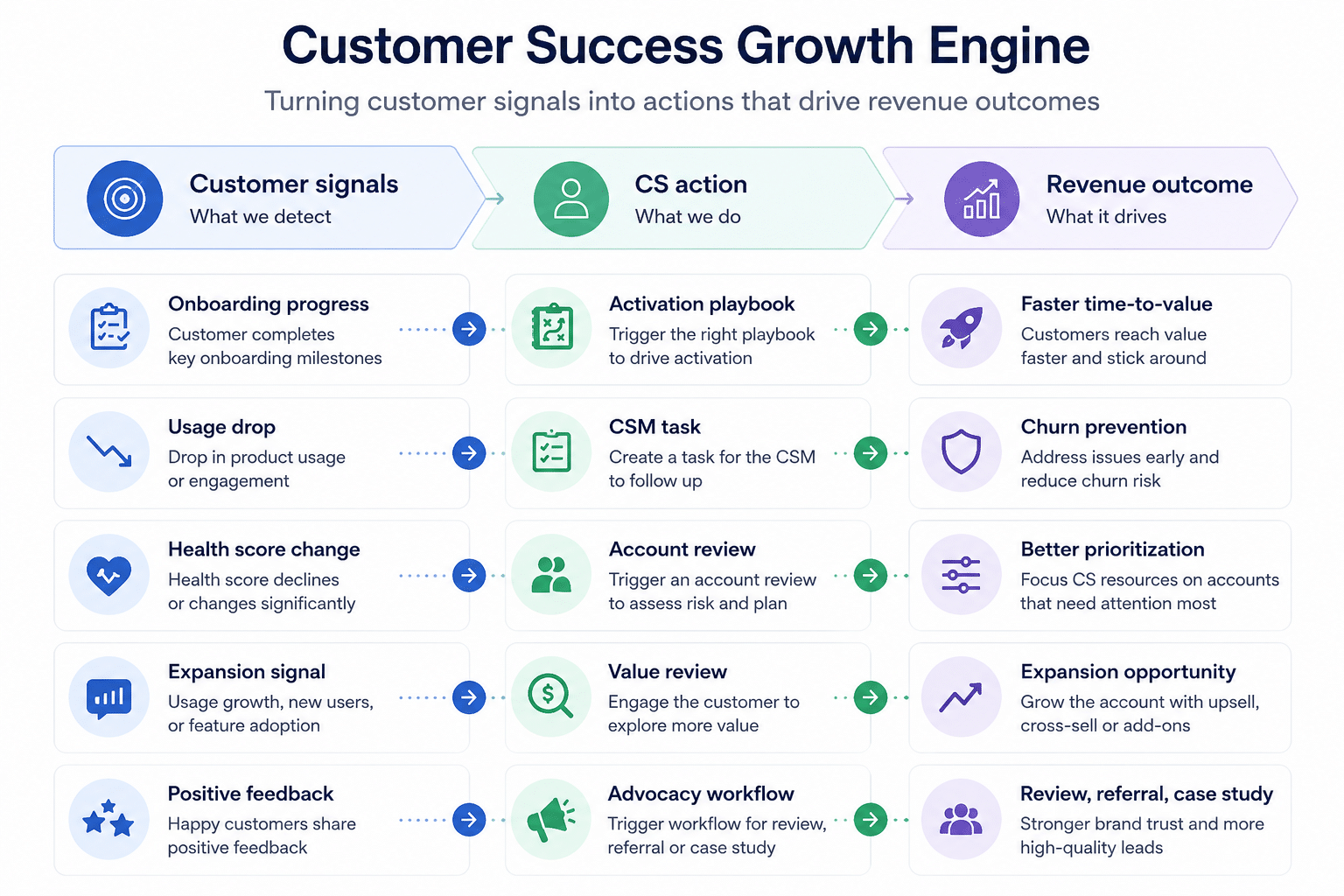
Instead of treating CS as support, a customer success growth engine turns customer signals into tasks, playbooks, account reviews, and revenue actions. The goal is not to track more data. The goal is to help the right person act before a customer becomes a churn risk or an expansion opportunity gets missed.
For Custify readers, this matters because customer success growth does not come from another dashboard. It comes from connecting account health, adoption, renewal risk, and expansion signals to clear CSM actions.
Why customer success became a revenue function
Customer success used to operate like a response team. A customer had a problem, opened a ticket, complained to the CSM, or raised an issue during renewal. The team stepped in after the damage started.
That model is too slow for modern SaaS. By the time a customer complains, the risk may already be old. Low adoption, weak onboarding, missing integrations, poor internal rollout, and unclear business value usually show up before the cancellation email.
Customer success became a revenue function because subscription revenue depends on renewal, expansion, and long-term usage. Customers need to keep seeing value after the contract is signed, not only during the sales process. This is why net revenue retention belongs in the same conversation as onboarding, product adoption, and customer health.
Forrester found that customer-obsessed organizations reported 41% faster revenue growth, 49% faster profit growth, and 51% better customer retention than companies that were not customer-obsessed. For SaaS companies, that finding points to a practical truth: customer focus is not a soft value. It affects revenue.
Customer success teams now influence 4 revenue outcomes:
- Retention, by keeping existing accounts healthy.
- Adoption, by helping users build habits around the product.
- Expansion, by identifying accounts with growing needs.
- Advocacy, by turning strong customer outcomes into reviews, referrals, and proof.
This does not mean CS should become sales with a softer title. That would be lazy org design. It means CS needs the data, workflows, and ownership to protect revenue after acquisition.
The 4 revenue levers of customer success
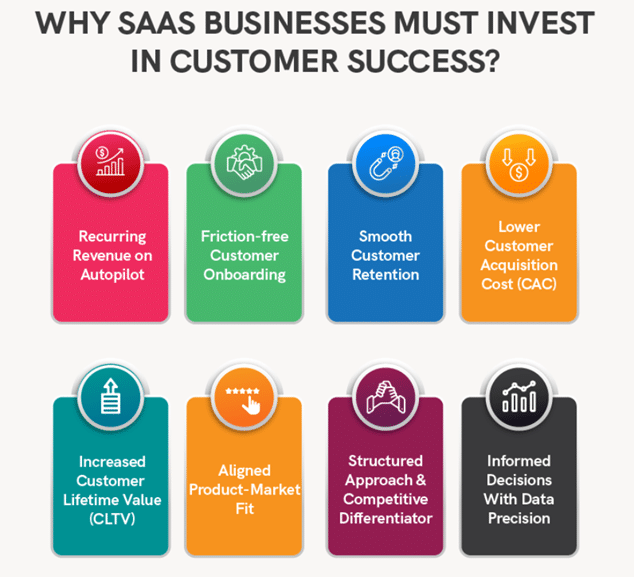
Customer success drives revenue through 4 connected levers: retention, adoption, expansion, and advocacy.
Retention protects existing revenue
Retention is the base layer of SaaS growth. If customers leave faster than new customers arrive, acquisition turns into a treadmill. You keep paying to replace revenue you already won.
Customer success protects retention by catching risk early. That risk may come from low usage, poor onboarding progress, unresolved support issues, weak stakeholder engagement, or missing business outcomes. Teams that need a tactical layer can use these customer retention strategies as a supporting resource.
The important part is not the signal itself. The important part is what happens next.
A usage drop should trigger a task. A poor health score should trigger an account review. A renewal risk should trigger a plan. Without ownership, risk signals become dashboard decoration.
Adoption makes the product harder to replace
Adoption is not the same as logins. Real adoption means customers use the product in ways that support their goals.
For example, a project management product should not measure onboarding by whether a user clicked through a tutorial. It should measure whether the customer created a project, invited the right team members, assigned work, and returned to manage progress.
The same logic applies across SaaS. Customer success teams should define what product success looks like for each segment, then guide customers toward that point.
Expansion grows healthy accounts
Expansion should not start with “Can we sell them more?” It should start with “Are they getting enough value to need more?”
Healthy account expansion signals include:
- More active users.
- Higher feature depth.
- New teams joining the account.
- Repeated requests for advanced workflows.
- More use cases inside the same company.
- Strong executive or champion engagement.
When these signals appear, CS can start a value-led expansion conversation. The offer feels natural because it is tied to the customer’s progress.
Advocacy turns outcomes into proof
Happy customers are not automatically advocates. CS needs to make advocacy easy and timely.
Strong advocacy motions include:
- Asking for reviews after a customer reaches a clear milestone.
- Turning measurable outcomes into case studies.
- Inviting champions to webinars or podcast interviews.
- Asking for referrals after a strong renewal or expansion.
- Capturing customer quotes for high-intent landing pages.
Once the timing is right, teams often lean on email outreach automation to send these review and referral asks consistently instead of letting them slip.
Advocacy works best when it comes after proof. Do not ask customers to promote a product before you have helped them win.
How to build a customer success growth engine
A customer success growth engine needs 5 parts: onboarding, health scoring, expansion signals, feedback loops, and automation. Each part should map to customer success metrics that help the team decide what to do next.
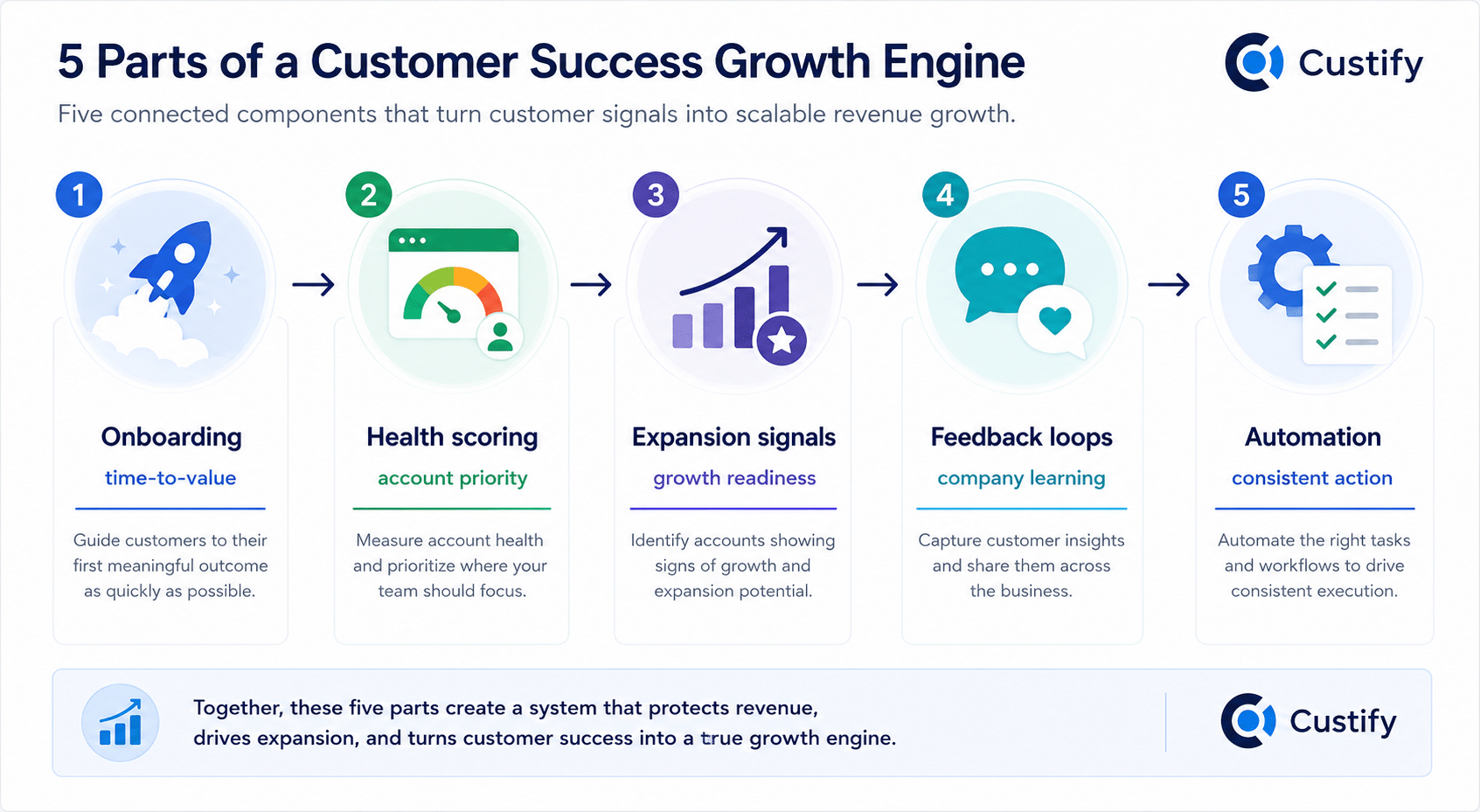
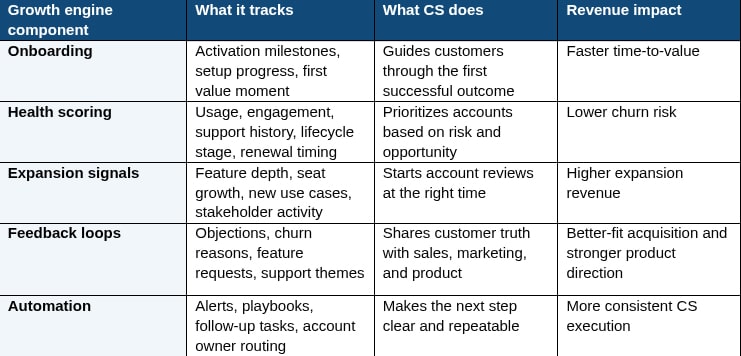
This table is the difference between “we care about customers” and “we run customer success as a business system.”
Onboarding should focus on time-to-value
Onboarding shapes whether customers reach value fast enough to stay. A long, confusing onboarding process creates churn risk before the customer has a fair chance to succeed.
A strong onboarding process defines:
- The activation milestone each customer must reach.
- The time-to-value target for each segment.
- The owner responsible for when progress stalls.
- The risk signal that shows onboarding is failing.
- The next step when the customer misses a milestone.
Customer success should not treat onboarding as a product tour. The job is not to show every feature. The job is to get the customer to the first meaningful outcome.
Health scoring should lead to decisions
A customer health score gives CS teams a simple view of account status. But a score is useless if nobody knows what to do with it.
A practical health score can include:
- Product usage, such as logins, active users, and feature adoption.
- Relationship health, such as CSM touchpoints and stakeholder engagement.
- Support signals, such as ticket volume, sentiment, and unresolved issues.
- Business risk, such as renewal date, contract size, and open escalations.
- Outcome progress, such as onboarding completion or goal achievement.
The score should answer one question: what should the team do next?
If a health score does not change priorities, trigger action, or guide ownership, it is just reporting theater.
Expansion signals should come from customer behavior
Upsells fail when they feel disconnected from customer value. Customers do not want to buy more because the vendor needs a bigger quarter.
Expansion works when CS can show the customer why the next plan, feature, or use case fits their current needs.
Good expansion signals include rising usage, growing teams, repeated feature requests, and customers trying to solve problems that the current plan does not cover well.
The CS team should track those signals and bring sales or account management in when timing makes sense. Not too early. Not when the customer is already frustrated. Not during a renewal panic.
Feedback loops should improve the whole company
Customer success hears the truth that does not always appear in CRM fields.
CS knows which customers were oversold. It knows which features create confusion. It knows which accounts need more onboarding. It knows which segments expand and which segments drain the team.
That information should move back into the business.
Sales needs CS feedback to set better expectations.
Marketing needs CS feedback to attract customers who match the product. Pairing that feedback with customer acquisition analysis helps marketing double down on the channels and segments that actually produce customers who stay.
Product needs CS feedback to fix blockers and prioritize work that affects retention.
Leadership needs CS feedback to understand whether growth is healthy or forced.
If customer feedback stays inside CS notes, the business keeps repeating the same mistakes.
Automation should support CSMs, not replace judgment
Automation helps CS teams act faster and more consistently. It should not make customer success feel robotic.
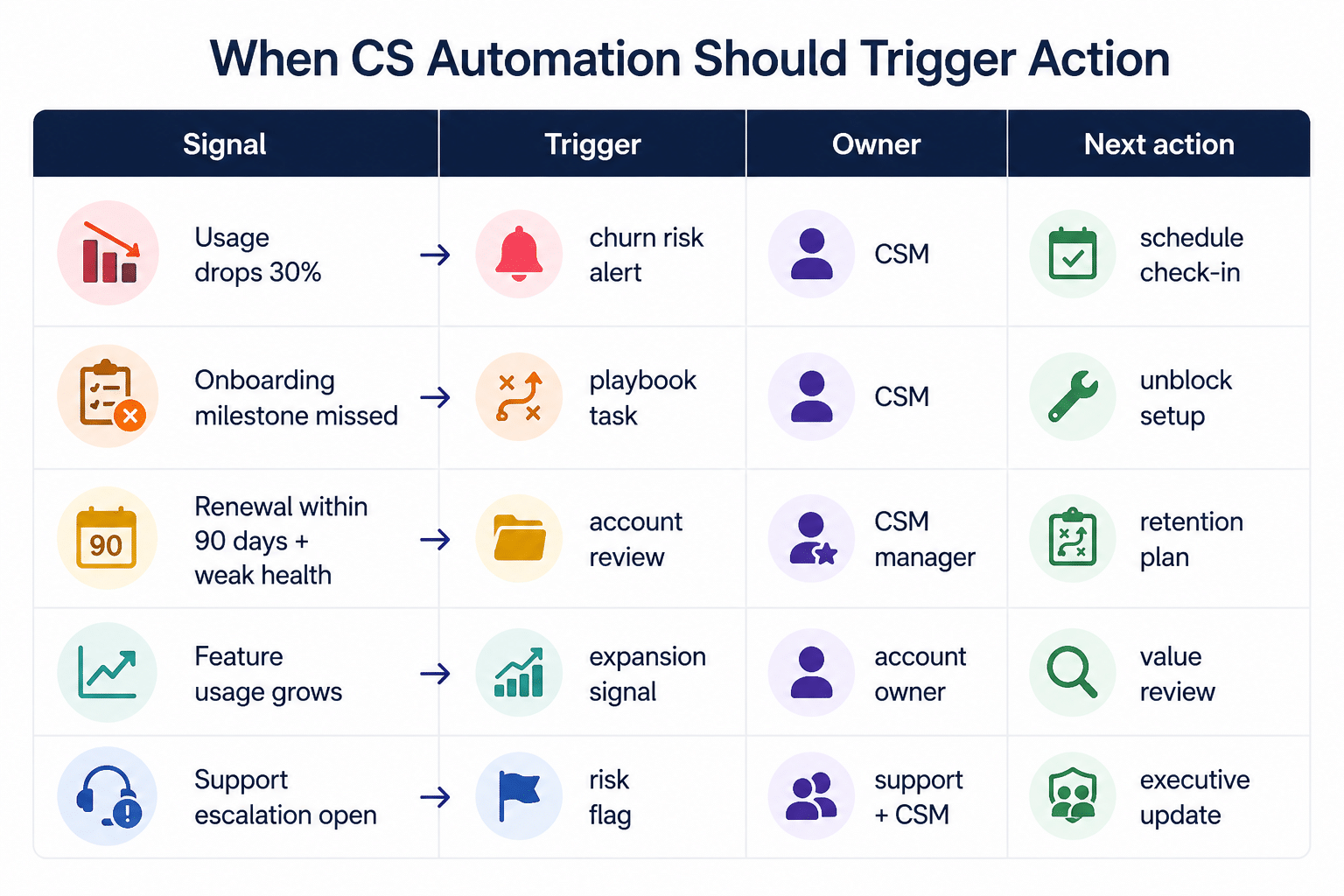
Good automation handles the repeatable work:
- Triggering onboarding playbooks.
- Creating tasks when usage drops.
- Alerting CSMs before renewal risk increases.
- Routing expansion signals to the right owner.
- Sending follow-ups after key milestones.
- Escalating support issues for high-value accounts.
The human part still matters. A CSM should decide how to handle complex relationships, strategic renewals, and sensitive customer issues.
Automation gives the team cleaner timing. Judgment gives the response weight.
Where customer success software fits
Customer success software helps SaaS teams turn customer signals into repeatable action.
Without a system, health scores sit in spreadsheets, usage drops get missed, expansion signals depend on memory, and follow-up tasks live across too many tools. That creates avoidable churn risk.
Custify helps SaaS teams monitor customer health, track product adoption, create playbooks, assign follow-up tasks, and prioritize accounts based on churn risk or expansion potential.
That matters because a growth engine is not another dashboard. It is a system that tells the team what changed, who owns the next step, and which account needs attention before revenue is at risk.
With the right customer success software, CS teams can:
- See which customers are healthy, stuck, or at risk.
- Track onboarding and adoption across accounts.
- Trigger playbooks when key signals change.
- Give CSMs clear account priorities.
- Identify expansion-ready customers.
- Keep customer context in one account view.
The goal is not more reporting. The goal is better timing, clearer ownership, and fewer missed signals.
Common mistakes that stop CS from driving growth
Many SaaS companies say customer success matters, but their operating model says something else.
The most common mistakes are predictable.
Treating CS as support with a different name
Support solves problems. Customer success prevents the wrong problems from reaching renewal. If CS only reacts to tickets, it cannot protect revenue early enough.
Tracking health scores without agreed actions
A health score should trigger decisions. If a red account does not create an owner, task, playbook, or account review, the score is cosmetic.
Asking CSMs to drive expansion without clear signals
CSMs need clear expansion triggers. Otherwise, expansion becomes guesswork and customers feel sold to at the wrong time.
Letting onboarding end before activation
Onboarding should end when the customer reaches value, not when the kickoff checklist is complete.
Sharing customer feedback too late
If sales, marketing, and product hear about customer issues only after churn, the feedback loop is broken. CS should surface patterns while there is still time to fix them.
Measuring activity instead of progress
Emails sent, meetings booked, and calls completed are not the same as customer progress. CS should measure whether customers are adopting, renewing, expanding, and reaching the outcomes they bought.
Customer success growth starts after acquisition
SaaS companies do not become stronger by chasing acquisition while ignoring what happens after the sale.
Customer success drives growth when it protects revenue, increases adoption, finds expansion opportunities, and turns customer outcomes into proof. That requires more than good intentions. It requires a system.
The companies that get this right build customer success around clear onboarding milestones, useful health scores, expansion signals, feedback loops, and automation that helps CSMs act at the right time.
Customer success becomes a growth engine when every signal has a next step, every account has an owner, and every customer outcome feeds the business back.
If you want to turn customer success into a repeatable revenue system, Custify can help your team track customer health, improve onboarding, reduce churn risk, and find expansion opportunities before they are missed.